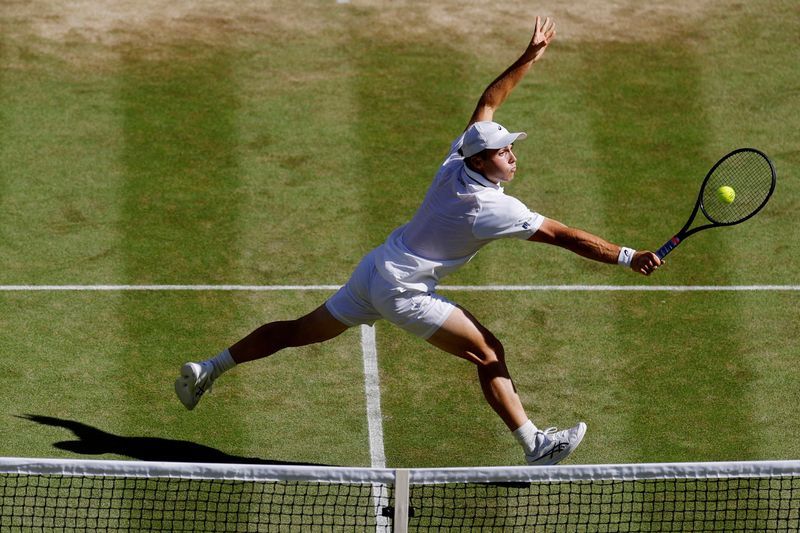
Arthur Fery's Wimbledon journey has taken on the air of sporting destiny, with the France-born, London-raised wildcard poised to celebrate his 24th birthday on the very day of the men's singles final on Sunday—a coincidence that could prove prophetic should his remarkable run continue. The rising British player made his Centre Court debut on Monday and promptly advanced to the quarterfinals by defeating fellow wildcard Grigor Dimitrov 7-5 3-6 4-6 6-4 7-6(7) in a match that captivated spectators and seemed to capture the fevered atmosphere engulfing the All England Club.
Fery's improbable progress through the draw stands in stark contrast to the broader struggles of the host nation at these Championships. Of the 19 British singles competitors who began the tournament, 15 have already fallen in the opening round, leaving the 24-year-old as the lone standard-bearer carrying British hopes on the men's side. His lonely vigil speaks volumes about the depth challenges facing tennis in Britain and makes his continued survival in the tournament feel all the more consequential for supporters who have grown accustomed to disappointment at their home Grand Slam.
The American sixth seed Taylor Fritz, who practiced extensively with Fery before the 2024 World Tour Finals, predicted this trajectory. Fritz found himself regularly outplayed during their practice sessions, winning only occasional baseline games against an opponent whose combination of power and precision left him impressed. "He was beating me, like, every day," Fritz recalled. "I was like, this guy's really good." Despite his own strong form at the time—he had reached the Turin final the following week—Fritz recognised that Fery possessed the tools to compete at the highest level, citing both his exceptional serve and forehand as standout weapons.
Fery's quarterfinal opponent is world number 10 Flavio Cobolli of Italy, whom the Briton has already defeated this year at the Australian Open. The calendar reset has nonetheless elevated expectations considerably; performance at a Grand Slam carries exponentially greater weight than any other tournament on the professional circuit. Cobolli represents a significant step up in ranking and prestige, yet Fery has already demonstrated an uncommon ability to elevate his game in high-pressure circumstances.
The manner of Fery's previous victory illuminates his competitive character. Against Zizou Bergs in the third round, the British player faced the prospect of defeat while down two sets to one and a double break in the fourth set. Rather than acquiesce, Fery summoned an extraordinary recovery, ultimately winning what became the longest match contested at the Championships thus far. He accomplished this remarkable turnaround while dealing with a succession of nosebleeds, an affliction that would have provided convenient excuse for surrender yet failed to diminish his resolve.
Monday's triumph over Dimitrov, the 35-year-old former world number three, captured the imagination in ways that transcended mere tennis. When the Czech-born player serving for Bulgaria bore down on victory, leading 4-3 with a break in the fourth set, victory appeared inevitable for the vastly experienced competitor. Fery, however, produced a stunning fightback that electrified the crowd, a roar reverberated through Wimbledon that observers noted matched anything heard at the venue in years. The timing amplified the emotional resonance; spectators were still giddy with euphoria from England's World Cup last-16 victory over Mexico mere hours earlier, creating a perfect convergence of sporting triumph across multiple arenas.
Fery's perspective on this convergence revealed the magnitude of what he is experiencing. "I can only speak from my experience today but it's good to see British sport doing well on a global level," he observed. The player recognised that this window into the global spotlight may represent something singular in his career trajectory. "What I experienced today, I'm really going to cherish it for the rest of my life. Who knows, maybe I will never, ever get to experience that ever again. It's the first time I'm playing on this stage." This measured gratitude, coupled with realistic acknowledgment that such moments may not recur, suggests a player mature beyond his years despite his relatively recent emergence on the professional circuit.
Fery's ascent through the rankings has been correspondingly rapid. He commenced this week ranked 114th globally, a position that secured his wildcard entry into the Championships. By advancing to the quarterfinals, he has already climbed inside the top 70, with his ranking continuing its upward trajectory as tournament points accumulate. This velocity of improvement adds another dimension to the narrative surrounding his Wimbledon performance—this is not merely a wildcard lucky to find himself in unfamiliar circumstances, but rather a player whose underlying quality is finally receiving the platform and recognition it has warranted.
The strategic and psychological implications of Fery's continued presence in the draw extend beyond his individual achievement. For British tennis, long plagued by questions about grassroots development and elite player pipeline, his performance provides evidence that homegrown talent capable of competing at the highest level does exist. The question that now hangs over the sport is whether Fery's emergence represents an isolated success story or the vanguard of broader revival. His college background at Stanford suggests that alternative pathways to elite competition, rather than exclusive reliance on the traditional British junior development system, may merit greater attention and investment.
Looking ahead to his quarterfinal clash with Cobolli, Fery enters as the lower-ranked player but carrying momentum and the psychological advantage of a convincing head-to-head victory. The Italian has shown steady improvement and consistency this season, but faces an opponent playing with the freedom that comes from exceeding expectations. Should Fery prevail, a semifinal berth would catapult him even further into the rarefied air of tennis elite, transforming his Wimbledon debut from remarkable achievement to historical milestone. Regardless of the immediate outcome, his journey has already redefined perceptions of what remains possible for British tennis at the sport's most prestigious stage.

