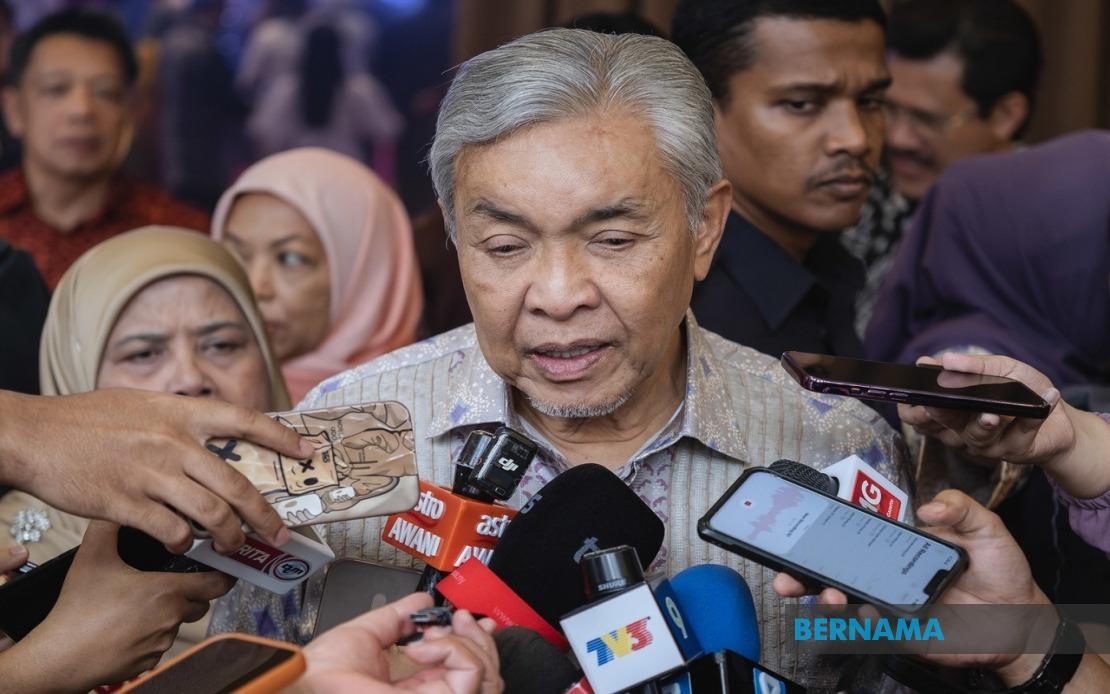
Deputy Prime Minister Datuk Seri Dr Ahmad Zahid Hamidi has drawn a clear boundary between Barisan Nasional's campaign activities and the affairs of Negeri Sembilan's royal institution and legal apparatus, signalling the ruling coalition's determination to avoid controversy during the forthcoming state election. Speaking after a Ministry of Rural and Regional Development ceremony in Kuala Lumpur, Ahmad Zahid, who simultaneously holds the UMNO presidency, underscored that BN would deliberately remain outside the sphere of royal and judicial matters despite the heightened political activity surrounding the August 1 polling day.
The declaration emerged following consultations with Negeri Sembilan's party leadership, where Ahmad Zahid emphasised this non-interference principle as a cornerstone of BN's election strategy for the state. The timing of this pronouncement is significant, as it reflects heightened awareness of sensitivities surrounding the royal establishment in a state where the monarchy remains a powerful institutional force. By publicly committing to this position, BN appears to be attempting to preempt potential criticism and distinguish itself from opposition narratives that might otherwise portray the coalition as overreaching into protected domains.
The Negeri Sembilan Council of Justice and Laws, or DKU in Malay, serves as an advisory body that includes royal representation and handles matters touching on constitutional and legal affairs specific to the state's governance structure. References to royal institutions carry particular weight in Malaysian political discourse, where the constitutional monarchy occupies a uniquely protected status. Ahmad Zahid's emphasis on keeping clear of such matters suggests BN recognises that any perceived entanglement could provide ammunition to opposition parties and potentially alienate segments of the electorate who regard the institution with reverence.
Beyond the royal and legal dimensions, Ahmad Zahid pivoted the discussion toward what he framed as BN's genuine electoral priority: achieving cohesion among party cadres at every organisational level. This strategic shift from potential institutional complications to internal solidarity indicates that BN's leadership views party discipline and unified messaging as more immediately pressing concerns than addressing complex constitutional questions. The emphasis reflects lessons potentially drawn from recent electoral contests where fragmented coalitions have stumbled against more tightly organised opposition blocs.
The contrast Ahmad Zahid drew between the upcoming contest and the 15th state election five years ago carries particular relevance for understanding the shifting political landscape in Negeri Sembilan. During that cycle, BN had worked in concert with Pakatan Harapan component parties, an arrangement born from the historic 2018 federal political realignment. However, the restoration of BN's federal dominance and the subsequent fracturing of the Pakatan Harapan coalition have fundamentally altered the terrain. This time, Ahmad Zahid made clear, BN would compete independently without relying on cross-coalition cooperation, necessitating correspondingly stronger internal mobilisation.
The 36 state seats up for contention in the August 1 election represent a compact but strategically important prize within Malaysia's federal system. While Negeri Sembilan lacks the demographic scale of Selangor or the political intensity of Perak, the state carries symbolic significance as a historical Umno stronghold and remains economically significant due to its location, infrastructure, and industrial base. Control of the state apparatus determines resource allocation, development priorities, and patronage opportunities that ripple through local communities and business networks.
Ahmad Zahid's framing of the election as presenting "a different situation" compared to previous contests reflects genuine structural changes in Malaysian politics. The rise of new opposition configurations, including the growing assertiveness of Perikatan Nasional and its various state-level iterations, has complicated the simple binary competitions of past decades. Additionally, urban-rural divides in voting behaviour have become more pronounced, requiring differently calibrated campaign strategies across constituencies. BN's acknowledgement of these shifting dynamics suggests a more sophisticated understanding of electoral mechanics than public commentary sometimes credits.
The Deputy Prime Minister's insistence on party unity carries practical implications for campaign operations. Internal divisions have plagued BN component parties, particularly Umno, in recent electoral cycles, with tensions between factions and personalities sometimes translating into voter ambivalence. By prioritising cohesion now, months before August 1, Ahmad Zahid signals that BN intends to present a consolidated front rather than allowing rival camps within the coalition to undermine messaging and candidate selection. Such discipline, however, requires managing competing interests and expectations across Umno, the Malaysian Chinese Association, and the Malaysian Indian Congress.
The timing of these comments also reflects the accelerated election calendar that has characterised Malaysian politics since 2018. Frequent state and federal elections have compressed campaign cycles and intensified resource competition among parties. For BN in Negeri Sembilan, the August 1 state election follows relatively closely on federal-level consolidation efforts, demanding rapid mobilisation and sustained momentum. Ahmad Zahid's public reaffirmation of strategic priorities serves partly as an internal discipline mechanism, signalling to party members what the leadership expects and will tolerate.
Regional implications for Malaysian electoral politics extend beyond Negeri Sembilan itself. The state's election results will provide early indicators of voter sentiment before potential federal-level contests. They will also test whether BN's renewed emphasis on internal unity and disciplined campaigning can translate into electoral gains without the external support structures that coalitions provide. The outcome may influence calculations in other states where BN confronts competitive pressures and offers lessons about coalition strategy more broadly.
The royal and legal sensitivities Ahmad Zahid specifically addressed underscore the complex constitutional terrain that Malaysian politicians must navigate. Unlike Western democracies where separation of powers follows clear institutional divisions, Malaysia's system interweaves royal authority with executive and legislative functions, particularly at state level. For BN's campaign team, maintaining this distinction publicly—while inevitably engaging with state institutions for ordinary governmental purposes—requires careful messaging discipline.
Looking forward to August 1, Negeri Sembilan's electoral contest will test whether Ahmad Zahid's emphasis on unity and boundary-observance translates into effective campaigning. The coalition faces not only conventional opposition but also internal pressures from party factions and the challenge of maintaining voter coalitions in an increasingly volatile political environment. The Deputy Prime Minister's recent statements suggest BN has identified these vulnerabilities and is attempting to address them through strategic messaging and internal discipline, though electoral outcomes ultimately depend on broader voter sentiments and campaign execution on the ground.

