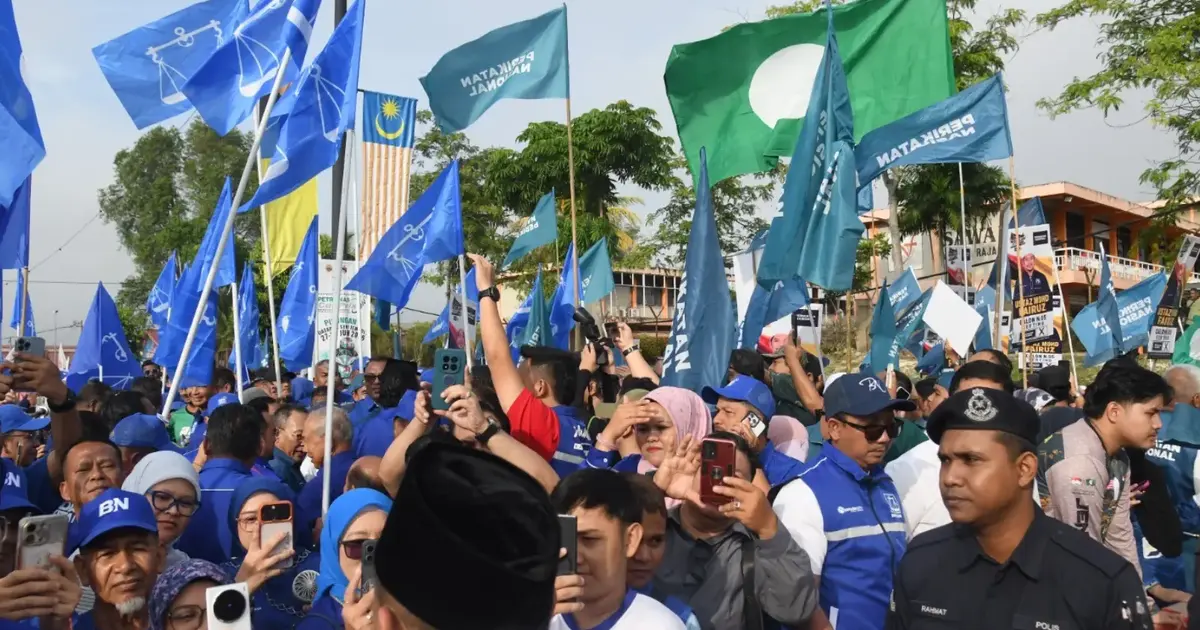
Efforts by PAS to capture control of Selangor may be hamstrung by the absence of Bersatu as a coalition partner, according to political analyst Azmi Hassan, who underscores the structural and strategic limitations of substituting Barisan Nasional in the equation. The observation surfaces ongoing complexities within Malaysia's fractured political landscape as Perikatan Nasional contemplates its path forward in the country's wealthiest state, where past electoral performance has proven disappointingly uneven despite repeated attempts at breakthrough.
Azmi Hassan's assessment highlights a critical distinction between the two potential coalition arrangements. During the 2022 Selangor state election, Bersatu functioned as more than merely another participating party within Perikatan Nasional's broader structure. The party delivered tangible organisational capabilities and voter mobilisation networks that penetrated specific constituencies, enabling PN to expand its electoral footprint substantially compared to previous contests. These ground-level advantages proved instrumental in converting sentiment into actual seat gains across portions of the state.
Barisan Nasional, conversely, carries a markedly different political pedigree and voter base composition. The coalition has historically performed unevenly in Selangor, maintaining strongholds in certain areas while struggling to compete effectively in urban and semi-urban districts where younger, more transient populations predominate. The structural inability of BN to replicate Bersatu's penetration reflects divergent party machinery, divergent demographic appeal, and divergent organisational philosophy—factors that cannot be easily overcome through alliance formation alone.
The significance of this distinction becomes particularly acute when considering Selangor's electoral map and demographic evolution. The state encompasses extraordinary diversity: sprawling Kuala Lumpur suburbs populated by middle-class professionals, industrial zones attracting migrant workers and younger voters, established Malay-Muslim communities in rural pockets, and affluent satellite towns oriented toward commerce and services. Bersatu's capacity to navigate these varied constituencies with tailored messaging and localised campaign strategies represented an asset that transcended simple party-switching logic.
Within PAS's strategic calculations, the party faces a fundamental conundrum about coalition architecture. Aligning with Barisan Nasional carries its own political baggage—historical association with developmental promises unfulfilled, perceptions of entrenched establishment politics, and demographic challenges in attracting younger voters who increasingly view BN with scepticism. Yet pursuing electoral dominance in Selangor without supplementary grassroots machinery appears equally problematic from a pure numbers standpoint.
The broader context involves Perikatan Nasional's positioning within Malaysia's increasingly tripolar political environment. Following the 2022 general election and subsequent state-level contests, PN consolidated itself as a consequential force capable of fragmenting traditional two-coalition dynamics. Selangor, however, has proven a stubborn outlier—a state where PAS and its allies have invested disproportionate resources yet reaped limited electoral returns relative to their performance elsewhere in the peninsula.
Bersatu's role transcended conventional party functions because the party operated as a bridge-builder with particular credibility. Formed from UMNO's fractious internal dynamics, Bersatu retained residual connections within traditional BN networks while simultaneously positioning itself as reformist and anti-establishment. This dual positioning allowed PN to access constituencies sceptical of conventional BN messaging whilst maintaining competitive viability among constituencies accustomed to UMNO's traditional dominance.
Regional observers tracking Malaysian politics recognise that coalition mathematics rarely proceeds neatly, particularly in multiethnic, religiously plural democracies where party switching and realignment occur frequently. Selangor presents an especially complex case because the state encompasses competing political narratives—aspirations toward Islamisation championed by PAS running parallel to secular development imperatives and pluralistic governance claims articulated by opposition forces. Bersatu, despite its limitations, managed threading this needle more effectively than either PAS operating independently or PAS aligned with the historically establishment-oriented Barisan Nasional.
The practical implications extend beyond immediate electoral calculations. Should Barisan Nasional prove insufficient as a coalition partner, PAS confronts a strategic recalibration challenge that could reverberate through peninsular Malay-Muslim politics more broadly. The party has staked considerable political capital on the belief that Selangor represents achievable territory—a state where demographic trends and voter sentiment could be harnessed toward Islamist governance. Repeated failures to materialise electoral breakthroughs despite varied coalition configurations risk eroding internal party morale and external voter confidence.
Looking ahead, Azmi Hassan's analysis suggests that structural, rather than merely tactical, obstacles constrain PAS's Selangor aspirations. Any coalition arrangement must address fundamental ground-level deficiencies in party machinery, volunteer mobilisation, and grassroots credibility—challenges that cannot be resolved through high-level political agreements alone. The absence of Bersatu therefore represents not merely the loss of additional votes but the loss of essential organisational pathways through which electoral messaging reaches prospective supporters and converts sympathies into actual electoral outcomes.
For Malaysian political observers tracking state-level dynamics, Azmi Hassan's observation underscores a broader truth: electoral victory requires more than ideological coherence or numerical sufficiency at the coalition level. Sustained competitive capacity demands institutional depth, organisational reach, and demographic connectivity—attributes that particular parties either possess or lack, irrespective of external alliance formation.

