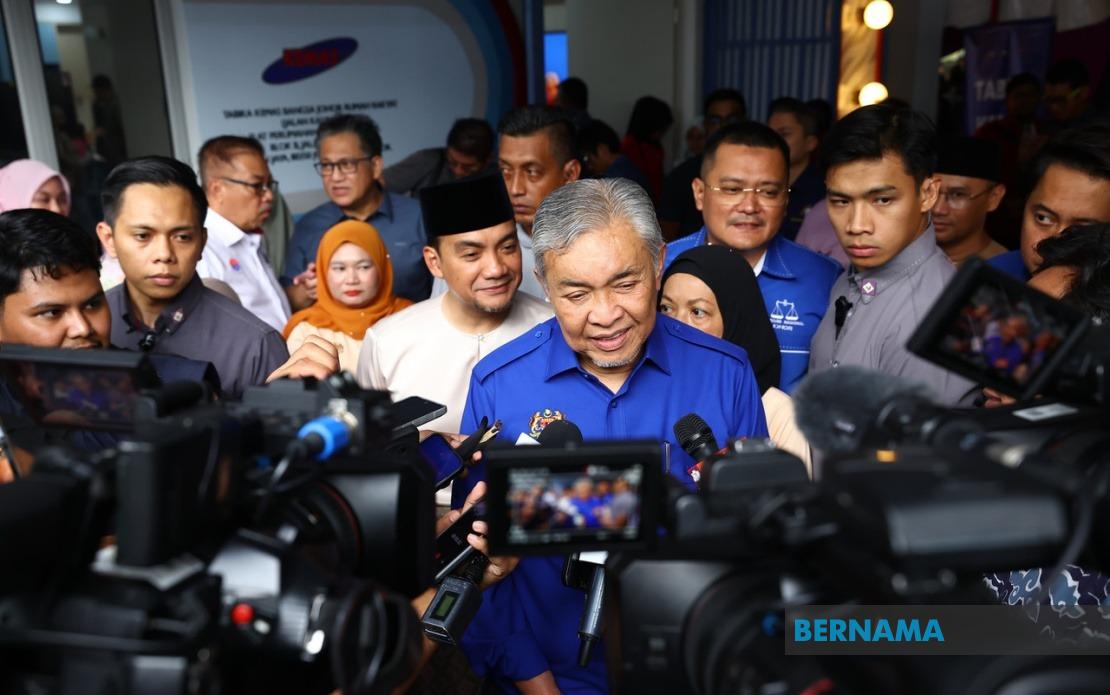
Barisan Nasional's leadership has indicated it views the upcoming Johor state election as a space for genuine democratic discourse, with BN Chairman Datuk Seri Dr Ahmad Zahid Hamidi publicly acknowledging the opposition coalition's campaign promises whilst pitching his own alliance's vision to voters. The Deputy Prime Minister's remarks, made during an engagement session with parents at Larkin Court 1 here, signal a measured approach to the July 11 polling day, emphasizing respect for competing ideas even as the ruling coalition seeks to retain control of the state assembly.
Ahmad Zahid's statement represents the tone that BN intends to strike throughout this electoral contest. Rather than dismissing Pakatan Harapan's proposals outright, the BN Chairman acknowledged having reviewed the opposition's platform and framed acceptance of diverse views as consistent with Malaysia's democratic system. This positioning allows BN to appear statesman-like whilst simultaneously creating space to highlight what it portrays as the superior merit of its own record and agenda. The careful language deployed—"respect" rather than "endorse"—maintains political distance without appearing dismissive of voters' right to consider alternative visions.
Pakatan Harapan unveiled an ambitious manifesto containing ten commitments aimed at addressing concerns among Johor's diverse electorate. The package includes a Johor Health Scheme designed to expand healthcare accessibility, financial assistance for first-time property buyers struggling with deposit requirements, a RM500 million allocation targeting youth empowerment programmes, and educational initiatives intended to strengthen schools and institutions across the state. These pledges reflect opposition calculations about which issues resonate most powerfully with voters, particularly younger residents and those grappling with housing affordability—persistent challenges throughout Malaysia.
In response, BN's strategy pivots toward demonstrating proven delivery rather than making fresh promises. Ahmad Zahid highlighted that the coalition's previous term achieved completion of over 90 per cent of its manifesto commitments, framing this as evidence of trustworthiness and competence. This emphasis on track record serves multiple purposes: it answers inevitable voter scepticism about whether any political party can deliver on ambitious plans, and it implicitly questions whether newcomers or less experienced administrators can match BN's implementation capacity. The comparison becomes especially pointed in a state like Johor, where BN has held power for an extended period.
The BN manifesto itself claims comprehensiveness, structured to benefit all demographic segments without privileging any particular racial or community group. According to Ahmad Zahid, the platform addresses needs spanning the entire lifecycle—from prenatal support for expectant mothers through childhood development, educational progression, youth advancement into university and employment, and provision for single parents navigating modern family structures. This architecturally ambitious approach attempts to neutralize one traditional criticism of BN governance: that its policies disproportionately benefit particular communities. By framing benefits as universally accessible, BN argues it moves beyond zero-sum communal competition.
The concept of "Bangsa Johor"—a Johor identity transcending racial and religious divisions—underpins BN's rhetorical framework for this election. Ahmad Zahid explicitly stated that all residents qualify for benefits regardless of background, positioning economic and social support as rights of citizenship rather than communal allocations. This invocation of state identity rather than communal categories represents a strategic choice, particularly in a state with Johor's demographic complexity and historical significance in Malaysian politics. The terminology attempts to reposition the election around shared interests in development and prosperity rather than communal representation.
Ahmad Zahid, simultaneously serving as Rural and Regional Development Minister, used the occasion to commit continued ministerial support for Johor's development agenda. This conflation of party leadership with government authority—common in Malaysian politics—reinforces the impression that voting for BN means securing access to federal resources and ministerial attention. The reassurance carries implicit weight: backing the ruling coalition ensures that whoever leads the state government can count on sympathetic treatment from the federal level, a consideration that influences pragmatic voters concerned with delivering tangible benefits to their constituencies.
The electoral contest involves 172 candidates competing across 56 state seats, with early polling scheduled for July 7 and main voting day on July 11. This scale reflects Johor's significance as Malaysia's second-largest state by population and its importance as a political bellwether. Results here could signal broader momentum heading into future national contests, making the campaign intensity understandable. The participation of figures including Johor Menteri Besar Datuk Onn Hafiz Ghazi and various candidates underscores how state-level elections mobilize the entire political apparatus.
The dynamics unfolding in Johor carry implications extending beyond the state's borders. Johor's economy, proximity to Singapore, and role as a manufacturing and logistics hub make it strategically important to national economic planning. An election outcome that shifts control of state government could influence infrastructure priorities, business regulations, and development trajectories for years ahead. Malaysian and regional observers will watch whether voter sentiment here reflects broader patterns in public satisfaction with economic management, cost of living concerns, or development priorities.
For Pakatan Harapan, the Johor contest represents an opportunity to demonstrate that its 2022 electoral recovery can translate into holding or gaining ground in state-level competitions. The manifesto's focus on healthcare access, housing affordability, and youth opportunity suggests opposition strategists have identified these as weaknesses in current governance perception. Whether PH can overcome BN's organizational advantages, incumbency benefits, and resource disparities remains uncertain, but the manifesto launch signals it intends to contest seriously rather than concede the field.
For BN, maintaining Johor control preserves crucial political and financial resources, given the state's economic weight. The coalition's emphasis on respectful democratic engagement whilst simultaneously highlighting past performance and comprehensive planning represents an attempt to present as both confident in its record and receptive to legitimate criticism. How voters ultimately assess these competing claims—whether BN's demonstrated delivery record outweighs desire for fresh approaches, or whether opposition momentum overcomes establishment advantages—will shape Johor politics and potentially influence broader Malaysian political trajectories in the post-2022 era of more fluid electoral competition.

