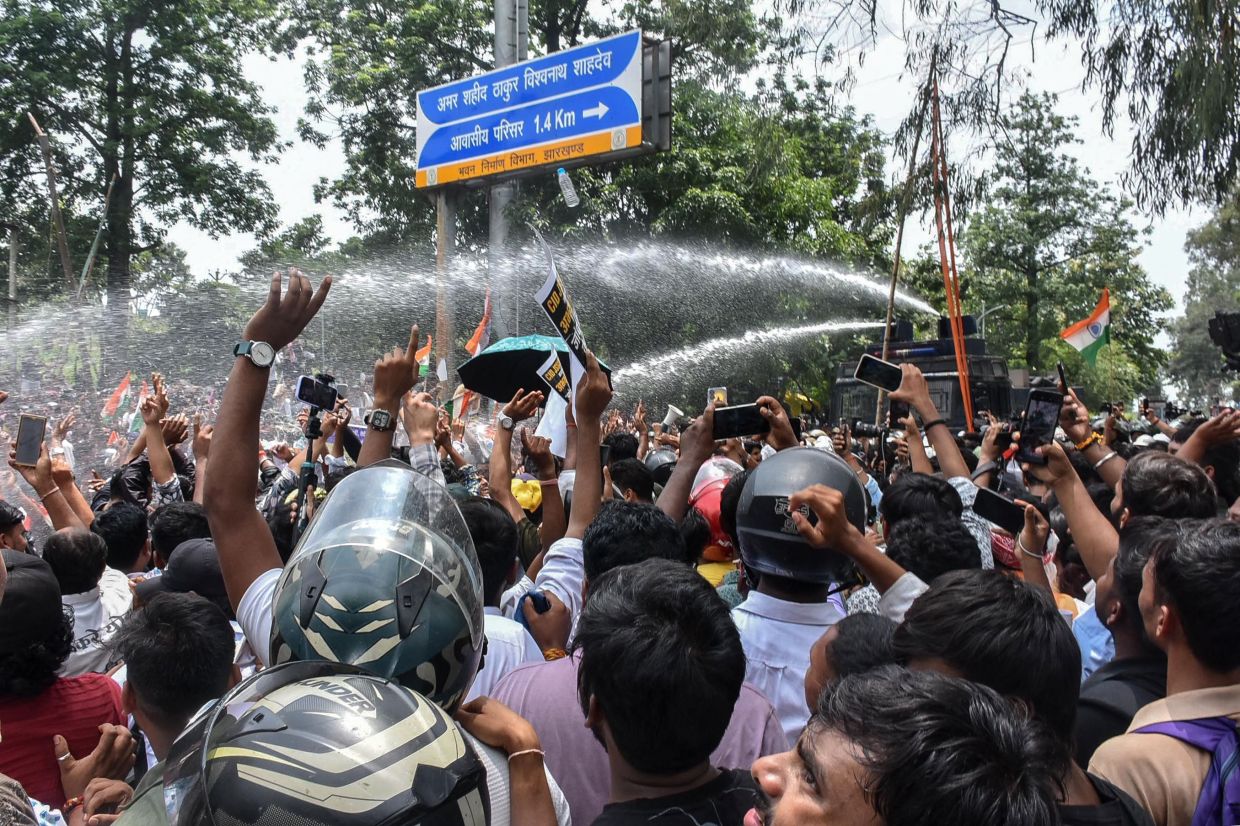
Prime Minister Narendra Modi's Bharatiya Janata Party has levelled fresh accusations of political hypocrisy at the Cockroach Janta Party, the activist group that mobilised thousands of students in New Delhi over examination irregularities. The controversy centres on what the ruling party views as selective activism, with the group maintaining a noticeably lower profile during ongoing agitations in Jharkhand, a state governed by a political coalition opposing Modi's government.
BJP spokesperson Keya Ghosh made the allegations public on Tuesday, describing the Cockroach Janta Party as a "mute spectator" to the Jharkhand demonstrations. Her comments suggest the saffron party believes the original New Delhi protests, which resulted in the resignation of Education Minister Dharmendra Pradhan, were fundamentally designed to embarrass the central government rather than driven by genuine concern for students' welfare. The timing of the group's retreat from activism after achieving a ministerial scalp, Ghosh implied, reveals a pattern of opportunistic engagement with protest movements.
The Cockroach Janta Party emerged as a satirical online movement before evolving into a tangible force during last month's agitation over competitive examination malpractices in New Delhi. The group's mobilisation efforts proved remarkably effective, channelling student anger into sustained demonstrations at Jantar Mantar that culminated in high-profile political consequences. However, when analogous protests erupted in Jharkhand over alleged irregularities in state recruitment examinations, the group's visible presence notably diminished, a fact that has not escaped the BJP's notice.
While the party accused the Cockroach Janta Party of abandoning the student movement, the activist group has maintained that it has provided substantive support to Jharkhand's demonstrators, albeit through different mechanisms than its headline-grabbing role in New Delhi. The organisation's founder, Abhijeet Dipke, issued a statement condemning police violence against Jharkhand protesters, criticising what he described as brutal use of water cannons and batons during Monday's law enforcement action. Several members of the Cockroach Janta Party have reportedly travelled to Jharkhand and actively participated alongside local student organisers, contributing to the logistics and coordination of sustained demonstrations.
Akshay Shinde, the national coordinator of the Cockroach Janta Party, defended the group's commitment to the Jharkhand cause, telling news agencies that members remained embedded within the protest movement and would maintain their presence until all student demands received satisfactory resolution. This statement suggests the group views its involvement as qualitatively meaningful despite lacking the media prominence that characterised its New Delhi campaign. The distinction between high-visibility activism in the capital and ground-level organising in a peripheral state may reflect strategic choices rather than ideological inconsistency, though the BJP shows no inclination toward charitable interpretation.
Jharkhand's political landscape adds another dimension to the controversy. The mineral-rich eastern state operates under a coalition government led by the Jharkhand Mukti Morcha, which includes the Indian National Congress as a partner, with the BJP serving as the principal opposition force. This configuration means Jharkhand's state leadership represents precisely the political opposition that the central government faces nationally. The BJP's attacks on the Cockroach Janta Party accordingly carry implicit accusations that opposition parties orchestrate or tacitly encourage protest movements against state governments they oppose while remaining silent when similar issues arise in territories controlled by their own allies.
Rahul Gandhi, the Congress leader and head of opposition in the Lok Sabha, has not physically visited demonstration sites in either New Delhi or Jharkhand, a fact the BJP has seized upon as evidence of selective outrage. Keya Ghosh posed the rhetorical question on Bloomberg Television regarding why Gandhi had absented himself from Jharkhand, explicitly suggesting that familial or coalition ties to the ruling Jharkhand government explained his reticence. Gandhi's response, released through social media, acknowledged students' constitutional right to peaceful demonstration and called for dialogue-based solutions, but his virtual engagement contrasts sharply with the physical presence expected of opposition leaders during major civic upheavals.
The substance of grievances animating both protest movements contains important similarities that underscore the BJP's accusations of selective attention. Students in both contexts alleged systematic irregularities in examination administration and recruitment procedures, suggesting systemic failures rather than isolated malfunctions. The capacity for these issues to generate sustained mass mobilisation across different geographical contexts and political jurisdictions indicates that examination integrity represents a genuine flashpoint for educated youth across India. Yet the differential commitment shown by national-level activist groups raises uncomfortable questions about whether movements transcend genuine policy concerns or devolve into exercises in political positioning.
For Malaysian and Southeast Asian observers, the controversy illuminates broader patterns of protest politics in large South Asian democracies. Student activism frequently catalyses political change across the region, from Thailand to Bangladesh to Malaysia itself. However, the Jharkhand-New Delhi disparity highlights the risks facing such movements when external organisations or opposition political actors attempt to channel grassroots energy toward factional advantage. The Cockroach Janta Party's apparent willingness to emphasise New Delhi protests while maintaining lower visibility in Jharkhand suggests that even ostensibly apolitical activist groups can become entangled in larger competitive struggles between state and opposition forces.
The episode also underscores tensions between centralised and decentralised protest activism in India's federal structure. Movements originating in the capital frequently struggle to maintain momentum or relevance when issues replicate themselves in distant states with distinct political configurations. Local student organisations in Jharkhand have demonstrated capacity for autonomous mobilisation without reliance on nationally prominent activist groups, yet the national media focus has shifted toward New Delhi-based actors and their perceived inconsistencies rather than toward the substantive examination irregularities that prompted agitation. This displacement of analytical attention from policy failures toward activist group positioning represents a broader problem in protest-era political journalism.
The BJP's public accusations, while appearing to criticise the Cockroach Janta Party, simultaneously attempt to delegitimise broader opposition politics by suggesting that all anti-government activism serves factional interests rather than public purpose. Whether through direct organisational capture or through the perception of selective engagement, the ruling party seeks to inoculate itself against the charge that student grievances reflect genuine systemic failures requiring corrective action. By framing the Cockroach Janta Party's lower Jharkhand profile as evidence of manufactured activism in New Delhi, the BJP proposes an alternative interpretation of protest movements that reframes them as instruments of political competition rather than expressions of democratic concern.

