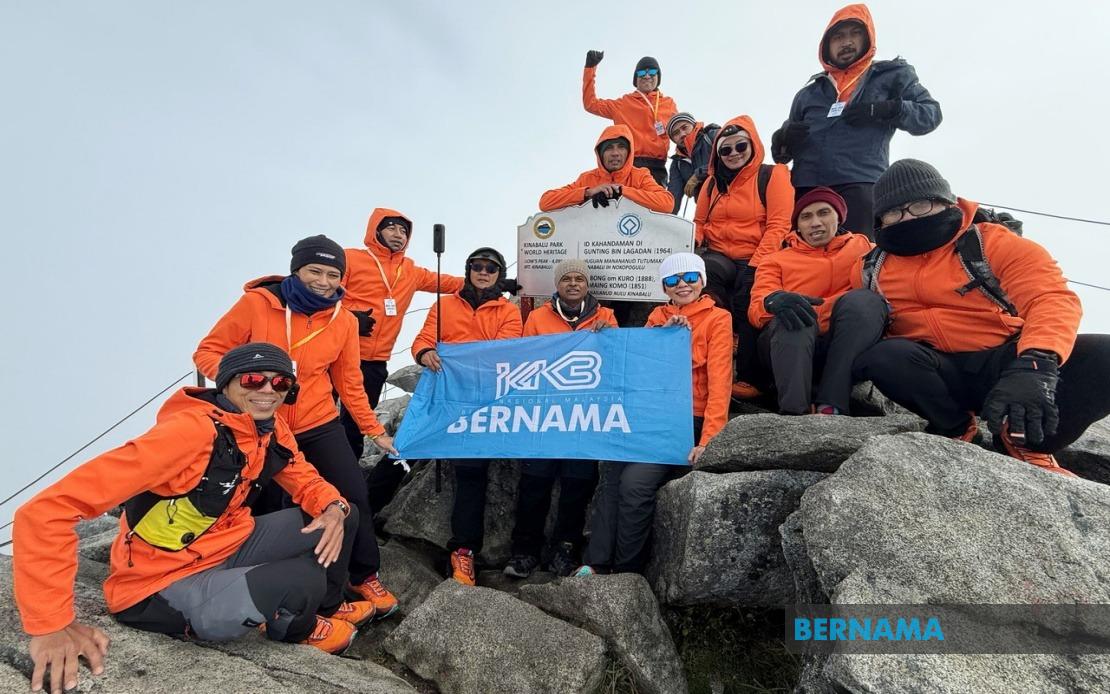
Twenty-three journalists and support staff from Malaysia's premier news agency, Bernama, successfully summited Mount Kinabalu on July 1 in a landmark expedition timed to commemorate the National Journalists' Day (HAWANA) 2026 celebration. The historic climb marked the first time Bernama as an organisation has undertaken such an ambitious physical challenge, bringing together reporters, photographers, video crew members, editors, and administrative personnel across multiple divisions for a coordinated assault on Southeast Asia's highest peak. The expedition departed Timpohon Gate at 10 am on June 30, with climbers spending an overnight rest at Panalaban before resuming their ascent at 2.30 am, ultimately reaching the summit at approximately 7.20 am despite battling unpredictable mountain weather including heavy rain, thick mist, and powerful winds.
Bernama Editor-in-Chief Arul Rajoo Durar Raj, who personally led the expedition, underscored the significance of the achievement beyond mere physical accomplishment. The climb pursued two ambitious Malaysia Book of Records entries, with the team targeting recognition as the largest contingent of media practitioners from a single organisation to summit Mount Kinabalu, and as the first media organisation capable of producing news reports in four languages from the mountain's summit. This dual objective reflected Bernama's commitment to innovation in journalism while celebrating the profession's enduring spirit and dedication. For Arul Rajoo personally, the successful summit represented a defining milestone as the first Editor-in-Chief in Bernama's history to reach the peak, cementing his leadership during a period of institutional achievement and demonstrating personal commitment to the values he champions among his staff.
The expedition showcased Mount Kinabalu's formidable character as a natural challenge and national treasure. Standing 4,095.2 metres above sea level within the boundaries of Kinabalu Park, a protected area spanning 754 square kilometres, the mountain commands respect from climbers worldwide. Its status as a UNESCO World Heritage Site and integral component of the Kinabalu UNESCO Global Geopark reflects its global ecological and geological significance. For Malaysian climbers, the mountain represents far more than a geographical landmark—it embodies the nation's natural heritage and provides a powerful symbol for demonstrating human resilience and teamwork. The hostile weather conditions encountered during this particular climb underscored why Mount Kinabalu demands serious preparation and courage, making Bernama's success particularly noteworthy given the expedition's secondary purpose of promoting institutional values.
Beyond the record-breaking aspirations, the expedition served broader institutional objectives for Bernama and its workforce. The Bernama Staff Club, which organised the climb for the first time, framed the expedition as an investment in employee wellbeing and team cohesion. The challenging shared experience was intended to strengthen bonds across departmental lines, test both physical and mental resilience among participants, and promote a culture of healthy living within the organisation. In Malaysia's increasingly desk-bound media environment, where journalists spend long hours researching, interviewing, and reporting stories, such physically demanding team exercises provide valuable counterbalance to sedentary work routines. The expedition thus represented a deliberate effort to align organisational values with practical wellbeing initiatives, recognising that stronger, healthier teams contribute to more effective journalism and institutional stability.
The mountaineering project received substantial support from a coalition of commercial and governmental partners, demonstrating how major institutional initiatives in Malaysia often draw upon diverse stakeholder networks. International sportswear manufacturer BMAI, Malaysia's Batik Air and beverage brand 100PLUS provided significant backing, while domestic enterprises including EHH Food Industry, Saloma Bistro, Marathon Baker, and Malaysia Insight contributed essential logistical support. Critical assistance also came from Malaysia Airports, Sabah Parks, and the University of Football League (UFL), creating a multi-sector partnership that extended well beyond Bernama's internal resources. Such collaborative structures have become increasingly common in Malaysia's institutional landscape, where achieving ambitious objectives frequently requires coordination across private enterprise, government agencies, and civil society organisations. The partnership model also generated positive visibility for corporate sponsors while advancing the broader Malaysian narrative around physical achievement and national pride.
The timing of the expedition relative to HAWANA 2026 held particular significance for Bernama's positioning within Malaysia's media landscape. National Journalists' Day celebrations provide periodic opportunities for news organisations to reflect on their mission, celebrate their practitioners' contributions, and recommit to professional standards. By anchoring such a demanding expedition to HAWANA 2026, Bernama signalled its understanding that modern journalism demands not only intellectual capability and ethical commitment but also physical and emotional resilience. Journalists operating across Malaysia's diverse geography frequently encounter demanding field conditions, remote locations, and compressed timelines that test their personal fortitude. The Mount Kinabalu expedition thus functioned as a metaphorical and literal validation of journalism as a profession demanding comprehensive human capability rather than cerebral accomplishment alone.
For Malaysian readers and the broader Southeast Asian audience, the Bernama expedition carries implications extending beyond celebration of a single organisation's achievements. It demonstrates how institutional initiatives can meaningfully engage employees while pursuing concrete, measurable objectives through Malaysia Book of Records entries. The four-language reporting capability represents particularly interesting innovation, as it highlights Malaysia's linguistic diversity and Bernama's position as a multilingual news source serving the nation's plural society. The expedition also exemplifies how Malaysian organisations are increasingly embracing ambitious undertakings that blend commercial partnership, institutional development, and national pride. Such initiatives resonate in a region where institutional effectiveness remains crucial to stable governance and informed public discourse.
The success of the Bernama expedition ultimately reflects broader trends within Southeast Asia's media sector regarding organisational development and employee engagement. News organisations across the region face mounting pressure to innovate, remain relevant to diverse audiences, and maintain staff morale amid disruption from digital transformation and economic challenges. By investing in ambitious team-building initiatives that generate recordable achievements and positive media attention, Bernama positions itself as an institution thinking strategically about long-term institutional health rather than merely reacting to immediate news cycles. The Mount Kinabalu climb, while perhaps unconventional as a journalistic endeavour, therefore represents sophisticated institutional management aligned with contemporary understanding of organisational effectiveness and employee satisfaction.

