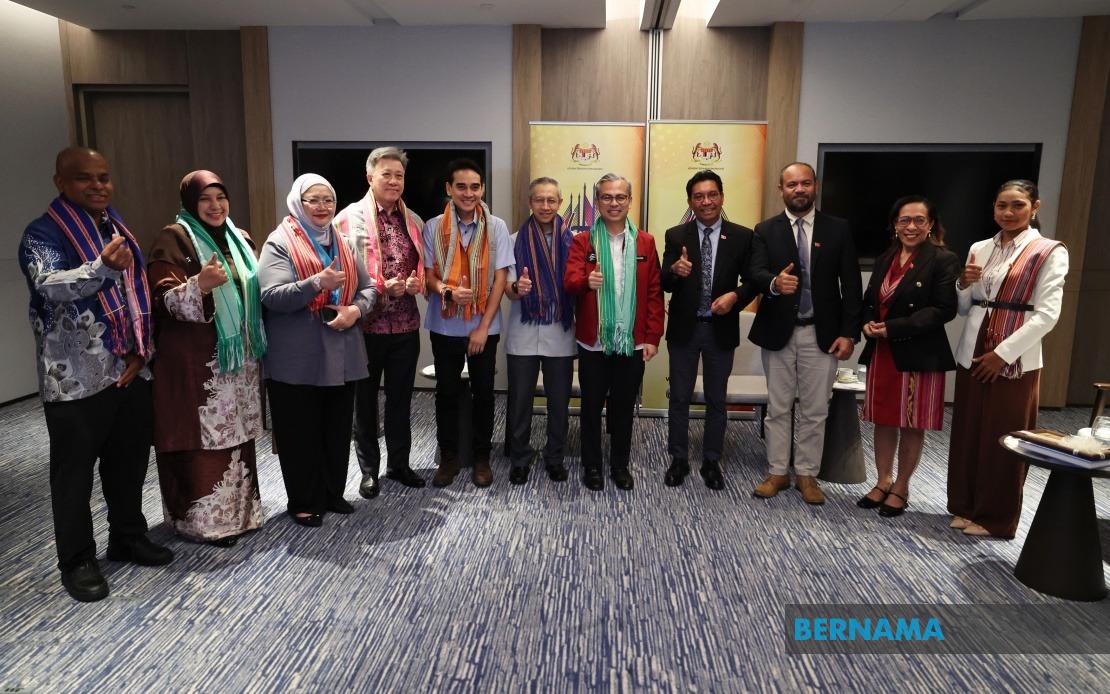
The Malaysian National News Agency Bernama and Timor-Leste's TATOLI have formalized a strategic partnership aimed at deepening media cooperation between the two ASEAN nations. Signed during National Journalists' Day celebrations in Butterworth, the memorandum of understanding represents a significant step in shaping regional narratives through locally-controlled news channels rather than relying on international wire services. The agreement was witnessed by Prime Minister Datuk Seri Anwar Ibrahim and Communication Minister Datuk Fahmi Fadzil, underscoring the Malaysian government's commitment to strengthening ties within Southeast Asia's newest member state.
Bernama Chief Executive Officer Datin Paduka Nur-ul Afida Kamaludin outlined the partnership's scope, which encompasses shared news, photographic, and multimedia content alongside structured journalism training and professional development programmes. This multifaceted approach addresses both immediate information-sharing needs and the longer-term capacity-building essential for developing robust media ecosystems. The collaboration carries particular significance given Timor-Leste's relatively recent accession to ASEAN in October 2025, positioning Bernama as a mentor organisation during a critical period of institutional development for the newly integrated nation.
Language accessibility emerges as a critical component of the partnership's design. Bernama content will be distributed through TATOLI's platform in four languages—Tetum, Portuguese, Bahasa Indonesia, and English—ensuring that Timorese audiences can access Malaysian perspectives and regional coverage in their preferred communication channels. This multilingual approach reflects the linguistic complexity of both nations and the broader Southeast Asian region. Following this collaboration, Bernama plans to add Portuguese to its existing suite of six languages including Bahasa Melayu, English, Tamil, Mandarin, Arabic, and Spanish, thereby extending its reach to Portuguese-speaking communities worldwide and demonstrating how bilateral partnerships can drive organisational evolution.
The training dimension of the agreement carries substantial implications for journalism standards across the region. TATOLI reporters will participate in structured programmes at Bernama's facilities before year-end, exposing them to Malaysian newsroom practices and editorial standards. Bernama's institutional depth—encompassing more than two decades of journalism training experience, a dedicated Bernama Excellence Centre, and the Bernama School of Journalism—provides a comprehensive resource base that few regional news agencies can match. This knowledge transfer addresses a fundamental challenge facing newer institutions seeking to establish professional credibility and operational excellence.
Bernama's editorial infrastructure spans multiple platforms and specialisations, from online and television to digital media, radio, and photography. By deploying experienced editors and subject-matter specialists to mentor TATOLI staff, the partnership facilitates hands-on learning across diverse newsroom functions rather than theoretical instruction alone. Such exposure to different media production models enables TATOLI journalists to evaluate and adapt best practices suited to Timor-Leste's specific media landscape and audience expectations. This practical orientation distinguishes the arrangement from conventional institutional twinning agreements that often remain largely symbolic.
TATOLI President Noémio Mateus Soares Falcão articulated his agency's commitment to strengthening professional journalism capacity through partnership and shared experience. He emphasised the partnership's potential to advance media innovation and foster an information environment characterised by freedom, responsibility, and social benefit. These principles resonate beyond bilateral arrangements, reflecting broader ASEAN commitments to press freedom and information accessibility. Falcão's remarks acknowledged the contemporary challenge of managing rapid information dissemination across digital platforms while maintaining journalistic integrity and factual accuracy.
The speed at which information circulates through social media and digital channels has complicated journalism's traditional gatekeeping function, creating new demands for verification protocols and ethical editorial judgment. Falcão's emphasis on responsibility in this environment highlights how the Bernama-TATOLI partnership addresses not merely content provision but foundational professional standards. As misinformation proliferates globally, collaborations that strengthen journalists' capacity to identify, verify, and contextualise information become increasingly valuable for protecting public discourse quality.
Bernama's historical trajectory provides context for its mentorship role. Established through parliamentary legislation in 1967 and formally launched during Malaysia's national independence decade celebrations, Bernama has evolved from a domestic news service into a multilingual regional broadcaster. This institutional longevity and accumulated expertise position it naturally as a capacity-building partner for newer agencies seeking to establish sustainable operational frameworks. The agency's expansion from two languages in its early years to current coverage in six languages demonstrates the organisational flexibility and strategic foresight required to adapt to changing regional demographics and international audiences.
TATOLI, by contrast, represents a younger institutional actor, established in 2016 as Timor-Leste's official information dissemination channel. The agency's limited operational history creates genuine capacity gaps in areas where Bernama possesses extensive institutional memory and proven methodologies. However, TATOLI's designation as Timor-Leste's government news agency conveys significant responsibility for shaping public understanding of national policy and international relations. This formal status makes professional capacity-building particularly consequential, as TATOLI's operations directly influence public discourse regarding the new nation's role within ASEAN and broader geopolitical contexts.
The partnership's timing coincides with broader regional efforts to strengthen ASEAN cohesion and cross-institutional cooperation. The National Journalists' Day 2026 celebration, which hosted the MoU signing, attracted representatives from Cambodia and Laos, suggesting convergent regional interest in media cooperation frameworks. These multilateral attendance patterns indicate that bilateral partnerships between news agencies may catalyse broader ASEAN-wide coordination on journalism standards, news exchange protocols, and professional development. Malaysian and Timor-Leste's arrangement could thereby establish templates adaptable to other member state pairings.
For Malaysian readers, this partnership reinforces their nation's positioning as a regional media leader and capacity-building hub within Southeast Asia. Bernama's willingness to invest training resources in TATOLI reflects confidence in the partnership's mutual benefits and long-term strategic value. Enhanced access to Timorese news and perspectives through TATOLI platforms simultaneously enriches Malaysian audiences' understanding of regional developments while extending Bernama's geographic footprint. This reciprocal value proposition—characteristic of successful partnerships—suggests sustainable institutional commitment beyond ceremonial commitments.
The collaboration also addresses ASEAN's persistent challenge of ensuring that regional narratives remain controlled by regional actors rather than dominated by international news organisations. By strengthening Timor-Leste's journalistic capacity and integrating its coverage into broader regional networks, the Bernama-TATOLI arrangement reinforces the principle that ASEAN states should shape how their own stories reach both regional and global audiences. This capacity-building approach proves more sustainable than dependency on wire service content and supports ASEAN's broader agenda of institutional autonomy and regional self-determination in information governance.
Looking forward, the partnership establishes foundations for deeper integration across ASEAN media sectors. As TATOLI gains operational maturity through training and experience-sharing with Bernama, the capacity exists for increasingly sophisticated coordination on cross-border news coverage, joint investigative projects, and coordinated coverage of regional events. Such evolution would strengthen ASEAN's information ecosystem while creating professional development pathways for journalists throughout the region. The Bernama-TATOLI arrangement thus transcends bilateral cooperation to represent ASEAN's broader commitment to institutional development and regional self-sufficiency in media production and distribution.

%22%2F%3E%3C%2Fpattern%3E%3C%2Fdefs%3E%3Crect%20width%3D%22100%25%22%20height%3D%22100%25%22%20fill%3D%22url(%23phd48ug)%22%2F%3E%3Crect%20width%3D%22100%25%22%20height%3D%22100%25%22%20fill%3D%22url(%23phd48up)%22%2F%3E%3Ctext%20x%3D%2250%25%22%20y%3D%2250%25%22%20text-anchor%3D%22middle%22%20dominant-baseline%3D%22central%22%20fill%3D%22rgba(255%2C255%2C255%2C0.95)%22%20font-family%3D%22Georgia%2C%20'Times%20New%20Roman'%2C%20serif%22%20font-weight%3D%22700%22%20font-size%3D%22151%22%20letter-spacing%3D%22-0.02em%22%3EMalaysian%3C%2Ftext%3E%3C%2Fsvg%3E)