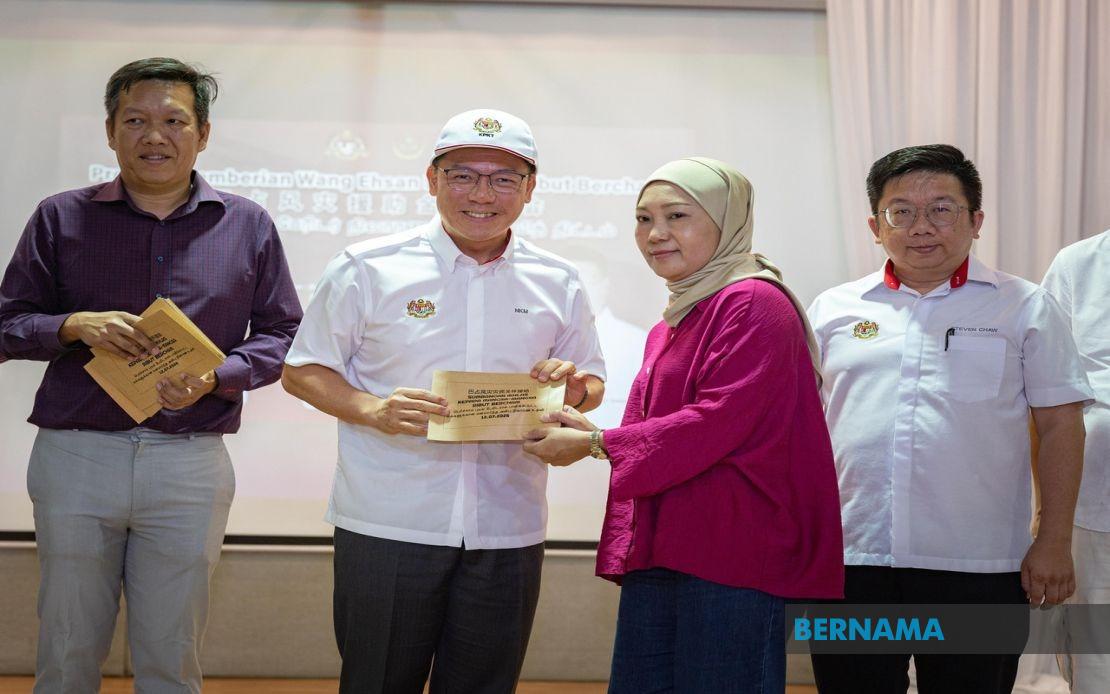
In a relief distribution ceremony held in Ipoh on July 12, Housing and Local Government Minister Nga Kor Ming handed over RM1 million to 554 families still recovering from the devastating storm that struck Bercham on June 19. The allocation, amounting to RM1,800 per household, represents a significant injection of funds aimed at helping residents rebuild their lives following the natural disaster that left extensive damage across multiple residential zones in the Perak district.
The financial assistance originated from two major corporate entities: Genting Malaysia and Genting Bersama Malaysia, which together contributed the relief package. The distribution underscores the role of private sector intervention in disaster recovery efforts, particularly when government resources face constraints. Bercham assemblyman Ong Boon Piow joined the minister at the ceremony, demonstrating unified political support for residents grappling with the aftermath of the weather event.
This latest assistance builds upon earlier government aid that had been distributed to the same families. Each household had previously received RM1,000 from the federal government's disaster relief allocation, with an additional RM300 provided through the district chief's office. The cumulative support thus reaches RM3,100 per family when combined with the newly distributed RM1,800, offering a more substantial safety net for households facing reconstruction costs and livelihood disruptions.
Nga Kor Ming acknowledged the limitations of available funding during his remarks at the ceremony. He candidly noted that while the allocated sums remain insufficient to fully address all losses incurred by residents, the government and its partners were committed to providing whatever assistance could be mobilised. The minister's statement reflects a broader challenge facing disaster management in Malaysia, where the scale of damage frequently outpaces the speed and scale of financial recovery mechanisms, necessitating creative funding solutions and corporate partnership.
The Bercham minister emphasised his personal commitment to the district despite his position within the federal administration in Putrajaya. His remarks signalled an intent to maintain close oversight of the community's recovery trajectory, framing the relief distribution as evidence of political responsiveness to constituency needs. Such messaging carries particular weight in Malaysian political discourse, where demonstrable delivery of tangible benefits to affected communities remains a critical measure of political legitimacy and electoral support.
The June 19 incident itself had proven exceptionally destructive for the Bercham locality. Nearly two hours of unrelenting heavy rainfall combined with powerful winds created hazardous conditions that overwhelmed many residential structures. More than 500 homes scattered across five distinct residential areas sustained varying degrees of damage, ranging from roof damage and window destruction to more severe structural compromise. The scale of the incident positioned it among the more significant weather events to impact the Ipoh metropolitan area in recent times.
The concentration of damage across five residential zones suggests that the storm followed a localised but intense weather pattern, affecting a contiguous population rather than scattered households. Such geographical clustering typically requires coordinated relief delivery and creates opportunities for community-based recovery initiatives. The fact that authorities managed to maintain relatively comprehensive household-level records and distribute aid systematically indicates that local administrative mechanisms, despite resource constraints, functioned adequately during the emergency response phase.
Corporate contributions like those from Genting Malaysia have become increasingly important in Malaysia's disaster relief ecosystem. As climate change drives more frequent and intense weather events, government budgets struggle to keep pace with recovery demands. Private sector entities, particularly large corporations with substantial market positions and stakeholder expectations for corporate social responsibility, have stepped into this gap. However, such reliance on voluntary corporate generosity raises questions about equity and predictability of disaster support across different regions and communities.
The timing of the relief distribution—nearly a month after the initial disaster—also reflects typical delays inherent in disaster management procedures. Between impact, damage assessment, fund mobilisation, and eventual distribution, considerable time typically elapses. For families facing immediate needs such as temporary shelter repairs or replacement of essential household items, such delays can compound hardship, even though the eventual assistance proves welcome. Streamlining these processes remains an ongoing challenge for Malaysian disaster management authorities.
For Malaysian policymakers and administrators, the Bercham case illustrates several broader imperatives. First, climate resilience in urban and peri-urban residential areas requires enhanced preparedness planning and infrastructure improvement. Second, disaster financing mechanisms need strengthening to enable faster response. Third, coordination between government agencies and willing corporate partners should be formalised to create more predictable relief pathways. Fourth, community-level recovery initiatives deserve greater policy emphasis alongside financial assistance, recognising that money alone cannot restore normalcy to affected populations.
The experience in Bercham also carries lessons for other Malaysian communities, particularly in Peninsular Malaysia's west coast states where monsoon seasons and occasional severe weather events pose recurring risks. Perak, Selangor, and Kuala Lumpur have all experienced significant storm damage in recent years, creating a pattern that warrants systemic policy responses rather than ad-hoc crisis management. The Bercham relief distribution, while welcome, ultimately represents symptom treatment rather than addressing underlying vulnerability factors.

