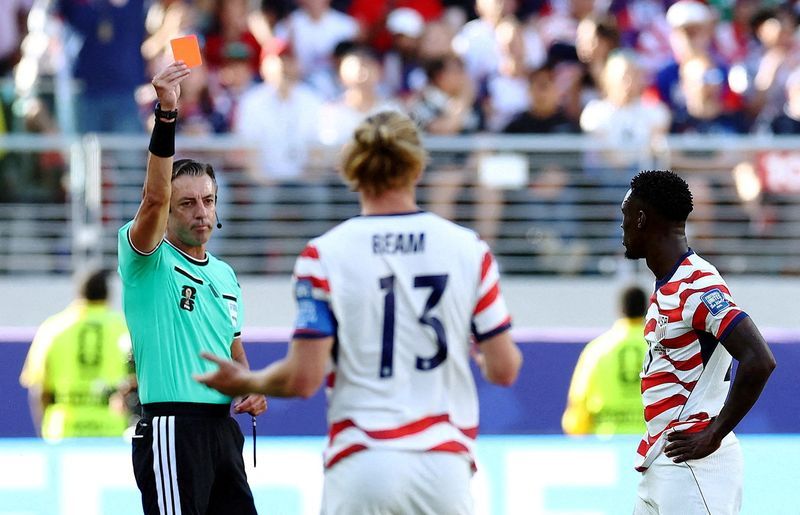
The controversy erupted on the eve of Belgium's knockout-stage encounter against the United States in Seattle, a fixture that has suddenly become overshadowed by allegations of improper political interference in FIFA's disciplinary mechanisms. FIFA's decision to suspend striker Folarin Balogun's red-card ban—thereby allowing him to participate in the crucial match—followed what sources have described as a direct personal appeal from U.S. President Donald Trump to FIFA President Gianni Infantino. The reversal marks an unprecedented instance of executive-level political intervention in the sport's regulatory framework, triggering a wave of condemnation from Belgian quarters.
In Brussels, the capital city that serves as the political heart of the European Union, public sentiment coalesced around the perception that FIFA had compromised its integrity. Therese Kpooubie, a Brussels resident interviewed outside official government circles, articulated the frustration many Belgians felt regarding the fundamental contradiction inherent in FIFA's action. She questioned the logical basis for overturning a disciplinary decision that, by definition, had been rendered for a serious breach of the sport's rules. If a referee deems conduct sufficiently severe to warrant ejection, she reasoned, what subsequent evidence or authority could justify erasing that judgment? Her rhetorical framing underscores the erosion of confidence in FIFA's judicial independence when political considerations appear to supersede sporting protocol.
The incident represents a collision between the principle of meritocratic competition and the reality of geopolitical power dynamics. For smaller nations like Belgium that lack the diplomatic leverage of major powers, such interventions signal a troubling asymmetry in how the world governing body applies its regulations. The Belgian side must navigate a psychological minefield: competing against an opponent bolstered by governmental backing at the highest level, knowing that conventional disciplinary enforcement has been rendered negotiable through political channels. This dynamic carries implications far beyond the immediate fixture, potentially establishing a precedent that undermines confidence in FIFA's rule-making authority across the global football community.
Belgium's Deputy Prime Minister Maxime Prevot elevated the dispute from public commentary into formal political protest. His statement characterized the situation as a fundamental violation of sport's foundational principles, suggesting that if Trump's intervention genuinely precipitated the decision, it constituted nothing less than an affront to the basic tenets governing athletic competition. Prevot's intervention legitimised grassroots Belgian concerns by anchoring them in governmental discourse, transforming what might otherwise be dismissed as sour grapes into a matter of institutional principle. The Belgian leadership's willingness to engage publicly reflected the depth of resentment toward perceived unfair advantage.
Some observers within Belgium, however, counselled against allowing the controversial decision to psychologically destabilise the squad's preparation. Bastien Noel, another Brussels respondent, advocated that the Red Devils channel any perceived injustice into heightened motivation. He suggested that regardless of FIFA's controversial ruling, Belgian players must demonstrate through their on-field performance that external manipulation cannot influence their competitive spirit or determination to advance in the tournament. This perspective reflects a pragmatic recognition that the decision, while administratively controversial, remains a fixed reality that the team must accommodate rather than contest.
The U.S. Embassy in Belgium attempted damage control through a public statement from Ambassador Bill White, who categorically denied that Trump's involvement constituted improper interference. White claimed that Trump had merely thanked FIFA after the decision had already been rendered, portraying the timeline as one of appreciation rather than precedence. This characterisation attempted to reframe the narrative, suggesting that Trump's actions occurred post-facto rather than causatively. However, this explanation failed to convince Belgian observers and officials, who remained sceptical that such unprecedented exceptions arise coincidentally alongside high-level governmental attention.
The broader implications of this episode extend beyond the immediate Belgium-United States fixture. FIFA's capitulation to political pressure, should that characterisation prove accurate, establishes a troubling precedent for future interventions. If heads of state or senior government officials can successfully petition FIFA to overturn disciplinary decisions, the organisation's independence becomes fundamentally compromised. This becomes particularly concerning for smaller nations and emerging football powers that lack comparable diplomatic channels or leverage with international institutions. The episode raises uncomfortable questions about whether FIFA, despite its ostensibly neutral governance structure, operates as a meritocratic institution or as one vulnerable to the gravitational pull of major powers.
From a Southeast Asian perspective, this controversy carries instructive lessons. Regional nations competing in FIFA competitions must recognise that sporting integrity cannot be assumed as a default condition, particularly when geopolitical considerations intersect with high-stakes competition. The incident demonstrates that even the world's most prominent sports organisations can become vectors for great-power politics, and that smaller nations must remain vigilant against institutional capture by more powerful actors. For Malaysian football and the broader sporting community across Southeast Asia, the precedent established here—or potentially established—warrants close observation.
Thereese Kpooubie, displaying her patriotic commitment through Belgian flag-coloured earrings, channelled her frustration into an exhortation for her national team to deliver sporting justice on the field. Her appeal encapsulated the sentiment animating Belgian public discourse: that since institutional mechanisms had failed to prevent what many perceived as an injustice, the Red Devils must compel recourse through excellence and determination. She urged focus, success, and an unwavering commitment to representing their nation's colours with distinction. This popular appeal reflected an implicit recognition that while formal remedies had been exhausted, the competition itself still offered opportunity for moral vindication through victory.

