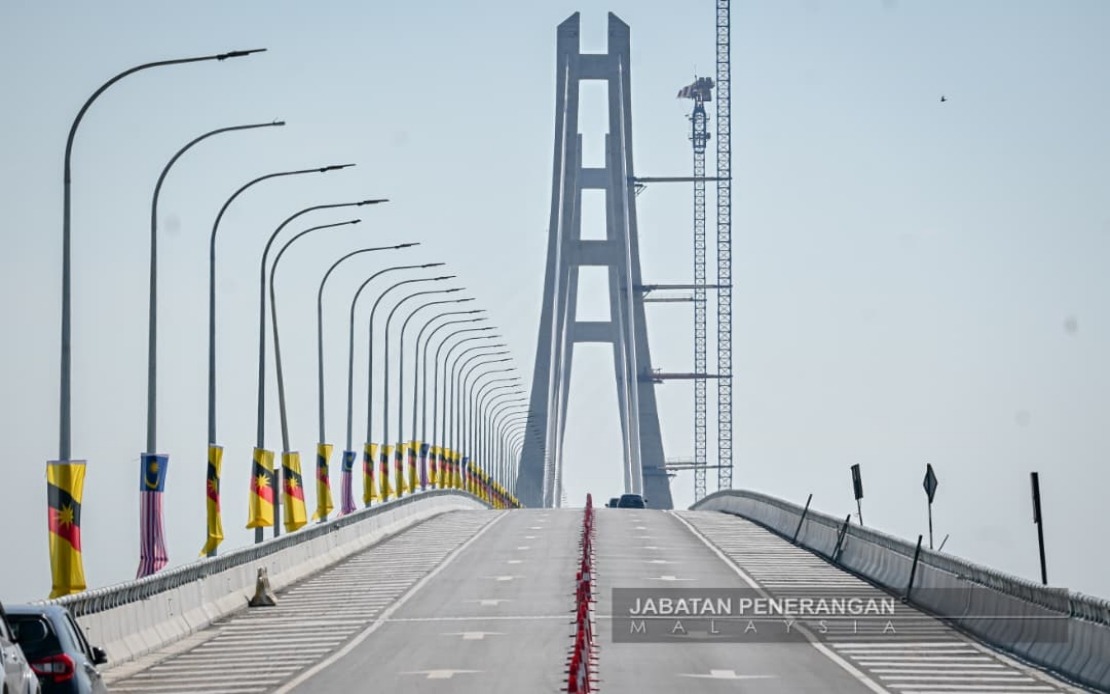
Sarawak has reached a watershed moment in its infrastructure development with the official opening of the Batang Lupar 1 Bridge, a massive engineering undertaking that Premier Tan Sri Abang Johari Tun Openg described as a historic breakthrough for the state's coastal corridor. The 4.844-kilometre crossing, constructed at a cost of RM848.75 million, represents far more than a conventional transport link—it symbolises Sarawak's determination to break geographical isolation and unlock the economic potential of its southern coastal regions, particularly the districts of Sebuyau, Betong, Sri Aman and Samarahan.
For decades, residents and businesses across the Batang Lupar River depended on ferry services to connect isolated communities and transport agricultural goods. That reliance came with substantial costs, both economic and human. The journey across the river could stretch to an hour during normal conditions, but weather disruptions were frequent and unpredictable. Perhaps most tragically, the waterway claimed lives through incidents triggered by strong waves and winds at the river's mouth. These challenges were not merely inconveniences but structural barriers to development, limiting investment, restricting market access and frustrating residents who repeatedly petitioned local and state representatives for a permanent solution.
Abang Johari emphasised that the bridge's conception directly reflected community demands, with both former and current elected representatives channelling local frustrations into concrete policy. This responsiveness to grassroots pressure demonstrates how infrastructure projects can emerge from genuine developmental needs rather than top-down planning. The bridge therefore carries particular symbolic weight as a demonstration of political accountability to coastal constituencies historically underserved by major connectivity projects.
The Batang Lupar 1 Bridge forms the centrepiece of the broader Sarawak Second Trunk Road (STRR), an ambitious RM3.21 billion initiative designed to establish a modern, efficient coastal highway network spanning the entire state. This larger ecosystem of infrastructure development reveals strategic thinking beyond a single bridge: Sarawak is deliberately constructing alternative transportation routes that reduce pressure on inland corridors while opening new economic geography. The STRR project, targeting full completion by 2030, represents a decade-long commitment to coastal connectivity that will fundamentally reshape regional trade patterns and settlement distribution.
Sarawak Deputy Premier Datuk Amar Douglas Uggah Embas, who oversees Infrastructure and Port Development, articulated the transformative scale of this network expansion. Once the entire STRR coastal road system becomes operational, the distance between Kuching and Sibu will compress from 396 kilometres to 252 kilometres—a reduction of 144 kilometres. This seemingly mathematical improvement carries profound implications: journey times collapse, logistics costs diminish, market access expands dramatically and the comparative disadvantage of coastal locations dissolves. A truck operator in Betong can now reach Kuching's markets in substantially less time, making agricultural exports more competitive. Investment decisions that previously favoured central locations along existing routes now become viable across coastal districts.
The bridge's designation by the Malaysia Book of Records as the longest bridge spanning a river in Malaysia elevates its status beyond regional significance. The recognition, formally presented by MBOR representative Megat Faris Hussein Megat Muzaffar Shah, establishes the structure as a notable engineering achievement within Malaysian infrastructure history. This acknowledgment serves both symbolic and practical purposes: it attracts external attention to Sarawak's development trajectory while providing local stakeholders with tangible evidence of progress and accomplishment.
From a Malaysian perspective, the Batang Lupar 1 Bridge exemplifies how states can leverage autonomy to address specific regional challenges through sustained capital investment. The RM848.75 million expenditure represents significant financial commitment, yet Sarawak's government clearly determined that the coastal corridor's latent economic potential justified the investment. This contrasts sharply with more cautious approaches to infrastructure spending in some other regions and demonstrates that strategic patience combined with targeted spending can unlock substantial developmental dividends.
The elimination of ferry services across this stretch marks the conclusion of a transportation era. Douglas Uggah explicitly characterised the ferry as now historical, emphasising that unpredictable weather, scheduling limitations and safety risks have definitively yielded to modern fixed infrastructure. This transition holds particular significance for agricultural producers who previously lost perishable goods due to journey delays and for vulnerable populations who faced genuine danger during adverse conditions. The bridge thus delivers safety improvements alongside economic benefits.
Looking forward, the Batang Lupar 1 Bridge will function as both practical infrastructure and developmental catalyst. Its opening creates immediate benefits—faster journey times, reduced transport costs, improved safety—but the longer-term value emerges through economic restructuring. Investors considering agricultural processing facilities, manufacturing operations or commercial ventures will now evaluate coastal locations more favourably. Agricultural cooperatives can expand their geographical reach for input procurement and output distribution. Tourism enterprises may discover new opportunities in previously remote areas. The bridge operates as a key that unlocks locked potential across four districts.
The project's completion also reflects broader trends within Southeast Asian infrastructure development, where countries increasingly recognise that inland concentration of economic activity represents suboptimal resource allocation. Sarawak's commitment to coastal connectivity follows similar patterns visible across Indonesia, Thailand and Vietnam—deliberate efforts to distribute development benefits across wider geographies and reduce dependence on metropolitan cores. This regional movement towards polycentric development represents a significant shift in thinking about how emerging economies achieve balanced, inclusive growth.
For Malaysian observers outside Sarawak, the bridge demonstration certain important principles about state-level governance and resource allocation. Sarawak's willingness to invest heavily in addressing a specific regional problem—despite that problem affecting only portions of the state—reflects commitment to addressing disparity rather than concentrating resources on already-developed areas. This approach has long characterised Sarawak's development strategy and contributes to relatively balanced regional development compared to some Malaysian states where centre-periphery gaps remain pronounced.
The infrastructure project also carries implications for federal-state coordination within Malaysia's political framework. The scale of investment required for the STRR coastal network demands substantial state resources, yet the resulting network delivers national-scale benefits by improving connectivity between major Sarawakian cities. This dynamic highlights the mutual interests of federal and state governments in major infrastructure projects and suggests continued opportunities for collaborative investment in transformative connectivity across Malaysian regions.
As the Batang Lupar 1 Bridge transitions from construction project to operational infrastructure, it enters a critical phase where projected economic benefits must materialise. Success requires not merely physical completion but sustained maintenance, supporting regulatory frameworks that facilitate commerce, and continued investment in complementary infrastructure. Sarawak's government has demonstrated commitment through the broader STRR project, but realising the full potential of this bridge will depend on how effectively stakeholders—government agencies, private businesses and local communities—coordinate to translate connectivity into concrete development outcomes across Sebuyau, Betong, Sri Aman and Samarahan.

