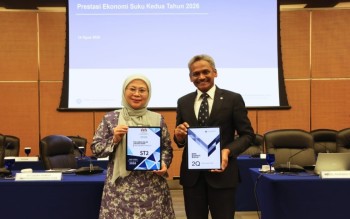
Bank Negara Malaysia (BNM) has opted to hold firm on its 2026 GDP growth forecast of 5.0 per cent, expressing confidence that economic expansion will maintain this trajectory despite a number of external uncertainties. Governor Datuk Seri Abdul Rasheed Ghaffour delivered this assessment during a press conference following the announcement of Malaysia's second-quarter economic data, signalling that the central bank sees sufficient momentum in domestic and external drivers to justify the current projection without adjustment at this stage.
The decision to refrain from revising the forecast represents a measured stance from BNM, which typically reserves such adjustments for the annual Budget announcement. This approach reflects the institution's belief that the underlying factors supporting growth remain intact across multiple dimensions of the economy, even as global headwinds persist. Abdul Rasheed noted that Malaysia has already exceeded growth expectations for three consecutive quarters, a pattern that provides confidence in the sustainability of the current outlook.
Malaysia's economy delivered particularly robust performance in the second quarter, expanding at 6.0 per cent—a result that outpaced the Department of Statistics Malaysia's advance estimate of 5.8 per cent. This stronger-than-anticipated outcome underscores the resilience of the Malaysian economy and provides further validation for BNM's continued confidence in the 5.0 per cent annual target. The growth trajectory suggests that the economy possesses more elasticity than originally anticipated, though BNM remains cautious about extrapolating this performance indefinitely.
Domestic demand has emerged as the principal engine of expansion, with household consumption demonstrating particular strength at 4.8 per cent in the second quarter. The robustness of consumer spending reflects multiple supporting factors, with income growth serving as the primary contributor, followed by accumulated savings and targeted government policy measures. Notably, Abdul Rasheed emphasised that household borrowing plays a relatively minor role in sustaining consumption levels, suggesting that the expansion is not being artificially propped up by unsustainable credit growth. This composition of consumption drivers carries implications for economic stability, as it indicates expansion rooted in genuine purchasing power rather than debt-fuelled spending.
The external sector has provided substantial supplementary support to growth, particularly during the first half of 2026. Unlike previous episodes of global slowdown that have severely constrained Malaysian exports, the current cycle has demonstrated considerable breadth and diversification. Both the traditional electrical and electronics (E&E) sector and non-E&E exports have contributed positively, indicating that Malaysia's export recovery is not concentrated in a single product category. The information and communications technology services sector has additionally emerged as a contributor, reflecting Malaysia's ongoing economic diversification beyond traditional manufacturing.
Abdul Rasheed acknowledged, however, that the path forward contains potential hazards that could necessitate a reassessment of the growth outlook. The global economic environment remains fraught with uncertainty, whilst geopolitical tensions introduce unpredictable variables that could disrupt supply chains and dampen international demand. These external factors could warrant revisions to the forecast, though BNM currently judges that the resilience demonstrated thus far provides adequate buffers against near-term shocks.
Among specific challenges warranting attention is the phenomenon of El Niño, whose economic ramifications BNM expects to unfold gradually and with a lagged impact. The central bank's current assessment suggests that disruptions will remain primarily confined to the agricultural sector rather than permeating throughout the broader economy. Nevertheless, BNM has cautioned that businesses and households should begin preparing for potential adverse scenarios, particularly if El Niño conditions intensify. This advisory reflects prudent economic stewardship, acknowledging that preparation and adaptation mechanisms can materially mitigate damage when environmental challenges materialise.
Investment activity represents another pillar of the growth story, though Abdul Rasheed's remarks suggested this component warrants closer monitoring. The diversification within export growth and the resilience of consumption demand imply that investment sentiment has remained sufficiently robust to support productive capacity expansion across sectors. This is particularly significant in the context of Malaysia's structural transformation objectives, as sustained investment levels are essential for shifting the economy towards higher value-added activities.
Tourism has constituted an additional source of strength, contributing to the broad-based nature of expansion that BNM has underscored. The recovery in international visitor arrivals and associated spending represents a substantial turnaround from pandemic-era disruptions and reflects both regional stability and Malaysia's continued appeal as a tourism destination. This sector's contribution to growth carries particular relevance for regional economies similarly dependent on tourism revenues, positioning Malaysia's experience as a bellwether for Southeast Asian recovery trajectories.
The composition of growth that has emerged—spanning consumption, investment, exports, and tourism—contrasts favourably with scenarios wherein expansion becomes narrowly concentrated in a single sector or demand source. BNM's emphasis on broad-based growth reflects recognition that such diversification provides resilience against targeted shocks. If growth were overly dependent on exports, for instance, geopolitical disruption could severely curtail expansion. The current pattern, conversely, suggests that domestic demand buffers remain available even should external conditions deteriorate.
For Malaysian policymakers and regional observers, BNM's steadfast maintenance of the 5.0 per cent forecast carries implications for monetary and fiscal policy calibration. The central bank's confidence suggests that the monetary policy framework need not be dramatically adjusted in the near term, though the acknowledgement of external risks implies that flexibility will remain important. Fiscal authorities similarly face a landscape wherein the current growth trajectory provides some budgetary breathing room, though persistent challenges in education, healthcare, and infrastructure require sustained investment.
Regionally, Malaysia's economic performance and BNM's outlook carry significance for Southeast Asian policy coordination and investor confidence. A sustained growth rate of 5.0 per cent or higher positions Malaysia favourably relative to regional peers and supports the narrative of a stable investment destination. This positioning becomes increasingly valuable as regional economies navigate ongoing global trade tensions and shifting geopolitical alignments that could reshape investment flows and supply chain architecture across Asia.

