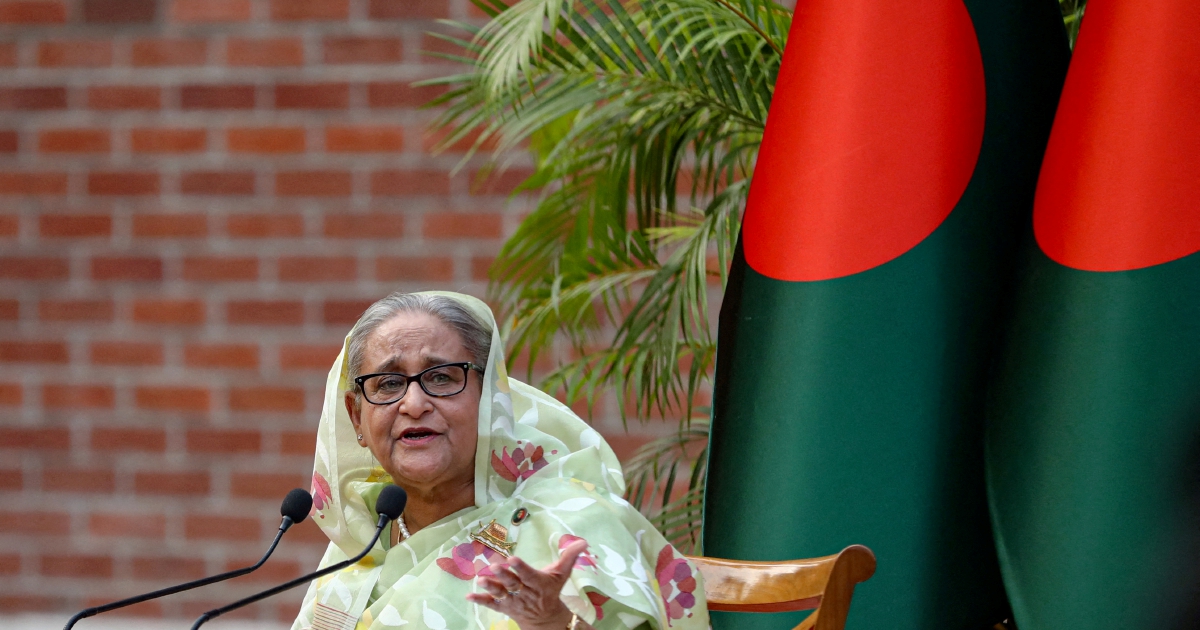
Bangladesh has moved to confiscate assets valued at 760 billion taka—equivalent to roughly $6.2 billion—that authorities say are linked to former prime minister Sheikh Hasina, members of her family circle, and a network of ten major business enterprises, according to an official statement released Wednesday. The sweeping asset seizure represents one of the most significant financial actions taken since Hasina's departure from office and underscores the new administration's commitment to investigating accumulation of wealth during her tenure.
The comprehensive nature of the confiscation reflects broader concerns about financial irregularities and alleged corruption networks that extended beyond Hasina herself to encompass her immediate family members and their commercial holdings. By targeting multiple business groups simultaneously, authorities are signalling an intent to dismantle what they characterize as an interconnected system of financial advantage that allegedly benefited from proximity to political power. The scale of the seizure—nearly half the annual defence budget of the nation—demonstrates the scope of assets that fell under investigative scrutiny.
For Malaysian observers, the Bangladesh situation carries instructive parallels. Like Malaysia's own experience with high-profile financial investigations following leadership transitions, Bangladesh's approach raises questions about the appropriate balance between accountability and economic stability. The seizure of such substantial assets, while politically popular among those who view it as justice, can also create uncertainty in the business environment and raise concerns about due process. How Bangladesh manages these assets during the investigation period will be closely watched by regional neighbours navigating similar governance challenges.
The timing of the confiscation also reflects the precarious political situation in Bangladesh. Following widespread public discontent and civil unrest that culminated in Hasina's departure, the interim administration faces pressure to demonstrate tangible results in its accountability agenda. By acting decisively on asset seizures, authorities can point to concrete action while investigations into alleged misconduct proceed through more measured legal channels. This provides the transitional government political space to manage other pressing governance priorities.
The involvement of ten business groups in the investigation suggests that corruption or misuse of political influence extended deeply into Bangladesh's commercial sector. These enterprises likely benefited from government contracts, regulatory favours, or other advantages that would have been unavailable in a genuinely competitive marketplace. Understanding the precise mechanisms through which political connections translated into commercial advantage will be crucial for implementing reforms that prevent similar patterns from re-emerging.
From a regional economic perspective, the asset seizure may have broader implications for business confidence across South Asia. International investors and regional enterprises will be assessing how Bangladesh handles the legal processes following these confiscations, and whether the rule of law will be applied consistently. The government's handling of asset recovery and eventual disposition—whether through auction, repatriation to state enterprises, or other mechanisms—will send signals about the institutional reliability of Bangladesh's new governance framework.
The quantum of assets involved also raises practical questions about management and safeguarding. The government must establish credible systems to prevent misappropriation or deterioration of these holdings while legal proceedings unfold. For Malaysia, which has faced its own challenges in managing seized assets and ensuring transparency in recovery processes, Bangladesh's experience offers an opportunity to reflect on best practices and institutional frameworks that can withstand scrutiny and allegations of political bias.
International dimensions of the seized assets likely complicate the recovery process. Significant portions of wealth accumulated by prominent political figures are often held overseas or converted into foreign investments, property, and financial instruments. Bangladesh will need to engage with foreign governments and international legal mechanisms to trace and recover assets held beyond its borders, a process that typically requires sustained diplomatic effort and cooperation from countries where the assets are located.
The investigation into Hasina's assets and those of her associates also carries implications for Bangladesh's broader anti-corruption agenda. Whether these seizures represent a one-time accountability exercise targeting a specific political faction or the beginning of systematic institutional reforms will shape how effective this moment of political transition becomes. The new administration's credibility will partly depend on whether it applies similar scrutiny to its own members and maintains momentum in accountability efforts over the medium term.
For Malaysian policymakers and observers, the Bangladesh case underscores both the necessity and complexity of addressing elite financial misconduct in post-transition environments. While public expectations for swift justice are understandable and politically significant, sustainable reform requires patience, legal rigour, and institutional capacity that cannot always be rushed. The coming months will reveal whether Bangladesh's asset seizures mark the foundation of genuine systemic change or represent primarily symbolic action disconnected from deeper institutional transformation.

