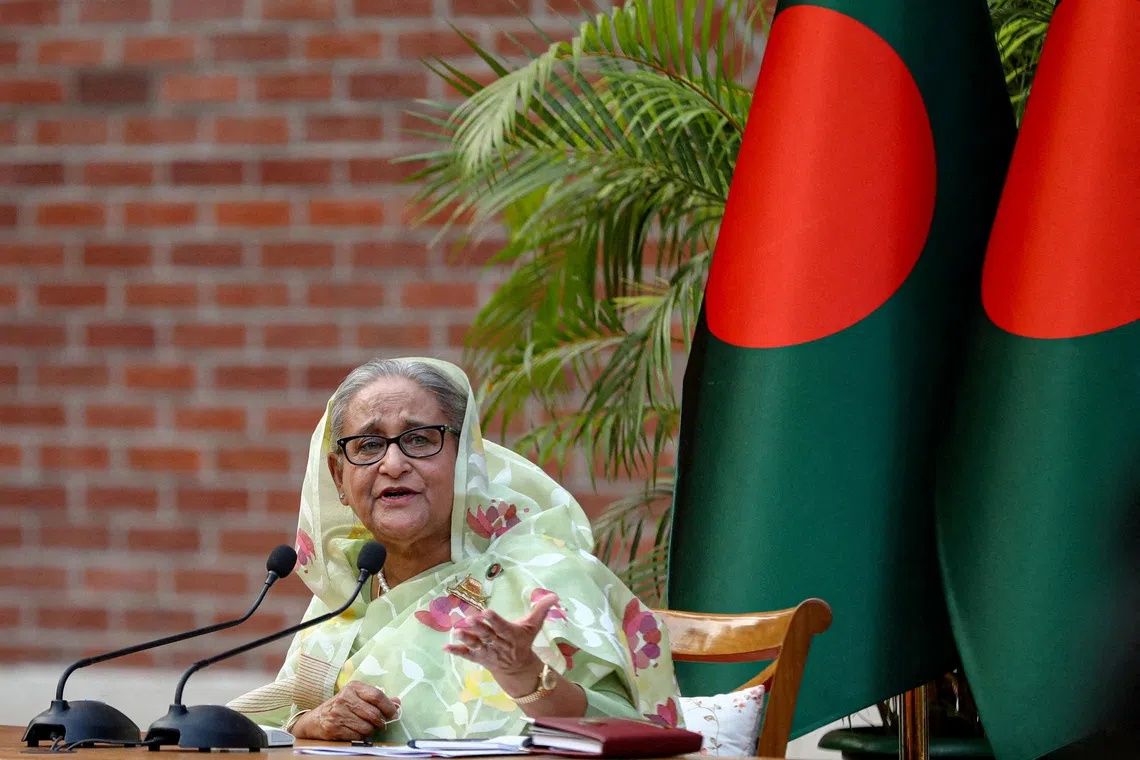
Bangladesh has formally asked India to clarify its official position on allowing exiled former prime minister Sheikh Hasina to deliver a planned virtual address from New Delhi next month, signalling concern that such political activities by a fugitive could undermine the neighbouring countries' efforts to repair their strained relationship. The diplomatic request marks Dhaka's first formal response to Hasina's announced participation in an August 5 event hosted by the Foreign Correspondents' Club of South Asia, which will commemorate the second anniversary of the student-led uprising that precipitated the fall of her government in August 2024.
Shama Obaed Islam, Bangladesh's State Minister for Foreign Affairs, articulated the government's position in a statement to journalists, emphasising that Dhaka has invested considerable effort in building momentum with New Delhi following months of tension. "We are moving forward with India with a forward-looking approach. We don't want that progress to be affected," Islam said, before directly challenging the Indian administration to articulate its stance. "India has to be clear about its stance." The comments underscore the delicate diplomatic balance that Dhaka must maintain as it simultaneously pursues the extradition of Hasina while attempting to stabilise relations with its powerful neighbour.
The scheduled appearance represents Hasina's second major political statement from Indian soil since her departure from Bangladesh. According to the Foreign Correspondents' Club of South Asia, the 78-year-old former leader will address the gathering via video link, accompanied by her son Sajeeb Wazed Joy and other speakers. The event itself carries significant symbolic weight in Bangladesh's domestic political landscape, as August 5 has become a commemorative date representing the popular rejection of Hasina's governance and the triumph of mass mobilisation over established political hierarchy. For exile-watchers in Dhaka, any successful broadcast would represent a tangible demonstration of political influence from abroad, potentially emboldening Hasina's supporters within Bangladesh.
The underlying tension reflects the complex position in which India finds itself. While New Delhi has traditionally hosted political figures and dissidents from across South Asia, the situation with Hasina presents particular complications. Islam reiterated that Bangladesh has repeatedly conveyed official concerns to India regarding Hasina and other senior Awami League figures engaging in political activities from Indian territory. "We do not want India-Bangladesh relations to be harmed by statements from fugitive accused individuals," she stated, while acknowledging that India has previously indicated its expectation that fugitives would refrain from political engagement whilst sheltered on its soil.
Hasina's legal status in Bangladesh has deteriorated significantly since her flight from the country nearly a year ago. In 2025, she was sentenced to death in absentia for crimes against humanity stemming from her government's 2024 crackdown on protesters, an operation the United Nations estimated resulted in up to 1,400 deaths. Hasina has rejected the verdict as legally void, maintaining her innocence and challenging the legitimacy of the proceedings conducted in her absence. Despite facing multiple criminal cases, Hasina has publicly declared her intention to return to Bangladesh in December, a statement that suggests she either anticipates legal reprieve through political negotiations or remains defiant about the charges against her.
The deterioration of India-Bangladesh relations since Hasina's removal represents a significant shift in South Asian geopolitics. For decades, the Awami League and India maintained close strategic ties, with New Delhi providing crucial support during Bangladesh's liberation war in 1971 and maintaining strong defence and cultural links thereafter. The student uprising and Hasina's subsequent exile therefore disrupted established regional alignments, leaving India in an awkward position between its historical ally and the new political order emerging in Dhaka. New Delhi's shelter of Hasina, while consistent with its tradition of offering refuge to displaced leaders, has nonetheless created friction with the interim government that has governed Bangladesh since February's elections.
Tarique Rahman, the son of previous prime minister Begum Khaleda Zia and leader of the Bangladesh Nationalist Party, now heads the interim administration that replaced Hasina's ousted regime. Both Rahman's government and New Delhi have recently signalled genuine interest in normalising bilateral relations, recognising that sustained tension serves neither nation's strategic interests. Senior officials from both countries have engaged in diplomatic visits and pledged enhanced cooperation across defence, trade, and energy sectors. However, the Hasina question represents a persistent thorn in these reconciliation efforts, as it raises questions about India's commitment to respecting the democratic transition in Bangladesh.
Islam indicated that while Bangladesh acknowledges the Foreign Correspondents' Club of South Asia event is not formally organised by the Indian government, Dhaka reserves the right to escalate the matter through diplomatic channels if necessary. This measured warning reflects Dhaka's diplomatic sophistication—stopping short of direct confrontation with India whilst making clear that inaction carries political costs. The statement suggests Bangladesh may approach India's external affairs ministry with a formal démarche if the event proceeds without modification.
The absence of an immediate response from India's foreign ministry suggests New Delhi may be carefully considering its approach. India's historical role as a democracy and refuge for political figures creates genuine diplomatic complexity regarding how to handle Hasina's situation. Unlike authoritarian regimes that might simply expel an inconvenient exile, India must balance humanitarian and democratic principles with bilateral diplomatic relations. However, the pressure from Bangladesh is mounting, and India faces a genuine choice between maintaining its traditional openness to political figures whilst potentially damaging crucial relationships in its immediate neighbourhood.
The Hasina situation also reflects broader questions about exile politics in South Asia, where neighbouring countries frequently host opposition figures and displaced leaders. Thailand, Pakistan, and other nations in the region have similarly grappled with managing exiles whose continued political activities complicate bilateral relations. Bangladesh's formal protest therefore sets a precedent that may influence how other regional governments manage similar situations in future. The principle at stake—whether host nations should restrict political activities by fugitive figures—carries implications extending well beyond the immediate circumstances of Hasina's case.

