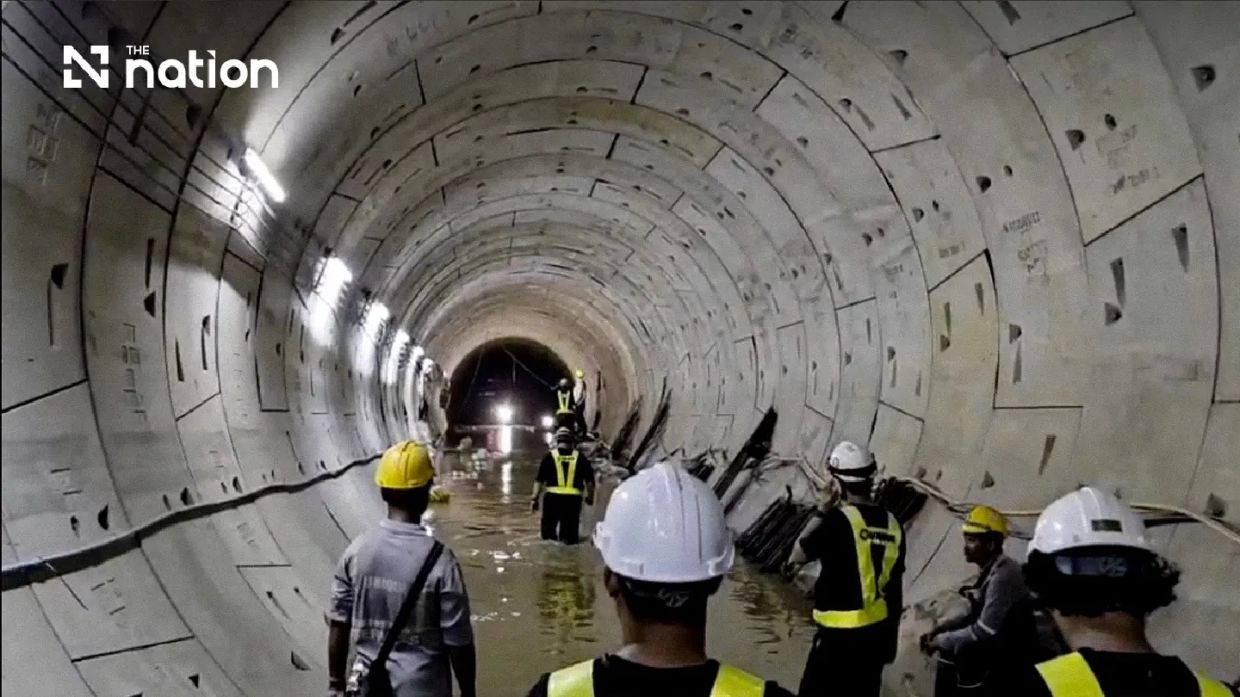
Prime Minister Anutin Charnvirakul descended on the Wongwian Yai construction site near midnight on Wednesday, July 8, after heavy downpours inundated a section of Bangkok's Purple Line extension project, forcing water into an underground tunnel chamber. The water intrusion occurred within a construction shaft beneath the Tao Poon–Rat Burana segment of the Kanchanaphisek Ring Road section, as rainfall throughout the day raised water levels across the Bangkok metropolitan area. The incident represents the latest challenge facing one of Thailand's most high-profile infrastructure projects, drawing immediate intervention from the nation's top transport officials.
Anutin's late-night arrival followed an earlier cascade of senior ministerial visits to the site. Deputy Prime Minister and Transport Minister Phiphat Ratchakitprakarn, alongside Deputy Transport Ministers Siripong Angsakulkiat, Phattharaphong Phatraprasit and Sanphet Boonyamanee, had already established a command presence at the location. The swiftness and seniority of the response underscores acute government anxiety about construction mishaps in the city's expanding rapid transit network. Additional attendees included Worasit Liangprasit, the Deputy Interior Minister, Gardphajon Udomdhammabhakdi representing the Mass Rapid Transit Authority of Thailand, and Prasong Suviwattanachai, executive chairman of Unique Engineering and Construction Public Company Limited, the contractor executing the work.
The affected area falls under Contract 4 of the Purple Line's southern extension, specifically the Saphan Phut–Dao Khanong section. This 14.982 billion baht contract, valued at approximately US$447.3 million, represents a substantial component of the broader project. Unique Engineering and Construction, commonly abbreviated as UNIQ, currently occupies this segment with tunnel excavation activities and retaining wall construction occupying the primary focus. The infrastructure challenge demonstrates how Bangkok's ambitious transport modernisation agenda intersects with the city's notorious seasonal flooding, creating operational vulnerabilities that demand constant engineering vigilance.
Deputy Transport Minister Phattharaphong Phatraprasit reported that preliminary assessments revealed the situation remained manageable, yet his subsequent directives conveyed unmistakable urgency. He mandated that both the MRTA and contractor maintain rigorous surveillance protocols, execute comprehensive technical evaluations, and rapidly pinpoint the leak's root cause. The instructions reflected concern that water infiltration could fundamentally compromise tunnel structural integrity, endanger public safety, or derail the project's construction timeline. Regular progress briefings to the Transport Ministry became mandatory, with explicit emphasis that all remedial actions must conform strictly to engineering standards and safety protocols.
Anutin characterised the response as engineering-focused rather than panic-driven, emphasising that immediate repairs and preventive measures received equal prioritisation. Crucially, the Prime Minister noted that water accumulation within the tunnel had not reached thresholds necessitating surface-level road closures. His assertion that "at this stage, we can control the water level" offered public reassurance while simultaneously flagging that the situation required continuous active management rather than passive monitoring. The distinction between controlled containment and unmanaged deterioration would prove central to public messaging surrounding the incident.
The Prime Minister's comparative analysis proved historically revealing. He deliberately distanced the Wongwian Yai incident from the catastrophic Vajira Hospital tunnel collapse, which had triggered massive ground subsidence and widespread structural damage in late September 2025. Anutin argued that the current situation differed fundamentally because officials had detected the leak immediately upon its manifestation and mobilised resources to seal it whilst simultaneously tracking internal water elevation. Since morning operations commenced, officials had successfully maintained stable water levels with no evidence of progressive rise, suggesting containment strategies were functioning effectively.
Technological safeguards received particular emphasis throughout Anutin's on-site assessment. The MRTA had coordinated installation of sophisticated monitoring equipment designed to detect any movement within nearby buildings and supporting structures. Preliminary readings had revealed no abnormal indicators, yet the Prime Minister acknowledged that sustained close observation would continue indefinitely. He indicated that the comprehensive inspection process would not consume extended timeframes, implying that a determination regarding long-term structural integrity could emerge relatively quickly.
When journalists probed whether his nocturnal site visit reflected lingering anxiety about repeating the Vajira Hospital disaster, Anutin acknowledged that the earlier incident had delivered difficult lessons that heightened governmental alertness regarding preparedness, public communication, and emergency assistance protocols. His explicit reaffirmation that "the most important issue is public safety" articulated the fundamental principle guiding all decision-making surrounding the incident. The statement tacitly acknowledged that prior construction accidents had damaged public confidence in infrastructure safety, rendering contemporary authorities acutely sensitive to perception management alongside technical remediation.
Following consultations with the MRTA governor, consulting engineers, and contractor representatives, Anutin conveyed consensus that the situation remained controllable and that repair acceleration would restore normalcy expeditiously. His characterisation of the ministerial mobilisation as organic rather than orchestrated offered subtle deflection when reporters questioned why multiple cabinet-level officials had responded. Anutin explained that he had simply informed colleagues through group messaging of his intention to visit the scene, and that such coordinated responses had become standard operating procedure. His insistence that he had proceeded directly to the site to ensure proper handling before complications emerged suggested that senior-level direct oversight had become institutionalised following previous construction failures.
The Purple Line incident illuminates persistent tensions within Bangkok's rapid infrastructure expansion. While the city pursues ambitious mass transit projects intended to alleviate chronic congestion, the combination of complex underground construction and tropical rainfall patterns creates perpetual vulnerability to water-related complications. The government's demonstrably heightened response protocols reflect institutional learning from earlier accidents, yet also betray underlying anxiety about whether current engineering practices and oversight mechanisms sufficiently protect public safety. For Malaysian observers monitoring regional infrastructure development, the Bangkok experience underscores the critical importance of integrating climate-adaptive engineering considerations and robust contingency planning into major construction contracts operating in Southeast Asia's monsoon-prone environment.
Looking forward, the outcome of the technical assessment will significantly influence public perception of both the Purple Line project and the broader Thai government's commitment to infrastructure safety oversight. Should remediation prove effective and the project resume without further complications, the incident may ultimately strengthen institutional processes. Conversely, should hidden structural damage or renewed water infiltration emerge during subsequent inspections, the episode could catalyse broader questioning about contractor competence and regulator effectiveness. For now, the government's visible engagement and technical confidence appear designed to prevent the narrative deterioration that accompanied the Vajira Hospital collapse, maintaining public support for continued infrastructure investment despite acknowledged construction risks.

