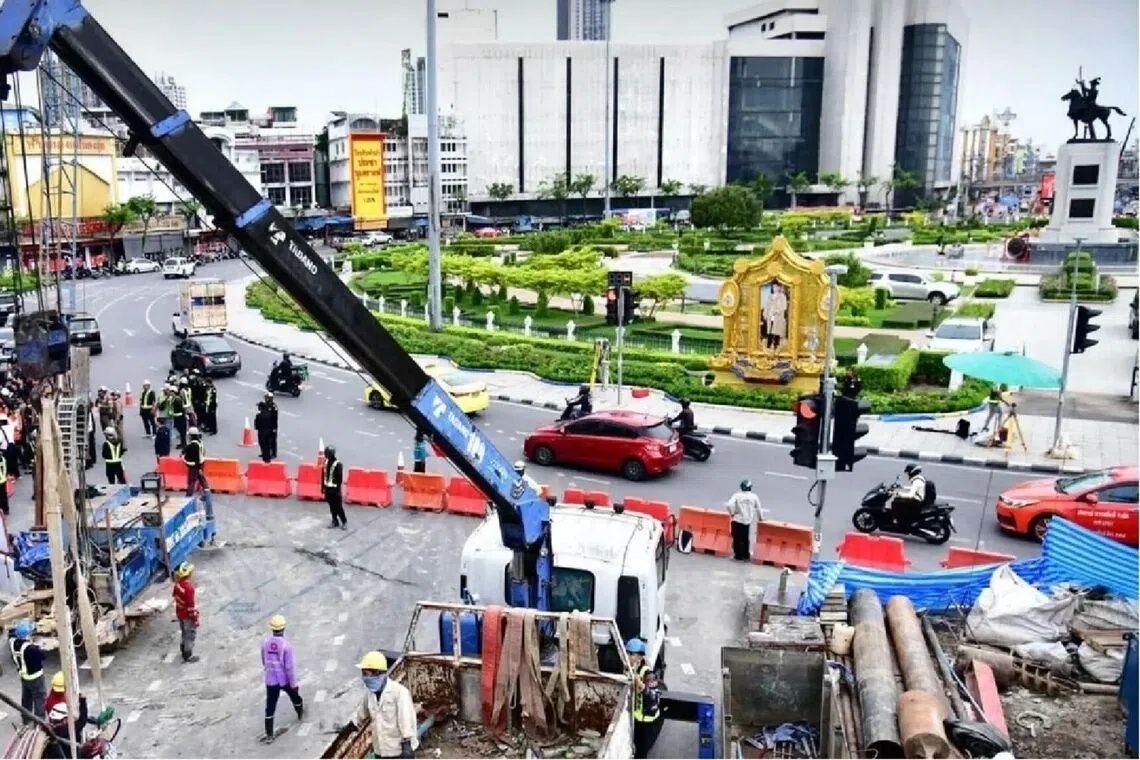
About 60 residents from three commercial buildings in Bangkok have been moved to temporary accommodation following a ground collapse linked to the Purple Line subway extension project near Wongwian Yai. The subsidence, discovered on July 9, stemmed from water infiltration into a drainage sump at the southern tunnel's lowest point, which allowed surrounding soil to erode into the underground structure. Bangkok governor Chadchart Sittipunt visited the site alongside deputy governor Wisanu Subsompon and other senior officials to assess the situation and coordinate response efforts.
The incident occurred along Prajadhipok Road between Ban Khaek intersection and Wongwian Yai, prompting authorities to close approximately 200 metres of outbound traffic lanes as a safety precaution. This extended closure reflects concerns that ongoing traffic vibration could destabilise the surrounding soil further or compromise the structural integrity of nearby buildings. Two inbound lanes have been converted temporarily to accommodate outbound traffic, creating significant disruption in an area already prone to congestion.
The evacuated residents, comprising occupants of three commercial structures within 30 metres of the damaged road surface, are expected to remain in temporary accommodation including hotels for roughly one week. The Mass Rapid Transit Authority of Thailand's contractor has agreed to cover all accommodation costs, compensation payments, and associated expenses during this period. Authorities have made clear that residents will not be permitted to return until engineers confirm that buildings and surrounding infrastructure meet safety standards.
To mitigate further risk, the Department of Disaster Prevention and Mitigation has installed two advanced monitoring units called Rescue Guardian devices on buildings proximate to the affected area. These real-time sensors continuously measure tilting and structural displacement, transmitting data to a centralised monitoring system that triggers immediate alerts if abnormal movement occurs. The sensors were strategically positioned within 30 metres of cracks observed in the road surface, allowing authorities to detect any developing problems before they escalate.
Engineers from Thailand's national Urban Search and Rescue team have joined inspections to evaluate structural conditions and ensure response measures comply with engineering standards and public safety requirements. A forward command centre has been established near the subsidence point to coordinate work across the Bangkok Metropolitan Administration, the MRTA, the contractor, district authorities, police, and emergency response teams. Rescue foundations and volunteers remain on standby to provide medical assistance if needed, while generators, lighting equipment, and specialised machinery support round-the-clock operations.
Authorities have reported that water levels and subsidence rates have begun stabilizing, though monitoring continues without interruption. The immediate priority involves sealing the water leak to prevent additional soil from flowing into the tunnel structure. Engineers are continuously tracking road surface conditions, soil movement patterns, water leakage rates, and building stability to detect any deterioration that might require intensified intervention.
The troubled section is part of the same southern Purple Line alignment where an earlier road collapse occurred near Vajira Hospital, though different contractors supervise each segment. This repetition of construction-related subsidence incidents raises questions about oversight mechanisms and the adequacy of geological surveys conducted before tunnelling commences in densely populated urban areas. The recurring nature of such failures suggests systemic issues requiring examination beyond immediate crisis response.
Prajadhipok Road serves as a major transportation corridor feeding through a significant bottleneck near substantial educational institutions, including Suankularb Wittayalai School and Suksanari School. The extended closure creates substantial disruption during school hours, forcing parents to navigate alternative routes or modify daily routines. Governor Chadchart has indicated that Bangkok may introduce additional school shuttle services, mirroring measures adopted after the Vajira Hospital subsidence, to reduce vehicular traffic in the affected zone.
Motorists have been directed to turn at Ban Khaek intersection and instead utilise Itsaraphap, Lat Ya, or Somdet Chao Phraya roads. These alternative routes, however, lack the capacity efficiency of Prajadhipok Road and typically experience heightened congestion during peak periods. Authorities acknowledge the longer-term traffic impact remains uncertain until engineers determine how extended the road closure must be sustained.
The incident underscores the operational challenges confronting Bangkok as it expands its mass transit network through established residential and commercial neighbourhoods. Underground construction in densely built environments demands rigorous hydrogeological assessment, robust prevention systems, and contingency protocols. The reliance on post-incident monitoring rather than preventative engineering suggests that improved pre-project planning and risk mitigation could reduce such disruptions to residents and commuters across the metropolitan region.
Restrictions on building access and road usage will be progressively eased only after engineers provide formal certification that structural integrity has been restored. The timeline for these determinations remains unclear, leaving evacuated residents in protracted uncertainty about when they can resume normal activities. Officials will announce further traffic arrangements once the duration of the closure becomes apparent, a timeline that may extend well beyond the initial one-week estimate provided to displaced residents.

