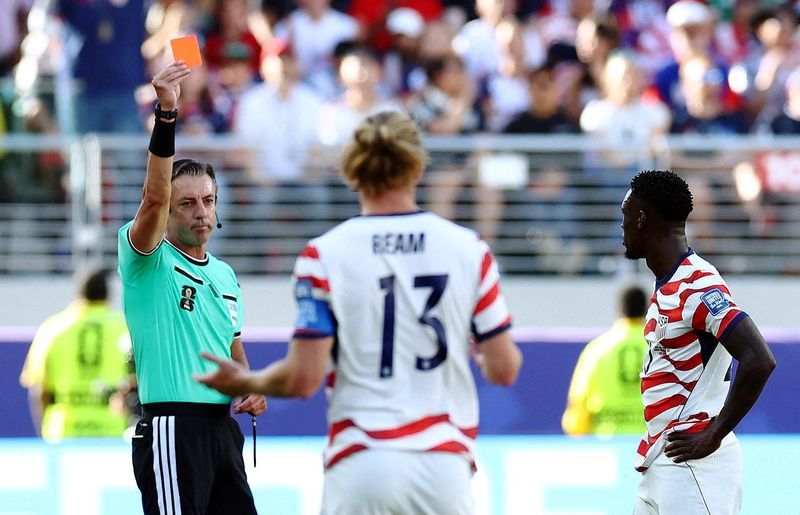
The fallout from FIFA's decision to allow United States forward Folarin Balogun to play despite incurring a World Cup red card threatens to erode public confidence in football's regulatory frameworks, according to Premier League officials. Howard Webb, head of Pro Ref, and chief executive Richard Masters both warned that the controversy surrounding Balogun's suspension could extend well beyond the global tournament and contaminate the domestic season that commenced on Friday.
The dismissal of the American striker became one of the most divisive moments of the World Cup after U.S. President Donald Trump publicly intervened in the matter. FIFA subsequently lifted Balogun's ban through a disciplinary process that observers and officials criticized for lacking transparency and appearing to be established retroactively solely to address this specific case. The sequence of events created a narrative that appeared to contradict established principles of fair play and institutional independence that underpin the sport.
Webb, who previously refereed the 2010 World Cup final, expressed particular alarm not about disagreements over the original decision itself, but rather about the perception and precedent established by how FIFA subsequently handled the appeal. He acknowledged that political pressure had been openly applied by a government official and that the subsequent suspension reversal proceeded through mechanisms that appeared not to have existed before the tournament began. This visibility of external influence, Webb suggested, represented a fundamental departure from how footballing matters ought to be resolved.
The timing of this controversy compounds existing challenges facing modern football's officiating systems. Webb noted that controversial decisions are increasingly characterized online as evidence of systemic corruption, regardless of factual foundation. Social media discourse often attributes improper motives to officials without evidence or substantiation, and the Balogun incident provides what critics perceive as concrete validation for such suspicions. By allowing a decision to be reversed apparently due to political pressure, FIFA inadvertently provided ammunition to those inclined to question whether similar behind-the-scenes influences regularly affect other matches and competitions.
Webb expressed deep concern that this narrative could poison perceptions throughout the upcoming Premier League season, during which every significant refereeing decision and VAR intervention will likely face intense public scrutiny. The episode, in his assessment, signals to fans that external pressure can successfully override established regulations—a perception that fundamentally undermines institutional credibility. He emphasized that in his professional experience such corruption does not occur with regularity, yet the Balogun precedent makes it increasingly difficult to convince a skeptical public of that reality.
Masters similarly lamented that discourse surrounding the World Cup had become dominated by governance and ethical concerns rather than celebrating the quality of football displayed. He pointed out that conversations should centre on Spain's dominant performance and England's heartbreaking semi-final defeat, yet instead public attention fixated on off-field controversies. This displacement of focus from sporting achievement to administrative failures represents a significant loss for the game's broader reputation and public engagement.
The Premier League executive also highlighted structural deficiencies within FIFA's disciplinary architecture that the Balogun incident exposed. Unlike many domestic competitions, FIFA's regulations do not provide mechanisms to review or overturn red card decisions through standard appeals processes. This absence created a regulatory vacuum that FIFA filled with an improvised solution, establishing the problematic precedent that suspensions could be suspended if sufficient external pressure materialized. Masters characterized the situation as uniquely difficult to comprehend and inherently corrosive to institutional legitimacy.
As English football enters a new season with heightened attention to officiating standards, Webb's concerns resonate with practical implications for match management. The Premier League will implement an unprecedented suite of new laws designed to reduce time-wasting and accelerate match tempo. These regulatory changes will themselves generate considerable debate and scrutiny from fans, players, and managers accustomed to previous standards. Webb acknowledged that referees will issue fewer warnings and penalize infractions more consistently, requiring players to adjust tactical approaches accordingly. The cumulative effect should be matches with fewer stoppages and more continuous play, though the adjustment period will inevitably produce friction.
For Malaysian and broader Southeast Asian football audiences, the Balogun controversy carries particular resonance regarding governance and institutional reliability. Asian football confederations and domestic leagues frequently struggle with questions about administrative transparency and perceived favoritism. The Balogun precedent—where visible political pressure successfully overturned a major disciplinary decision—provides an uncomfortable template suggesting that external influence can effectively circumvent established regulations even at football's highest levels. This undermines arguments that institutional reform and regulatory strengthening can genuinely protect competitive integrity if political will can simply override formal processes.
Webb's warnings about social media amplification of corruption narratives also reflect evolving challenges for global football governance. Digital platforms enable rapid dissemination of both legitimate criticism and unfounded speculation, making it exponentially harder for officials and administrators to restore credibility once damaged. The Balogun incident's visibility, combined with its apparent vindication of corruption theories, creates a communications crisis extending far beyond the specific case. Webb suggested that restoring faith requires not merely better refereeing decisions, but fundamental reassurance that external pressure cannot influence regulatory outcomes—a reassurance the Balogun decision fundamentally compromised.
The controversy arrives at a particularly inopportune moment as the Premier League emphasizes expanded officiating authority through new laws and continuing VAR implementation. Officials already face public skepticism regarding technology's application and interpretation consistency. Adding concerns that regulatory decisions respond to political pressure rather than sporting principles creates a compounded credibility deficit. Webb's position as Pro Ref's head means these concerns originate from within football's officiating establishment itself, lending them particular weight and suggesting that internal confidence in institutional independence has been genuinely shaken by FIFA's handling of the Balogun matter.
Looking forward, the challenge extends beyond managing individual controversial decisions. Football's regulatory bodies must reestablish demonstrable independence from external pressure and ensure that disciplinary processes operate transparently according to pre-established criteria. The Balogun precedent suggests this work remains incomplete, and Webb's expressed concern that public trust will deteriorate throughout the season reflects his professional assessment that FIFA's decision has inflicted genuine reputational damage extending well beyond a single player's competition eligibility.

