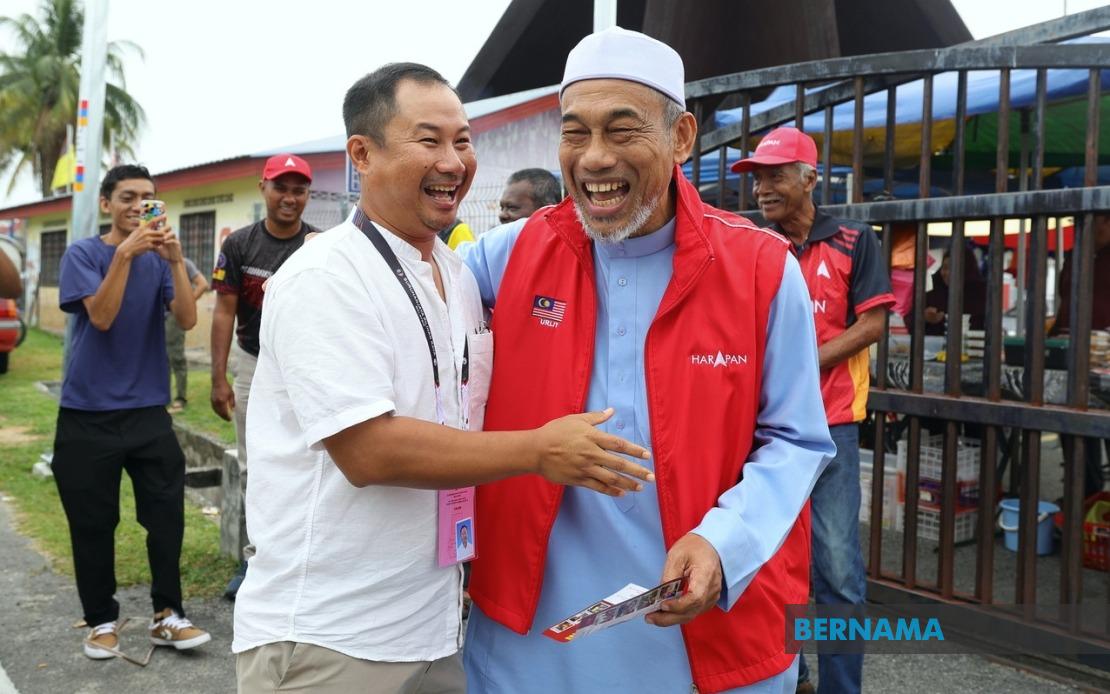
Datuk Bakri Sawir, the Pakatan Harapan candidate defending the Klawang state seat, is entering the 16th Negeri Sembilan State Election with a fundamentally different campaign strategy from his rivals: his proven tenure as a two-term assemblyman. The 67-year-old incumbent, first elected in 2018, has built his political platform on the premise that sustained presence and direct engagement matter more than periodic campaign appearances, a philosophy that appears designed to distinguish him in a three-cornered contest.
Bakri's campaign centres on what he describes as a people-centric philosophy that has guided his tenure since entering office six years ago. During campaigning at Pekan Kuala Klawang's weekly market, he articulated a vision of politics as service rather than transactional engagement. This framing is particularly relevant in Klawang, where the constituency encompasses fewer than 14,000 voters, a scale that theoretically enables more granular constituent relationships than larger urban seats. His assertion that he remains accessible to residents at all times reflects his decision to reside within the constituency throughout his tenure, a factor that distinguishes him from representatives who maintain distant service offices.
The incumbent's operational approach inverts conventional service delivery logic. Rather than establishing a centralised constituency office where residents queue for assistance, Bakri has institutionalised door-to-door engagement, visiting constituents' homes to deliver support directly. This methodology requires significantly more time investment but creates persistent visibility and personal relationships that become difficult for challengers to replicate. In an election environment where polling day falls on August 1, with early voting on July 28, the established connections Bakri claims to have cultivated represent a potential structural advantage over first-time candidates.
However, Bakri's campaign also implicitly acknowledges the limits of grassroots presence alone by highlighting development aspirations that extend beyond service delivery. His long-standing proposal to establish Universiti Malaysia Negeri Sembilan represents transformative infrastructure that would fundamentally alter Jelebu's human capital trajectory, yet financial constraints have prevented realisation. This disconnect between ambition and feasibility reveals a tension in his campaign narrative: while accessibility and direct service distinguish his incumbent record, the absence of major institutional development during two previous terms might invite questions about implementation capacity or resource allocation dynamics.
The proposed Rest and Recreation Area in Tembun, Hulu Klawang, and the planned transformation of Bukit Tajali into a recreational park reflect more achievable development objectives. These infrastructure projects target tourism and leisure economics, a strategic pivot given Malaysia's broader emphasis on domestic tourism revenue following pandemic disruptions. By positioning Klawang as a viable stopover destination with improved facilities, Bakri frames development through an immediate economic benefit lens that contrasts with aspirational institutional proposals. The logic suggests that incremental infrastructure improvements create tangible local economic opportunities before larger transformational projects become feasible.
Agrotourism development incorporating the British Memorial Stone represents another strategic element, connecting historical heritage with rural economic diversification. Jelebu's agricultural identity positions it naturally for agrotourism ventures, yet such initiatives require coordinated investment across private and public sectors. Bakri's framing of these projects as continuations of ongoing efforts suggests implementation timelines extending beyond a single electoral cycle, indicating constituent expectations for sustained commitment rather than immediate results.
The electoral contest itself reflects broader Negeri Sembilan political dynamics. Bakri faces challenges from Danni Rais, 38, representing Perikatan Nasional, and Muhammad Adib Musa, 25, from Bersatu, creating a three-way competition where vote distribution becomes strategically crucial. The youth of his challengers—particularly Musa at 25—contrasts markedly with Bakri's 67 years, potentially framing the race as experience versus generational renewal. In a constituency with fewer than 14,000 voters, the margin between first and third place likely determines outcomes, making swing voters and turnout mechanics particularly significant.
Bakri's articulation of political purpose reveals philosophical positioning beyond typical electoral messaging. His invocation of making "politics an act of worship and a path to paradise" positions public service within Islamic moral frameworks, addressing Malaysian voters for whom religious consistency in leadership carries weight. This rhetorical positioning respects diverse political choices while defending his own commitment, avoiding confrontational language that might alienate undecided voters evaluating candidates across partisan lines.
The Negeri Sembilan State Legislative Assembly dissolution on June 5 triggered the current election cycle, with 889,490 registered voters eligible to participate across the state. The electoral body encompasses 867,151 ordinary voters alongside 16,884 military personnel and 5,455 police officers voting early, demographic composition that varies significantly by constituency. Klawang's smaller voter base means individual preference shifts produce proportionally larger outcome changes, suggesting that Bakri's door-to-door engagement specifically targets the persuadable margin.
For Malaysian observers tracking state-level electoral patterns, the Klawang contest illuminates whether incumbency and demonstrated accessibility retain electoral value when challenged by younger, potentially digitally-native candidates. Bakri's campaign implicitly argues that personal relationships and consistent presence transcend generational divides, yet this assumption requires testing against youth voter preferences and urban-rural turnout variations within the constituency. His emphasis on living within Klawang and maintaining constant accessibility stands as his distinctive positioning, potentially decisive if constituent surveys reveal that accessibility and responsiveness outweigh other candidate attributes.
Looking forward, outcomes in Klawang may signal broader state patterns regarding whether Pakatan Harapan maintains constituency strongholds through incumbent advantage or whether Perikatan Nasional and Bersatu can mobilise voter coalitions across Negeri Sembilan. The seat itself, with its smaller electorate and Bakri's demonstrated community engagement over two terms, represents territory where incumbency theoretically carries maximum weight. Yet the presence of organised opposition from both PN and Bersatu suggests that voter satisfaction with incumbent performance may face genuine challenge, making the election outcome less predetermined than raw incumbency analysis might suggest.

