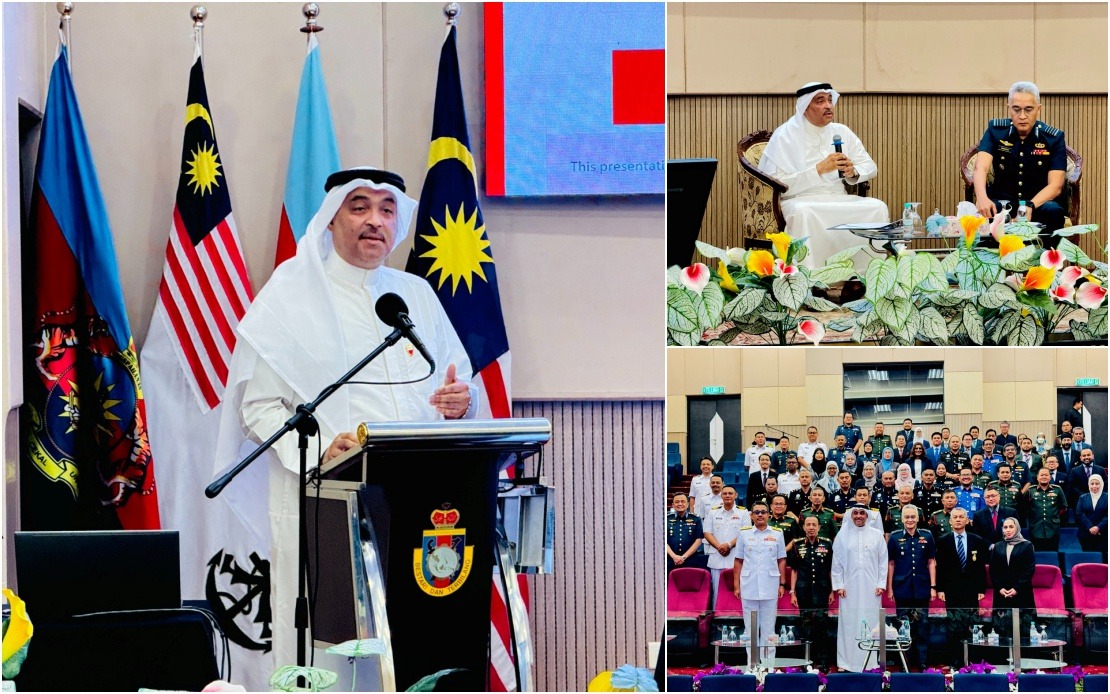
The relationship between Bahrain and Malaysia is entering a deeper phase of engagement, with both Gulf and Southeast Asian nations moving beyond traditional bilateral arrangements to forge what officials describe as a genuine strategic partnership. Speaking at the National Resilience College in Putrajaya, Bahrain's Ambassador to Malaysia Dr Waleed Khalifa Al Manea articulated a vision of expanded collaboration that touches security, diplomatic coordination, and even sporting spectacle, reflecting the broadening nature of contemporary state-to-state relations in an increasingly interconnected world.
The foundation for this intensifying partnership rests squarely on the personal rapport between the two monarchs. King Hamad bin Isa Al Khalifa of Bahrain and Sultan Ibrahim of Malaysia have established a warm working relationship that translates into concrete policy directives from their respective governments. Equally important are the parallel efforts of Crown Prince and Prime Minister Prince Salman bin Hamad Al Khalifa and Malaysia's Prime Minister Datuk Seri Anwar Ibrahim, whose administrations are tasked with operationalising the royal vision through practical initiatives across multiple sectors. This dual-track approach—combining high-level political commitment with technocratic implementation—has become the hallmark of successful bilateral partnerships in the modern era.
Among the most visible expressions of this deepening bond is Malaysia's commitment to hosting the 2026 Formula 1 Gulf Air Bahrain Grand Prix. While Formula 1 partnerships might appear purely commercial on the surface, they carry significant diplomatic weight in contemporary international relations. Such major sporting events serve as platforms for national branding, economic engagement, and people-to-people exchange. For both nations, the arrangement signals mutual recognition of shared interests and a willingness to collaborate on projects of regional significance. The symbolism extends beyond the racetrack, effectively anchoring Bahrain within Malaysia's strategic calculus even as geographic distance and regional differences might suggest otherwise.
The substance of bilateral cooperation extends far into the realm of regional security architecture, a domain increasingly critical for Southeast Asian nations as geopolitical tensions in West Asia ripple across global trade routes and international stability. Al Manea's presentation at Malaysia's premier defence education institution underscored Bahrain's perspective on the evolving security landscape affecting the broader Indo-Pacific region. The ambassador detailed how the kingdom approaches the intersection of sovereignty defence, civilian protection, factual documentation, and diplomatic problem-solving—four pillars that reflect sophisticated statecraft in an environment of competing pressures and limited options.
The Middle Eastern context that shapes Bahrain's strategic thinking involves complex regional dynamics centred on the Gulf Cooperation Council and its relations with neighbouring powers. Recent Iranian military actions against GCC member states have created cascading security concerns that extend well beyond the immediate region. The targeting of civilian infrastructure, maritime navigation routes, and vital installations represents a category of challenge that demands coordinated international response rather than isolated national reactions. For Bahrain, positioned at the intersection of these tensions, the stakes are existential. The kingdom has moved beyond rhetorical concern to active diplomacy, leveraging its presidency of the UN Security Council in April to advance concrete measures protecting critical infrastructure and ensuring freedom of navigation—rights upon which global commerce depends.
Malaysia's position on these Middle Eastern developments carries weight precisely because Southeast Asian nations maintain delicate balancing acts between powerful actors while depending on stable international shipping lanes for economic survival. The Strait of Malacca and other vital waterways through which Malaysian trade flows rely on secure passage and predictable international law. This shared vulnerability creates natural common ground between Bahrain and Malaysia, despite their geographic separation. When Malaysia co-sponsored UN Security Council Resolution 2817, affirming the sovereignty of affected states and demanding an end to attacks on civilian infrastructure, the decision reflected not mere diplomatic courtesy but genuine alignment of national interests.
The lecture format chosen for Al Manea's remarks—delivered to Malaysia's National Resilience College during the institution's Executive Week Programme—signals the seriousness with which both governments view this intellectual exchange. The audience assembled included Major General Dr Abdul Karim Ahmad and other senior military commandants, Members of Parliament, defence ministry representatives, and regional security specialists. This gathering of Malaysia's defence and security establishment underscores that Bahrain's message carried weight beyond standard diplomatic courtesy. The kingdom's insights into regional security challenges, coupled with its experience managing complex geopolitical pressures, offer valuable lessons for ASEAN nations navigating similar terrain.
The ramifications of West Asian instability for Southeast Asia remain underappreciated in mainstream regional discourse. Trade disruptions in the Gulf region inevitably affect supply chains that feed Malaysian industries. Energy security concerns emanating from the Middle East influence regional economics and policy priorities. Moreover, maritime security challenges originating in the Persian Gulf establish precedents and practices that eventually ripple into Southeast Asian waters. By deepening ties with Bahrain and other Gulf actors, Malaysia positions itself not merely as a passive observer of Middle Eastern developments but as an active participant in shaping regional responses to transnational security challenges.
The breadth of cooperation between Bahrain and Malaysia extends across economic, educational, and defence dimensions, creating resilient bilateral ties less vulnerable to fluctuations in any single sector. This diversified approach reflects mature statecraft, moving away from transactional relationships toward genuine partnerships built on complementary interests and shared values. Both nations embrace multilateralism as a framework for addressing complex challenges, both maintain commitment to international law and UN processes, and both seek to preserve regional stability through diplomatic channels rather than military confrontation.
Looking forward, the Bahrain-Malaysia partnership appears positioned to deepen further as regional circumstances evolve. The 2026 Formula 1 Grand Prix represents merely a single visible marker on a trajectory toward expanded engagement. Behind the headlines lie quieter work in defence cooperation, intelligence sharing, maritime coordination, and diplomatic consultation. The establishment of this strategic partnership during a period of significant regional turbulence suggests that both governments recognize the necessity of building alliances capable of weathering extended periods of uncertainty and tension. For Malaysia, deepening ties with Gulf states like Bahrain offers strategic hedging opportunities and expanded diplomatic leverage in an increasingly multipolar international system.

