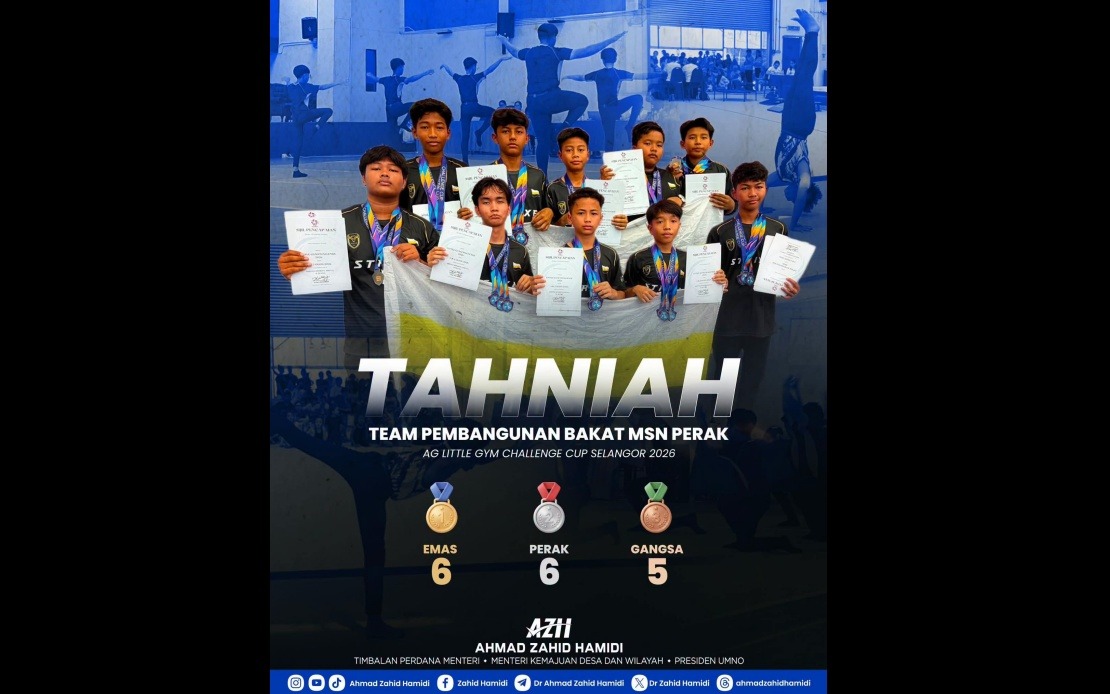
Young gymnasts representing Bagan Datuk have achieved a historic milestone at the AG Little Gym Challenge Cup Selangor 2026, securing six gold medals alongside six silver and five bronze medals in competitions held on August 1 in Kajang. The accomplishment marks a significant success for the district's sporting development programme and has drawn recognition from prominent political figures and local sporting organisations.
Deputy Prime Minister Datuk Seri Dr Ahmad Zahid Hamidi, who represents Bagan Datuk in Parliament, publicly celebrated the athletes' performance through social media, underscoring the significance of the achievement for his constituency. His endorsement reflects broader interest within Malaysia's political leadership in grassroots sports development and the potential of young talent emerging from smaller districts to compete at regional levels.
In his remarks, Ahmad Zahid emphasised that the success demonstrated the multifaceted capabilities of Bagan Datuk's youth population. He framed the gymnasts' achievement not merely as a sporting victory but as evidence that young people from the district possess both academic strength and athletic prowess when provided with adequate resources, expert coaching, and parental backing. This framing aligns with broader national discourse about developing well-rounded youth who can contribute to Malaysia's competitive position in regional sports.
The Bagan Datuk Generasi Muda Gymnastics Club shared further details about the competition through their own announcement, highlighting the dedication required to achieve medal success at such events. Their statement acknowledged the individual contributions of each gymnast while also recognising the collective effort of coaches and supporting families whose commitment proved essential to competitive performance.
The club's messaging emphasised that individual medals represented thousands of hours of training, disciplined practice schedules, and mental resilience. This perspective provides insight into the infrastructure supporting young athletes in developing districts, where gymnastics clubs operate with limited resources compared to urban centres but nonetheless produce competitive results. The success suggests that effective coaching and community-level support systems can partially compensate for resource disparities.
The Bagan Datuk team's performance at the Selangor-level competition carries implications for how Malaysia's sports development framework operates outside major metropolitan areas. Gymnastics remains a discipline requiring specialised facilities and qualified coaching, elements that are typically concentrated in larger cities. The ability of a district-based club to produce medal-winning performances indicates either significant local investment in sports infrastructure or particularly effective coaching methodology.
For young athletes in smaller Malaysian towns, this achievement provides tangible evidence that competitive success remains attainable despite geographic or economic disadvantages. Regional competitions such as the AG Little Gym Challenge Cup serve an important developmental function by offering platforms where athletes from across Selangor can benchmark their abilities and gain experience competing against diverse opponents, building confidence for potential progression to state or national levels.
The political dimension of Ahmad Zahid's recognition reflects how sports achievements feed into local identity and constituency pride in Malaysia. Deputies frequently leverage sporting accomplishments by constituents to build community engagement narratives, portraying their representation as facilitating opportunities for local development. In this case, the emphasis on youth excellence serves dual purposes: celebrating genuine athletic achievement while subtly reinforcing the constituency's viability as a location where opportunities and support systems function effectively.
The Generasi Muda Gymnastics Club's stated commitment to continued training and progression indicates that this victory is positioned as a stepping stone rather than a culmination. Such messaging is common in sports clubs seeking to maintain momentum and encourage continued participation among young athletes. However, sustaining this upward trajectory requires consistent access to competitive opportunities, coaching expertise, and facilities—resources that remain unevenly distributed across Malaysia.
Gymnastics as a sport has experienced growing popularity in Malaysia over recent years, with increased participation at school and club levels. Young athletes from districts like Bagan Datuk competing successfully at regional championships contributes to this expansion and may inspire neighbouring districts to establish or strengthen their own gymnastics programmes. The ripple effects of such grassroots success often extend beyond individual medals, influencing sports culture and participation rates in surrounding communities.
The specific medal breakdown achieved by the Bagan Datuk team—six gold, six silver, and five bronze across multiple events and age categories—suggests a programme with depth across various gymnastic disciplines rather than concentrated strength in single events. This breadth indicates a comprehensive coaching approach and diverse talent development within the club, positioning it favourably for sustaining competitive performance across multiple future competitions.
Looking forward, maintaining this standard of achievement will depend on factors including coaching continuity, facility quality, funding for competitions and training camps, and the ability to retain promising young athletes within the programme. Malaysian sporting bodies increasingly recognise that identifying and nurturing talent at district level produces better long-term outcomes for national sporting development than concentrating resources exclusively on elite-level athletes. The Bagan Datuk gymnastics team exemplifies this developmental pathway, transforming grassroots participation into measurable competitive success.

