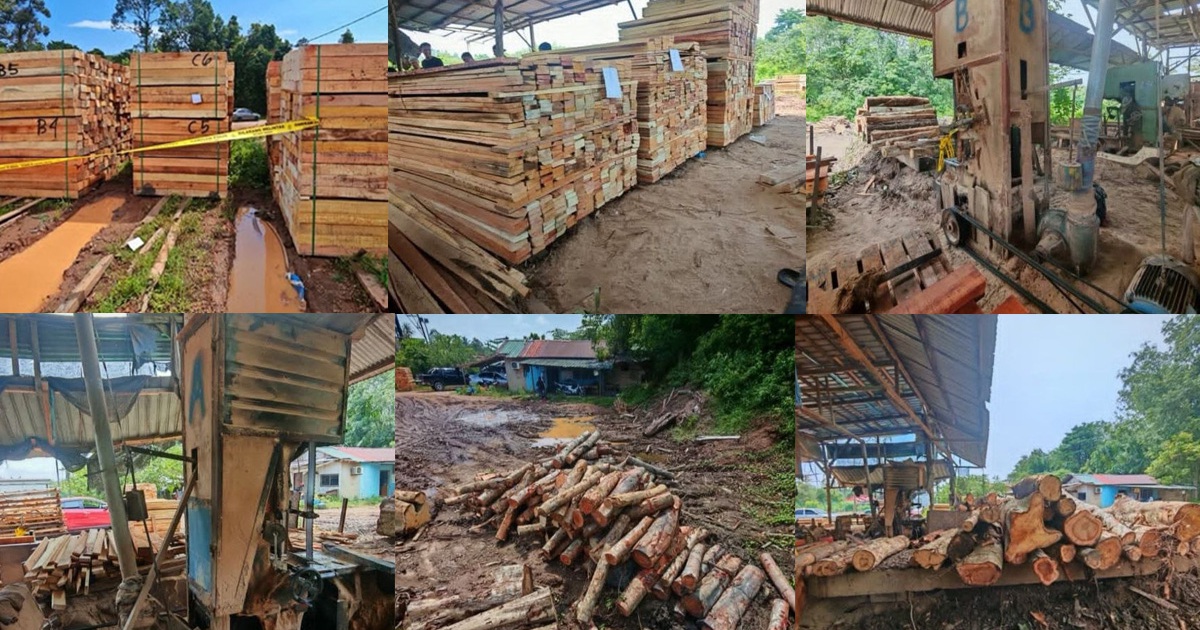
Law enforcement officers in Kelantan have intensified their crackdown on illegal timber operations, detaining four individuals including a sawmill proprietor and three employees following a coordinated operation at an unlicensed processing facility in Kampung Bukit Kechik, Tanah Merah. The action represents part of a broader regulatory push to curb unauthorised forestry activities that have long plagued the timber-rich state, draining government revenue and undermining sustainable resource management.
The enforcement team confiscated substantial quantities of processed timber alongside industrial machinery valued collectively at RM600,000, signalling the scale of operations that state authorities have been targeting through enhanced surveillance and intelligence gathering. The seizure represents a significant disruption to what appears to have been an established unlicensed enterprise operating in the region. Such operations often flourish in rural areas where monitoring proves challenging, particularly in Kelantan where forestry remains a significant economic sector but enforcement capacity has historically been stretched.
Unlicensed sawmill operations constitute a particularly problematic category of forest crime, as they often process timber sourced from irregular channels or without proper authorisation. Beyond the direct revenue loss to the state through unpaid licensing fees and taxes, these enterprises frequently operate with minimal regard for environmental regulations, labour standards, and safety protocols. The processing waste generated by unlicensed facilities often contaminates local waterways and soil, creating externalities that communities bear without compensation.
Kelantan's natural resource endowment has historically made it vulnerable to timber-related infractions. The state possesses significant forest reserves and a well-established timber industry infrastructure, creating conditions where illegal operators can more easily blend into legitimate commercial landscapes. However, mounting pressure from federal authorities and international scrutiny regarding sustainable forestry practices has prompted state-level agencies to strengthen enforcement mechanisms. This particular raid reflects those intensifying efforts to demonstrate regulatory commitment.
The arrest of the sawmill operator carries particular significance, as proprietors typically hold responsibility for licensing compliance and operational standards. Their detention suggests investigators may pursue charges beyond mere unlicensed operation, potentially including environmental violations or labour infractions depending on conditions found at the facility. The three workers apprehended may face lighter charges if evidence indicates they were simply employed without knowledge of the unlicensed status, though this remains subject to investigation and prosecutorial discretion.
For Malaysian stakeholders in the timber industry, such enforcement actions carry mixed implications. Legitimate sawmill operators may view these raids positively as efforts to eliminate unfair competition from unlicensed enterprises operating without compliance costs. However, some industry representatives express concern that enforcement focus sometimes falls on larger visible operations while smaller informal mills escape detection. The configuration of this particular raid—targeting a single medium-scale facility rather than a network of operations—suggests enforcement may remain reactive rather than following systematic strategic planning.
The RM600,000 asset seizure underscores the financial dimensions of timber crime in Malaysia. Unlike high-profile drug enforcement actions, forest and timber crimes rarely receive equivalent public attention despite comparable economic significance. A single unlicensed sawmill can generate substantial turnover, with confiscated stocks representing perhaps only a fraction of annual processed output. This suggests multiple similar operations likely continue functioning across Kelantan and neighbouring states, constrained primarily by periodic enforcement interventions rather than systemic prevention.
Regional context adds complexity to Malaysia's timber enforcement challenges. The country's position within the global timber trade, combined with cross-border dynamics within Southeast Asia, creates pressure for strengthened domestic controls. International buyers increasingly demand certification of legal origin for timber products, making documented compliance increasingly essential for Malaysian exporters. Unlicensed domestic operations undermine the collective credibility of Malaysia's timber sector internationally, potentially affecting legitimate enterprises' access to premium markets and reducing long-term competitiveness.
The Tanah Merah operation reflects coordination between state and federal enforcement bodies, though the institutional framework governing such cooperation varies across Malaysia's states. Kelantan maintains its own forestry department and state wildlife authority, which coordinate with federal entities including the Department of Environment and the Royal Malaysian Police. The effectiveness of these inter-agency operations depends considerably on resource allocation, information sharing protocols, and political priority assigned to forestry enforcement relative to competing security concerns.
Looking forward, this enforcement action may prompt facility operators elsewhere to improve their licensing status or curtail operations, though deterrent effects depend partly on perceived prosecution likelihood and penalties imposed. Malaysian courts have demonstrated variable sentencing approaches to forest crimes, with some convictions resulting in minimal fines relative to operational profits. Stronger deterrence would likely require consistent prosecution of proprietors combined with substantial penalties exceeding the financial benefits of illegal operation.
The raid also highlights persistent challenges in monitoring dispersed small-to-medium enterprises across Kelantan's landscape. Satellite imagery and field intelligence gathering remain resource-intensive, and many illegal operations maintain low profiles through careful siting and operational discretion. Sustainable enforcement improvement would benefit from community reporting mechanisms and incentive structures rewarding information provision, alongside technological solutions like GPS tracking of timber movements and automated licensing verification systems.
Citizens and industry observers in Malaysia and across Southeast Asia will monitor whether this enforcement initiative represents sustained commitment to timber sector regulation or constitutes an isolated action responding to particular circumstances or political pressures. The trajectory of similar operations in coming months will indicate whether Kelantan and federal authorities have substantially upgraded their forest crime capabilities or whether enforcement intensity will revert to historical patterns once immediate attention fades.

