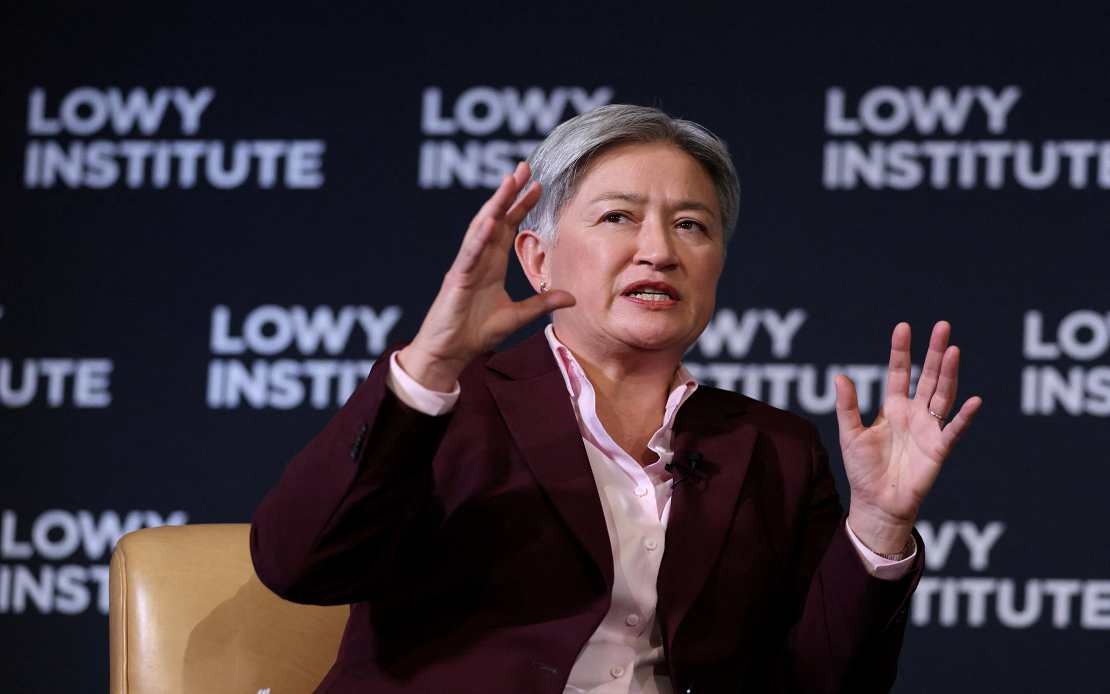
Australia's Foreign Affairs Minister Penny Wong has issued a stark warning about the dangers of monoculturalism, arguing that abandoning the nation's multicultural identity would cripple its economic prospects and geopolitical influence. Speaking at the Lowy Institute in Sydney on Friday, Wong characterised calls for a homogeneous society as a "melancholic fantasy" that would fundamentally weaken Australia's position in an increasingly interconnected world.
The minister's remarks represent a significant pushback against populist voices gaining traction across the country, particularly Senator Pauline Hanson and her One Nation party. Hanson made headlines in June when she declared that Australia must become a monocultural nation, a position that resonates with a segment of the electorate anxious about demographic and cultural change. Wong's speech appears calculated to reframe this debate away from nostalgia and toward pragmatism, arguing that Australia's competitive advantage derives directly from its ability to bridge cultures and maintain global partnerships.
Wong elaborated on the concrete costs of monoculturalism, suggesting that such a shift would force Australia to "curtail our choices" and sever the commercial and diplomatic networks essential to national prosperity. She warned that retreating into cultural isolation would leave Australia friendless in international affairs, stripped of trading partners, and deprived of the innovations and growth opportunities that flow from global cooperation. This framing positions multiculturalism not as an ideological choice but as a strategic necessity in an era when supply chains, talent flows, and investment are inherently transnational.
One Nation's electoral momentum presents a genuine challenge to Australia's political establishment. According to YouGov Australia polling from July, support for Hanson's party has surged to 26 per cent of voters intending to support it at the next election, a dramatic jump from the 6.4 per cent One Nation received at the 2025 election. This fourfold increase in stated support reflects significant voter dissatisfaction and suggests that anti-immigration and nationalist messaging has gained genuine traction beyond fringe circles.
The polling data indicates broader turbulence in Australian politics. The governing Labour Party, which won the 2025 election with 34.5 per cent of the vote, has seen support contract to 28 per cent, while the opposition Coalition has fallen even more sharply from 31.8 per cent to 20 per cent. This erosion of support for both major parties suggests voters are gravitating toward One Nation and other protest movements, a pattern that mirrors shifts in other Western democracies where anti-establishment parties have capitalised on economic uncertainty and cultural anxieties.
Immigration concerns specifically underpin much of One Nation's appeal. The Lowy Institute's annual poll for 2026, released in June, found that 55 per cent of Australians believe the number of migrants entering the country is too high, an increase from 53 per cent the previous year and 48 per cent in 2024. This upward trajectory reveals deepening public concern about immigration levels, suggesting that Wong's defence of multiculturalism faces headwinds in public opinion. The trend indicates that anti-immigration sentiment is not merely a fringe position but reflects mainstream anxiety about population growth, housing costs, job competition, and social cohesion.
One Nation's policy platform extends beyond immigration restriction. The party has pledged to slash foreign aid, withdraw from multilateral institutions if it reaches power, and fundamentally reorient Australia's international engagement. These commitments reflect a coherent isolationist worldview that stands in direct opposition to the interconnected, institutionally embedded approach that Wong is defending. Should One Nation gain electoral influence or eventually govern, it could dramatically reshape Australia's role in the Asia-Pacific region and beyond.
For Malaysia and the broader Southeast Asian region, Australia's political trajectory carries significant implications. Australia remains a crucial partner in regional security architecture, investment flows, and trade relationships. A shift toward One Nation's isolationist posture could diminish Australian engagement with Southeast Asian economies and weaken the coalition of democracies that counterbalances Chinese regional influence. Malaysian policymakers will be monitoring these developments closely, as Australian disengagement could affect everything from the ASEAN-Australia relationship to bilateral trade arrangements and security cooperation.
Wong's intervention also reflects concern within the Australian foreign policy establishment that domestic political shifts could undermine long-standing strategic commitments. The foreign minister's emphasis on Australia's enduring multicultural character is partly a defence of the institutional and diplomatic consensus that has guided the country's international role for decades. Her appeal to pragmatism rather than ideology attempts to demonstrate that multiculturalism serves national interests rather than merely reflecting progressive values, a rhetorical strategy designed to compete in the language of sovereignty and strength that populists deploy.
The tension between Wong's message and public sentiment points to a deeper challenge facing liberal democracies across the developed world. Even as globalisation has created genuine economic and social dislocations that fuel anti-immigration sentiment, the structural integration of economies and security systems makes wholesale retreat increasingly difficult. Australia's economy depends on trade partnerships, skilled migration, and capital flows; genuine isolationism would impose substantial costs. Yet political actors exploiting grievances need not offer practical alternatives to gain power, only to articulate public frustrations convincingly.
The 2028 election will prove pivotal in determining whether One Nation's current polling strength translates into actual electoral support or whether voters ultimately revert to the major parties. However, regardless of the election outcome, the rightward shift in public opinion on immigration suggests that even if One Nation does not govern, its influence on policy agendas will persist. Future Australian governments, whether Labour or Coalition, will likely need to address immigration and integration issues more directly than in the recent past.
Wong's speech can be read as an attempt to establish intellectual and moral ground ahead of what promises to be a contentious campaign. By positioning multiculturalism as strength rather than vulnerability, and by framing the choice in terms of national competitiveness, she seeks to recast the debate on terms favourable to her government. Whether this rhetorical strategy will prove sufficient to reverse Labour's declining support or to contain One Nation's momentum remains unclear, but her intervention signals that Australia's political establishment recognises the seriousness of the populist challenge and intends to contest it vigorously.

