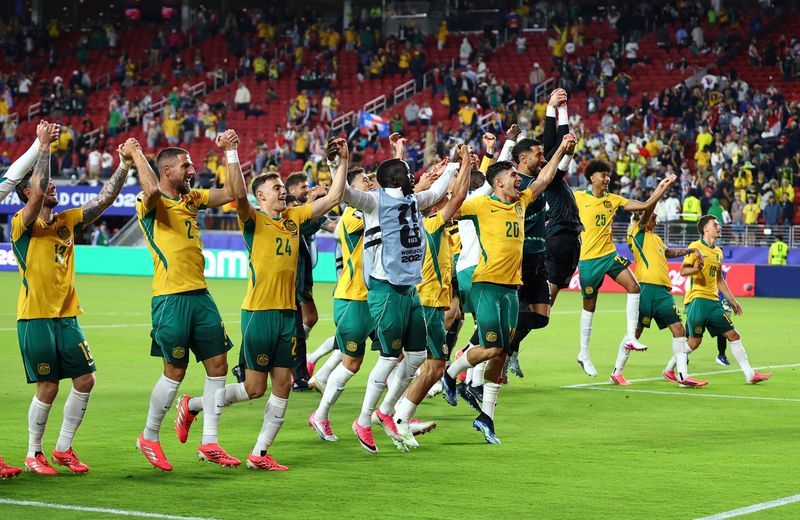
Australia have secured their passage into the World Cup knockout rounds, reaching the last 32 for only the third time in their tournament history after holding Paraguay to a goalless stalemate on Thursday in Santa Clara. The match, contested at San Francisco Bay Area Stadium in the heart of California's Bay Area, proved a tightly contested affair that saw both teams create opportunities without finding the back of the net. The result confirms the Socceroos will face the second-placed team from Group G, a pool that remains tantalizingly open as Egypt, Iran, Belgium, and New Zealand conclude their group fixtures on Friday.
Australian coach Tony Popovic orchestrated an ambitious tactical shift, making six alterations to his starting lineup in a clear statement of attacking ambition. The inclusion of pacey winger Nestory Irankunda and striker Cristian Volpato signalled an intent to press forward against a resilient Paraguayan defensive unit. The restructuring of the backline, with Jordan Bos repositioned from left-back to right-back in place of the injured Jacob Italiano, gave Australia width on the flank they would repeatedly exploit during the opening period of play.
Australia dominated the early exchanges with sustained pressure and territorial advantage. The right flank became a focal point of their attacking strategy, with Bos and Volpato combining to probe Paraguay's defences. In the opening minutes, Volpato delivered a promising opportunity to midfield general Jackson Irvine just inside the penalty area, but the Socceroos captain's angled effort went directly at Paraguay goalkeeper Orlando Gill without troubling him. Late in the first half, both Bos and Volpato tested Gill again, though neither effort could be classified as a genuine scoring opportunity, highlighting Australia's difficulty in converting promising positions into clear-cut chances.
Paraguay's attacking output in the first 45 minutes proved minimal, with Gustavo Alfaro's side content to absorb Australian pressure while seeking opportunities on the break. The South Americans managed just a single shot before halftime, suggesting a tactical approach centred on defensive solidity rather than open play ambition. The introduction of Brazilian-born forward Mauricio at the interval appeared designed to inject greater attacking impetus, and within five minutes of the restart he tested the waters with a long-range effort that drifted harmlessly wide.
The complexion of the match shifted perceptibly as Paraguay grew into the contest during the second half. Julio Enciso, the energetic Paraguayan attacker, became an increasingly influential figure, repeatedly finding space in Australian territory and threatening to unravel their defensive line. The 22-year-old forward's mobility and directness created genuine problems, and in the 82nd minute he squandered one of Paraguay's best opportunities when his low shot flashed well wide of the far post. The miss proved costly, as Paraguay had moved into the ascendancy and appeared to have built momentum heading into the final stages.
Australia mounted a late resurgence that encapsulated the scrappy, physical nature of the encounter. Bos created a moment of genuine excitement in the 89th minute when he burst forward from the right-back position, split two Paraguayan defenders, and charged into the penalty area before sending his shot narrowly across the goal. His attempted finish epitomized Australia's evening—creative movement and determination undermined by a lack of clinical finishing. Mauricio answered with a late chance of his own as the match careened toward its conclusion, finding a pocket of space on the edge of the area but his tame effort posed no real threat to Australian goalkeeper Thomas Glover.
The draw represents a pragmatic outcome for Australia, who emerged from a testing group stage encounter with their qualification secured. Their progression comes four years after reaching the knockout stage at Qatar 2022, establishing a pattern of consistent World Cup participation. The Socceroos' second-place finish behind the tournament's co-hosts United States sets up a likely matchup against Belgium, Egypt, or Iran, depending on outcomes in Group G on Friday.
Paraguay's situation remains considerably more precarious. The 2010 quarter-finalists occupy fourth place in the group standings with four points and must await the outcomes of other group matches to determine whether they have accumulated sufficient points to progress as one of the eight best-finishing third-placed teams. This uncertainty creates significant anxiety for the Paraguayan camp, whose manager Gustavo Alfaro will have to accept that despite a second-half improvement, his team's early lack of attacking ambition may ultimately prove their undoing.
The match reflected broader tournament patterns wherein teams navigate the fine balance between aggressive intent and defensive caution, particularly in situations where multiple outcomes remain possible. Australia's willingness to rotate personnel and seek attacking opportunities, combined with Paraguay's defensive discipline, produced a sterile contest that satisfied neither spectators seeking goals nor analysts searching for tactical innovation. For Malaysian and Southeast Asian audiences, Australia's progression carries added significance within an Asian football context, as the Socceroos represent the regional confederation's most reliable World Cup participants and advance the cause of Asia-Pacific football at the tournament's latter stages.

