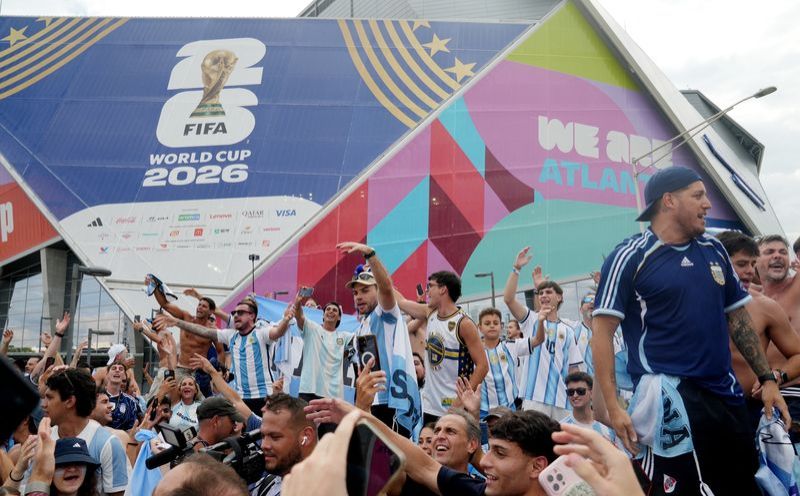
Atlanta's month-long hosting of the 2024 Women's World Cup transformed the American city into a global soccer stage, with moments ranging from Cape Verde's tournament debut to England's dramatic comeback against DR Congo and Argentina's two consecutive comeback victories that propelled them toward the final. The southeastern metropolis, long synonymous with hip-hop culture and African American heritage, found itself marching to an entirely different cadence as international fans converged on its streets and stadiums, their traditional songs, rhythmic chants, and vibrant colours reshaping the urban landscape in unexpected ways.
The path to hosting this prestigious tournament began modestly with an email in July 2017 directed to Dan Corso, president of Atlanta's host committee, inviting the city to participate in the bidding process. Corso recalled the decision-making process as swift and decisive, with the committee moving rapidly from initial contact to formal commitment. What followed was a strategic alignment of existing sporting infrastructure and organisational capacity that would ultimately prove persuasive to FIFA's selection panel, demonstrating how major sporting events reward cities that have already invested in foundational development.
Atlanta's pre-existing credentials as an American soccer hub significantly strengthened its candidacy. The founding of Major League Soccer franchise Atlanta United in 2017, followed by their domestic cup victory in 2018, represented a watershed moment for professional soccer in the region. The team's consistent leadership in MLS attendance figures year after year established the market's genuine appetite for the sport, moving it beyond novelty status into sustained fan engagement. Arthur Blank, who owns both Atlanta United and the NFL's Falcons, further solidified the city's soccer infrastructure by donating $50 million toward the U.S. Soccer National Training Center located just outside the metropolitan area, creating a permanent institutional presence for the sport.
Corse emphasised how these developments functioned as interconnected elements of a broader narrative when presenting Atlanta's case to FIFA evaluators. The combination of a recently successful professional team, record-breaking attendance metrics, and substantial investment in grassroots training facilities created a compelling argument that the city possessed not merely temporary event-hosting capacity but a genuine, durable commitment to soccer development. The presence of U.S. Soccer's administrative headquarters and training infrastructure further reinforced Atlanta's claim to be more than a venue—it was becoming a genuine epicentre for American soccer.
Atlanta's broader track record hosting major sporting events provided additional confidence for tournament organisers. The city had previously played host to the 1996 Olympic Games, establishing its logistical competence in managing complex, multi-site international events. The 2028 Super Bowl, returning to Atlanta for the fourth time, further testified to the city's capacity to absorb and execute events at the highest competitive level. This was no maiden voyage into global event hosting but rather another chapter in a documented history of successful large-scale operations.
The tournament itself delivered substantial impact across eight matches, including three knockout-round contests that culminated in Wednesday's thrilling semi-final clash between Argentina and England. More than 544,000 spectators attended matches across the venue, while the associated Fan Fest attracted over half a million additional visitors during its nineteen-day run. The numbers underscore the genuine grassroots enthusiasm the tournament generated—this was not an event that relied primarily on mandatory attendance or corporate hospitality to fill venues but rather drew organic interest from the broader community.
The volunteer mobilisation reflected similarly impressive participation rates. More than 2,000 residents from Atlanta and Georgia stepped forward to support tournament operations, indicating how the event functioned as a unifying civic project rather than an external imposition. Corso observed that the World Cup appeared to generate connections across the city's diverse neighbourhoods and demographics, providing shared cultural experiences that transcended typical urban fragmentation. For visitors unfamiliar with Atlanta, the tournament offered an opportunity to experience the city's complexity—its cosmopolitan character, its diverse immigrant communities, and its evolving identity beyond historical stereotypes.
Beyond the immediate excitement of matches and fan celebrations, the tournament catalysed infrastructure development with longer-term implications. The host committee, in partnership with local transport authority MARTA and the Soccer in the Streets programme, created a new mini-pitch designed to provide free access to soccer for children throughout the region. This represents not merely a decorative legacy project but rather an institutional commitment to expanding soccer participation among populations that historically lacked access to formal facilities. Such grassroots initiatives often determine whether temporary tournament enthusiasm translates into sustained sporting culture change.
Atlanta's ambitions extend well beyond the 2024 tournament's conclusion. The city is positioned to launch a women's National Women's Soccer League franchise in 2028, introducing a permanent professional team that would complement the existing Atlanta United operation and solidify women's soccer as part of the city's sporting fabric. More ambitiously, Atlanta is actively pursuing hosting rights for the 2031 Women's World Cup, seeking to position itself as a preferred venue for women's international tournaments. This forward-looking orientation suggests that the 2024 tournament served not as a concluding event but rather as a foundation for deepened engagement with soccer development.
For Southeast Asian observers, Atlanta's trajectory offers instructive parallels. Many regional cities harbour aspirations to host major international sporting events as catalysts for development and global visibility. Atlanta's experience demonstrates that successful major event hosting requires pre-existing institutional investment—the infrastructure, the professional teams, the training facilities—before the bidding process even begins. The presence of Atlanta United and the U.S. Soccer training centre were not consequences of World Cup selection but rather prerequisites that made selection conceivable. This sequencing matters considerably for cities throughout Southeast Asia evaluating their own event-hosting ambitions.
Moreover, Atlanta's integration of community participation through volunteering and grassroots programming suggests that tournament success requires genuine local enthusiasm rather than top-down imposition. The 2,000 volunteers and the half-million Fan Fest attendees represent civic buy-in that cannot be manufactured through promotional campaigns alone but must emerge from authentic interest in the sport. Cities seeking to replicate Atlanta's success would need to cultivate similar foundational interest before expecting a major tournament to crystallise public enthusiasm.
As the tournament's immediate echoes fade, Atlanta has positioned itself within a narrative arc of sustained soccer development stretching across multiple years and initiatives. The World Cup served as a accelerant for trends already underway, a validation of investments already made, and a launching point for ambitions yet to be realised. Whether measured by spectator attendance, volunteer participation, or infrastructure development, the 2024 Women's World Cup left Atlanta transformed, with the city's relationship to global soccer fundamentally altered in ways that will likely persist for decades.

