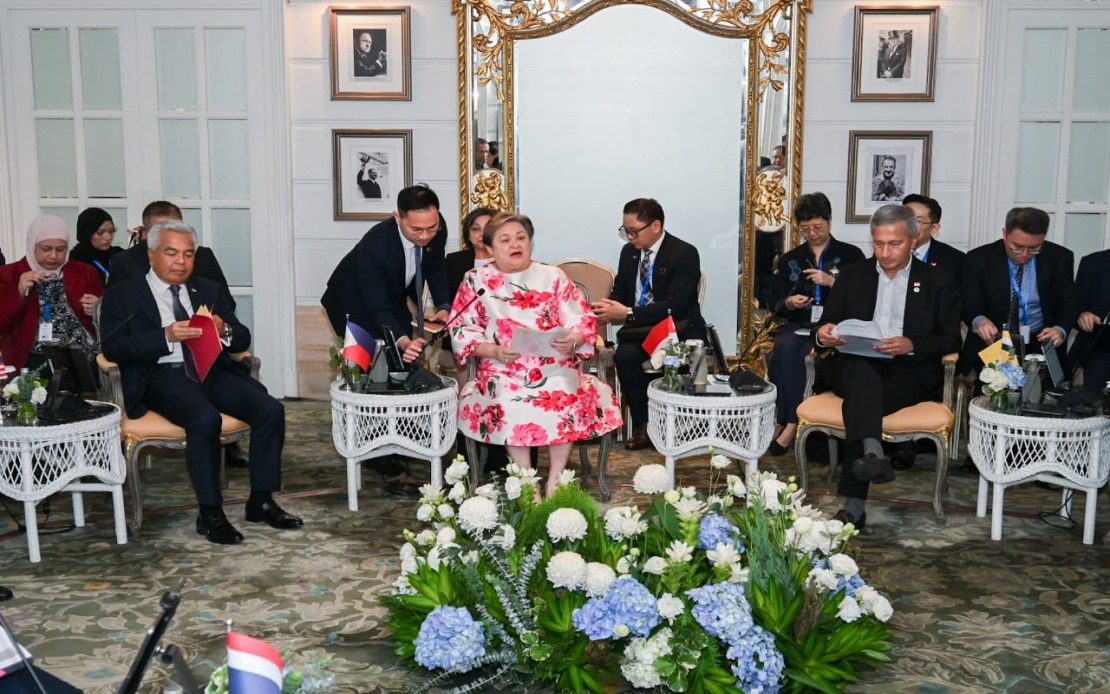
ASEAN foreign ministers have doubled down on the Five-Point Consensus as their primary diplomatic tool for tackling Myanmar's deepening political turmoil, signalling resolve even as the military-backed government in Naypyidaw continues to resist the regional framework. The reaffirmation came during an informal ministerial gathering in Bangkok, marking a significant moment in ASEAN's three-year effort to mediate the crisis that erupted following the February 2021 coup d'état. Philippine Foreign Secretary Maria Theresa Lazaro, serving as ASEAN Chair's Special Envoy on Myanmar, underscored that the consensus document remains non-negotiable for the bloc's engagement strategy, regardless of whether Myanmar's junta embraces or rejects its provisions.
The Five-Point Consensus, originally adopted in April 2021, represents ASEAN's most coherent diplomatic response to Myanmar's turmoil. Its pillars encompass an immediate cessation of violence, establishment of inclusive dialogue involving all stakeholders, acceleration of humanitarian assistance to vulnerable populations, deployment of an ASEAN Special Envoy to facilitate negotiations with all parties, and commitment to constructive engagement rather than confrontation. However, Myanmar's parliament dealt a symbolic blow last week by formally rejecting the peace framework, a move that underscores the military junta's determination to sideline regional mediation efforts. This rejection reflects the fundamental disconnect between ASEAN's gradualist approach and Naypyidaw's intransigence, creating tension within the organisation's consensus-based decision-making structure.
Lazaro emphasised that ASEAN has articulated three specific expectations to Myanmar's government in response to the crisis. The first priority centres on scaling up humanitarian operations, with the current ASEAN Chair planning a dedicated mission to assess feasibility of expanding aid channels into Myanmar. This focus acknowledges the severe humanitarian deterioration across the country, where fighting has displaced hundreds of thousands and created acute shortages of food, medicine, and basic services. The second expectation demands tangible reductions in violence directed at civilian populations, a response to documented killings and mass arrests by security forces. The third expectation advocates for creating space for meaningful political dialogue among all relevant actors, including efforts to secure the release of detained opposition figures and establish conditions for eventual national reconciliation.
Thailand's Foreign Minister Sihasak Phuangketkeow, whose government hosted the ministerial gathering, articulated a crucial point about ASEAN's strategic dilemma. He characterised the region's approach as "calibrated engagement," stressing that such diplomatic overtures remain effective only when both parties demonstrate willingness to negotiate. Sihasak explicitly stated that Myanmar must reciprocate ASEAN's gestures by responding substantively to regional concerns and engaging constructively with the international community. This framing acknowledges a persistent frustration within ASEAN capitals: despite months of mediation efforts, the Myanmar junta has shown minimal inclination to modify its hardline policies or accept external constraints on its actions.
The Bangkok meeting itself represented something of a breakthrough in logistical terms. It constituted the first face-to-face gathering between ASEAN's collective foreign ministry leadership and Myanmar's Foreign Minister since the coup triggered the current diplomatic crisis. The symbolic significance of this in-person engagement should not be underestimated in Southeast Asian diplomatic culture, where direct human interaction traditionally carries weight in relationship-building and confidence-testing. Yet the substance proved less encouraging, with the junta maintaining its position that Myanmar's internal affairs remain beyond ASEAN's remit and that external pressure undermines rather than facilitates reconciliation.
For Malaysia, represented at the meeting by Foreign Ministry Secretary-General Tan Sri Amran Mohamed Zin, the reaffirmation of the Five-Point Consensus carries particular weight. As a committed ASEAN member with historical experience mediating regional crises, Malaysia has consistently supported the bloc's framework approach while privately acknowledging its limitations. The Malaysian delegation's participation in these discussions reflects Kuala Lumpur's investment in ASEAN cohesion and its concern that Myanmar's instability could trigger refugee flows, fuel transnational criminal networks, and destabilise Southeast Asian security architecture more broadly.
The absence of Cambodia from the ministerial meeting warrants attention. Phnom Penh's non-attendance at a gathering focused on Myanmar highlights ASEAN's fragile consensus on Myanmar policy, with Cambodia having historically maintained closer ties to China and occasionally offered diplomatic cover to military governments in the region. This gap in representation underscores the persistent challenge facing ASEAN's consensus-driven approach: when member states hold divergent geopolitical interests or maintain separate strategic partnerships, collective action becomes difficult and credibility suffers. The implications for Myanmar are significant, as the junta can exploit such divisions to resist pressure and dismiss ASEAN demands as lacking universal bloc endorsement.
Sihasak indicated that ASEAN will use the forthcoming ASEAN Summit later in 2024 as a checkpoint for assessing progress against Myanmar's commitment to address regional concerns. This timeline-setting reflects both diplomatic patience and underlying pressure, signalling that ASEAN will eventually require concrete evidence of movement rather than accepting indefinite stalling. The question remains whether Myanmar will utilise the intervening months to demonstrate goodwill gestures—such as reducing security force violence, releasing political detainees, or engaging opposition figures—or whether it will persist in its current trajectory of rejecting external mediation entirely.
The humanitarian dimension has emerged as potentially the most tractable element of ASEAN's strategy. By focusing on assistance delivery rather than political conditionality, the region can maintain engagement channels and provide relief to suffering populations without appearing to impose internal political solutions. The planned humanitarian mission represents an effort to translate diplomatic statements into tangible action that demonstrates ASEAN's value to Myanmar's civilians. Yet this approach carries risks: if ASEAN members are perceived as accommodating the junta through humanitarian engagement while overlooking documented human rights violations and political repression, the region's credibility with Myanmar's civil society and democracy advocates will further erode.
The Five-Point Consensus itself reflects ASEAN's fundamental diplomatic philosophy: preference for dialogue, incremental progress, and respect for state sovereignty combined with concern for regional stability. However, Myanmar's rejection of this framework exposes the limitations of ASEAN's approach in contexts where one party refuses to acknowledge legitimacy of the mediation effort. The junta's parliamentary vote against the consensus represents not merely a disagreement over specific provisions but a fundamental challenge to ASEAN's role and authority in regional matters. This dynamic mirrors similar challenges ASEAN has faced with other member states, raising questions about the bloc's long-term relevance when confronted with determined defiance from one of its own members.
Moving forward, ASEAN faces a critical juncture. Continuing to emphasise the Five-Point Consensus without demonstrable progress risks rendering the framework meaningless and undermining ASEAN's credibility as a mediating force. Conversely, abandoning the consensus or adopting more coercive measures would represent a departure from ASEAN's foundational principles and could trigger internal splits among member states with differing views on appropriate pressure tactics. The path forward likely involves maintaining diplomatic engagement while simultaneously exploring whether Myanmar's security situation can stabilise enough to create openings for inclusive dialogue—an outcome that remains uncertain given the intensity of ongoing conflict and the junta's apparent unwillingness to compromise on power-sharing arrangements.

