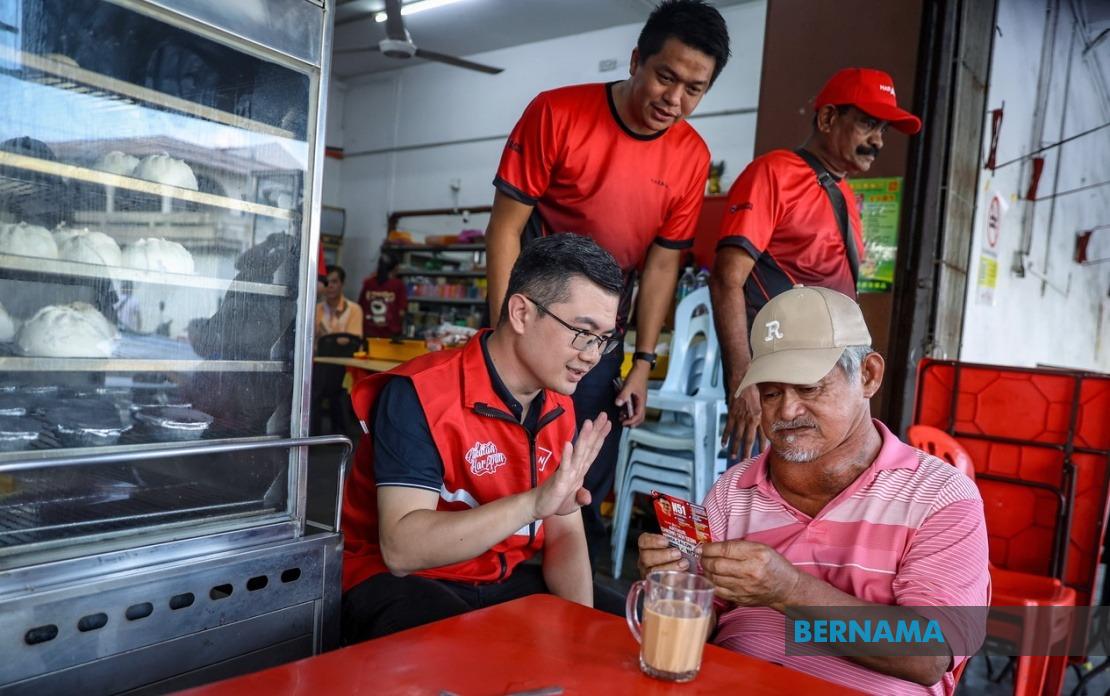
Arthur Chiong Sen Sern, the Pakatan Harapan assemblyman representing Bukit Batu, is entering the 16th Johor State Election with confidence born from two years of intensive grassroots engagement across his constituency. The 36-year-old incumbent is betting that consistent delivery on local concerns—from infrastructure repairs to flood mitigation—will convert his slim 2022 victory into a commanding mandate when voters head to the polls on July 11. Having secured just 9,439 votes and a 137-vote margin two years ago in a four-cornered contest, Chiong recognises that his initial win was a tight affair that demanded he prove his mettle as an elected representative.
Chiong's strategy rests squarely on demonstrating tangible improvements to Bukit Batu's quality of life rather than partisan messaging. He has prioritised flood-prone villages like Kampung Rahmat and Kampung Seri Paya, working closely with the Department of Irrigation and Drainage to implement drainage solutions and reduce inundation frequency. Rather than delegating these issues to bureaucrats, Chiong has made a point of personally arriving at affected areas during flash flood incidents, a presence he believes residents have come to appreciate and expect. This hands-on approach extends to Felda settlements scattered across his constituency, where he has cultivated relationships with farming communities often overlooked in state-level campaigns.
Beyond flood management, Chiong has channelled resources into youth-oriented projects and community infrastructure. He directed RM20,000 towards installing lights at a futsal court, a relatively modest investment that has generated genuine enthusiasm among young players who continue using the facility. Such targeted funding for non-governmental organisations reflects a philosophy of meeting voters where they live rather than imposing top-down development priorities. The cumulative effect of these initiatives—addressing infrastructure deficits, supporting community organisations, and maintaining visible representation across diverse communities regardless of ethnicity or political affiliation—has, according to Chiong, generated positive feedback that underpins his confidence.
The electoral landscape facing Chiong in July is notably crowded. The Bukit Batu state seat, encompassing 49,963 registered voters, will feature a four-cornered contest expanded to five candidates. Beyond Chiong's Pakatan Harapan candidacy, the race includes R. Kumaran representing Barisan Nasional as the Kulai PKR chief, M. Premanand contesting for Ikatan Demokratik Malaysia (MUDA), G. Tamili flying the Bersama banner, and independent candidate Kamaruzaman Ali. This fragmentation potentially benefits an incumbent with established voter recognition and a track record of constituency service, though it also means Chiong cannot take a single demographic segment for granted.
Chiong's 2022 performance provides essential context for understanding the competitive intensity ahead. He defeated Datuk S. Suppayah of Barisan Nasional, Tan Heng Choon representing Perikatan Nasional, and Lee Ming Wen of Warisan—a genuinely contested four-way race where every community's voting patterns mattered. The slenderness of his victory was both humbling and instructive, forcing him to recognise that his mandate was conditional on demonstrating competence and accessibility. Rather than viewing his narrow win as a liability, Chiong has reframed it as motivation to expand his base by serving constituencies that may have supported other candidates in 2022. His intensive ground presence appears designed to transform sceptics into supporters through demonstrated action.
The Bukit Batu constituency itself reflects broader demographic patterns across southern Johor. It encompasses Felda schemes, semi-urban Kulai areas, and village settlements with distinct economic bases and service expectations. This heterogeneity requires an elected representative to balance competing priorities: agricultural support for Felda residents, infrastructure development in growing suburban zones, and essential services for traditional villages. Chiong's two-year portfolio suggests he has attempted this balancing act, though his effectiveness will ultimately be judged by voters comparing his record against challengers' promises and his opponents' critiques of areas he may not have adequately addressed.
Chiong has expressed gratitude towards Pakatan Harapan leadership, particularly Prime Minister Datuk Seri Anwar Ibrahim in his capacity as PH chairman, for nominating him to defend the seat. This acknowledgment signals party confidence in his candidacy while anchoring his campaign within the national coalition's broader narrative. For Malaysian voters following the Johor election, Chiong's contest exemplifies the tension between incumbency advantage and vulnerability—he must defend a narrow victory while facing a more fragmented opposition that could theoretically consolidate against him, yet his constituency service record offers a counternarrative to purely partisan campaign dynamics.
The electoral calendar compressed into just twelve days between early voting on July 7 and polling day on July 11 means campaigns must move quickly from mobilisation to momentum building. For Chiong, this compressed timeline advantageously underscores his immediate availability and established presence, factors that become most salient in short campaigns where voter familiarity with candidates is predetermined by prior visibility. His intensive constituency work over nearly two years of parliamentary term provides a foundation of recognition that newer challengers must overcome in rapid fashion. Early voting on July 7 will offer the first substantive indication of whether his ground-level campaign strategy has genuinely expanded his support base beyond the 137-vote margin that carried him to office in 2022.
The broader implications for Johor's political trajectory hinge partly on whether Chiong and similarly-positioned Pakatan Harapan incumbents can consolidate gains made in 2022 or whether the state's electorate is realigning once more. A comfortable victory for Chiong would suggest that systematic constituency service and grassroots accessibility remain valued by voters, even in an era of volatile electoral politics. Conversely, if his expanded majority proves elusive or if opposition candidates successfully mobilise specific demographics against him, Bukit Batu becomes a barometer for whether Pakatan Harapan's performance metrics and governance approach resonate across southern Johor's diverse constituencies. The contest ultimately transcends Chiong's personal political fortunes, offering regional observers insights into which campaign strategies—established service records versus fresh policy promises, incumbency advantage versus anti-establishment sentiment—remain most persuasive to Malaysian voters navigating the state's evolving political terrain.

