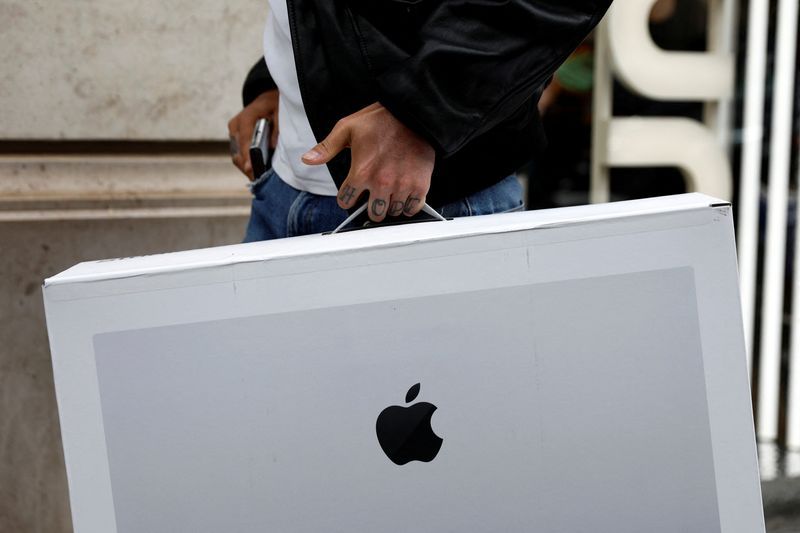
The technology sector's leadership hierarchy underwent a significant realignment on Friday when Apple displaced Nvidia from the coveted position of world's most valuable company. Apple's market capitalisation reached $4.88 trillion while Nvidia declined to approximately $4.86 trillion, marking a decisive moment in how global investors view artificial intelligence opportunities and the companies best positioned to capitalize on them. This shuffle represents a meaningful recalibration in market sentiment after Nvidia had dominated the rankings for nearly a year, underscoring the dynamic nature of technology valuations in an era of rapid innovation and shifting strategic priorities.
The transition carries particular significance for understanding where institutional and retail investors believe genuine wealth creation lies within the AI revolution. Toni Meadows, head of investment at BRI Wealth Management, articulated this perspective clearly, noting that Apple's previous perception as lagging in artificial intelligence development has fundamentally reversed. The reassessment reflects recognition that companies need not pursue expensive, capital-intensive model development to benefit substantially from AI advancement. Instead, Apple's strategy of leveraging artificial intelligence through services, ecosystem lock-in mechanisms, and hardware refresh cycles offers a more sustainable path to earnings growth without the enormous expenditure requirements that characterise chip design and manufacturing.
Apple's reclamation of the top ranking represents its first return to this position since April of the previous year, symbolizing a broader narrative about how the technology industry's value proposition is being reinterpreted. For much of the preceding period, Apple had been dismissed by some market participants as a follower rather than a leader in artificial intelligence capabilities. The company faced criticism for not aggressively building large language models or investing heavily in generative AI infrastructure. Yet this assessment overlooked Apple's fundamental strengths: an unparalleled installed base of devices, direct relationships with hundreds of millions of consumers, and the ability to embed AI features into products that users already depend upon daily.
The timing of Apple's valuation milestone carries symbolic weight as the company navigates a significant leadership transition. Chief Executive Officer Tim Cook is preparing to hand over operational control to John Ternus, a seasoned hardware executive, in September. The achievement of returning to market leadership status during Cook's final months in the role potentially reframes the narrative surrounding his tenure, demonstrating that Apple remains capable of capturing investor imagination and commanding premium valuations. The transition itself suggests continuity in Apple's hardware-centric philosophy, as Ternus brings deep expertise in designing and manufacturing the physical products that form the foundation of the company's ecosystem.
Central to Apple's AI strategy is the substantially redesigned Siri assistant, which the company rolled out following considerable delays. This upgrade represents Apple's deliberate effort to close competitive gaps with larger technology rivals and well-funded artificial intelligence startups that have captured headlines with advanced chatbot capabilities. The revamped Siri aims to integrate more seamlessly into users' daily interactions with Apple devices, addressing longstanding criticisms about the assistant's limitations compared to competing offerings. Beyond basic functionality improvements, however, Siri embodies a deeper strategic opportunity that Apple has been cultivating for over a decade.
Analysts have highlighted that Apple possesses what could be termed an artificial intelligence goldmine in the form of personal data resident across its global network of iPhones, iPads, and other connected devices. This information—encompassing user preferences, behavioral patterns, location histories, and interaction patterns—could theoretically enable Siri to deliver dramatically more contextually relevant and useful responses. The personal data stored on individual devices represents an unparalleled resource for training and personalizing artificial intelligence systems. However, Apple faces a fundamental tension between maximizing the commercial value of this data and the company's carefully cultivated public positioning as a privacy-first organization committed to protecting user information from unauthorized access or commercial exploitation.
The resolution of this dilemma will significantly influence Apple's ability to fully monetize its AI capabilities. Currently, the personal data stored within individual devices remains largely isolated from the servers and systems that power Siri's core intelligence. Apple would need to develop sophisticated mechanisms to extract value from this information while maintaining credible privacy protections. This technical and philosophical challenge distinguishes Apple's situation from competitors who have fewer qualms about centralizing and analyzing user data at scale. The company's resolution of these competing imperatives will shape its trajectory in artificial intelligence over the coming years and potentially affect its competitive position against rivals with fewer privacy constraints.
While Apple's ascension to the top valuation merits attention, analysts caution against interpreting this moment as a definitive reordering of competitive dynamics. Nvidia remains fundamentally positioned to benefit from continued artificial intelligence infrastructure spending. The company's graphics processors continue to power the vast majority of generative artificial intelligence systems being deployed globally, from large language models to specialized applications. The demand for Nvidia's specialized computing hardware reflects structural factors that are unlikely to disappear quickly, regardless of near-term sentiment shifts. Market leadership positions can shift rapidly in technology sectors, and Nvidia retains the capacity to reclaim the top ranking if investor sentiment reverses direction.
Apple itself faces non-trivial headwinds that could constrain its valuation trajectory. The company has pursued a strategy of raising prices on new devices to offset escalating manufacturing and component costs. This approach, while protecting profit margins, risks dampening consumer demand, particularly in price-sensitive geographic markets where competition from local manufacturers remains intense. Consumer spending patterns could deteriorate if economic growth slows or if purchasing power declines in key markets. Additionally, the company's ability to capture the full value of artificial intelligence integration remains unproven; consumers must perceive tangible benefits from AI features substantial enough to justify purchasing new devices, a proposition that remains uncertain.
The broader semiconductor sector has begun to share in the artificial intelligence investment boom, with competitive dynamics extending well beyond the Nvidia-Apple dichotomy. Memory chipmakers such as Micron have emerged as significant beneficiaries of artificial intelligence infrastructure development, with Micron crossing a $1 trillion market capitalisation threshold in May. South Korea's SK Hynix, another major memory manufacturer, recently completed a listing on the Nasdaq, introducing additional significant participants to the global investor landscape. Benjamin Hall, vice president of alpha research at Segal Marco Advisors, observed that the expansion of artificial intelligence opportunities across the semiconductor value chain is likely to disperse investor attention away from the concentrated focus on the largest technology companies toward a broader constellation of beneficiaries.
This democratization of artificial intelligence investment has contributed to meaningful turbulence in semiconductor equities during July. The Philadelphia SE Semiconductor index declined nearly 19 percent from its previous all-time highs as investors undertook a comprehensive reassessment of artificial intelligence's sustainability and profitability. The sharp correction reflects a broader pattern in technology markets where enthusiasm undergoes periodic recalibration as investors weigh speculative excitement against fundamentals and valuation multiples. Despite the significant decline, the semiconductor index has nonetheless outperformed broader equity markets and has delivered superior returns compared to the overall market year-to-date, suggesting that investors continue to perceive artificial intelligence as a structural growth driver despite near-term volatility.
The reshuffling of valuations among technology giants ultimately reflects the market's ongoing struggle to assess which business models will generate sustainable competitive advantages and shareholder value from artificial intelligence advancement. Nvidia's dominance was premised on the assumption that infrastructure investment would remain the primary source of artificial intelligence-related wealth creation. Apple's resurgence challenges this assumption by demonstrating investor appetite for companies that can embed artificial intelligence into consumer-facing products and services while leveraging existing competitive advantages. The coming years will reveal whether Apple can successfully monetize its unique positioning or whether the market's embrace of artificial intelligence hardware specialists proves more durable. For Malaysian and Southeast Asian investors, this strategic realignment underscores the importance of diversifying exposure across multiple beneficiaries of artificial intelligence advancement rather than concentrating bets on single companies or sectors.

