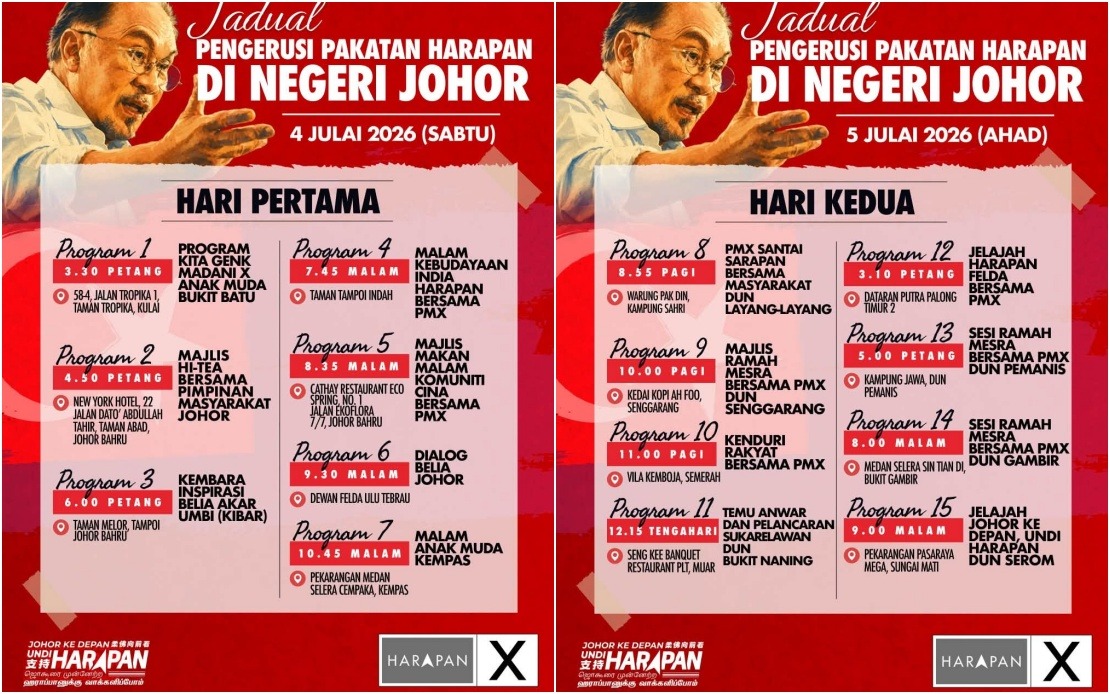
Pakatan Harapan chairman Datuk Seri Anwar Ibrahim is preparing for an exhaustive campaign schedule across Johor this weekend, planning to appear at 15 separate events designed to generate momentum for the coalition's 56 candidates ahead of the 16th state election. The veteran politician's decision to concentrate his efforts across consecutive days reflects the importance PH places on retaining electoral support in Malaysia's southern state, where political control remains fiercely contested among multiple coalitions.
Anwar's weekend itinerary reflects a deliberate strategy to reach diverse voter demographics and geographic areas within the state. The schedule begins on Saturday afternoon in Kulai with the Kita Genk MADANI x Anak Muda Bukit Batu programme at 3.30 pm, immediately followed by a high tea engagement with community leaders, signalling the coalition's intention to forge connections across different social strata. This sequencing demonstrates an understanding that electoral success requires mobilising both grassroots supporters and established community figures who command influence within their respective networks.
The evening programme takes on particular significance in Malaysian political culture, where night events often draw younger voters and working professionals who cannot attend daytime activities. Anwar's packed schedule for Saturday night encompasses cultural community events, including an Indian Cultural Night and a Chinese Community Dinner, both designed to reinforce PH's multiracial positioning. These gatherings serve multiple functions simultaneously: they provide candidates with high-profile support, create opportunities for direct voter engagement, and generate social media content that can amplify the coalition's campaign messaging beyond those physically present.
The youth-focused component of Anwar's campaign merits particular attention given demographic shifts within Johor's electorate. Two dedicated youth programmes—the Anak Muda Bukit Batu event and the Johor Youth Dialogue—reflect PH's recognition that younger voters represent a contested battleground. Johor's youth population, increasingly digitally connected and politically conscious, can swing marginal constituencies either direction, making their engagement a strategic priority for any coalition seeking to expand or defend its parliamentary position.
Sunday's schedule maintains the intensity while pivoting toward grassroots community engagement. The early morning breakfast with Layang-Layang constituents at a local warung signals accessibility and informal connection, contrasting with formal state politics. Such engagements help cultivate the perception that PH leadership remains connected to ordinary Malaysians' daily concerns, a messaging angle particularly valuable in rural and semi-urban constituencies where personal relationships and local responsiveness influence voting behaviour.
The inclusion of Felda-related programmes across both days indicates PH's strategic focus on agricultural constituencies, which traditionally swing between major coalitions. Federal Land Development Authority (Felda) communities represent significant voter blocs, and their support can substantially alter state-level outcomes. By allocating multiple campaign slots to Felda areas, PH demonstrates commitment to these communities' concerns, whether regarding agricultural prices, land rights, or cooperative benefits—issues that directly affect Felda residents' economic wellbeing.
Anwar's personal participation in this intensive schedule carries symbolic weight beyond the immediate campaign logistics. His presence validates PH candidates' legitimacy within the party hierarchy and signals to voters that the coalition takes this election seriously enough to commit its highest-ranking leadership to sustained ground engagement. This approach contrasts with campaigns relying primarily on lower-ranking surrogates, potentially conveying an image of institutional seriousness that resonates with voters concerned about governance competence.
The electoral context matters significantly for understanding this campaign intensity. The July 11 voting date falls within a compressed campaign window, with early voting occurring on July 7. This timeline means that campaign events in early July represent some of the final opportunities for direct voter contact before ballots are cast. Anwar's concentrated effort thus reflects the tactical reality that campaign momentum can shift rapidly in the final days, making saturation engagement particularly valuable at this late campaign stage.
From a broader regional perspective, the Johor election carries implications extending beyond state politics into national parliamentary mathematics. Johor's 56 state assembly constituencies translate into representation that influences Dewan Negara composition and federal-state relations. PH's performance here will signal the coalition's strength in traditional stronghold areas and provide data about whether recent political volatility has eroded voter confidence or whether the party maintains sufficient institutional loyalty to weather electoral challenges.
The diversity of Anwar's campaign venues—spanning urban centres like Tampoi, rural areas with Felda populations, and semi-rural constituencies—reflects the geographic complexity of state-level politics in Malaysia. No single demographic or geographic segment dominates Johor elections; rather, success requires piecing together winning coalitions across multiple constituencies with distinct characteristics. Anwar's comprehensive tour addresses this fragmentation directly, ensuring that PH's leadership presence reaches communities that might otherwise feel neglected by state-focused campaigns.
Candidates accompanying Anwar at these events gain substantial campaign assistance beyond mere headline support. The operational infrastructure required to organise 15 programmes over two days—logistics, transportation, media coordination, crowd management—represents significant resources that party headquarters can mobilise. Candidates benefit from this institutional machinery while gaining opportunities for direct association with the party's most recognised national figure, an advantage that candidates from weaker parties cannot match.
Anwar's Facebook announcement inviting all Johor voters to participate in the weekend's programmes extends the campaign beyond formal event attendees. Digital amplification through social media means that opposition voters may also see campaign content, potentially influencing undecided voters who browse social platforms without seeking political information. This organic reach represents one advantage of high-profile politician engagement that traditional campaign methods cannot replicate as effectively.
As Malaysia's political landscape continues to fragment and realign, Johor's election will test whether traditional coalition politics can mobilise voters through intensive leadership engagement or whether newer forces have displaced the appeal of established figures. Anwar's substantial time investment suggests PH leadership believes personal engagement remains electorally valuable, a calculation that will become clearer once July 11 results are announced and analysts assess whether ground-level campaign intensity translated into actual electoral gains.

