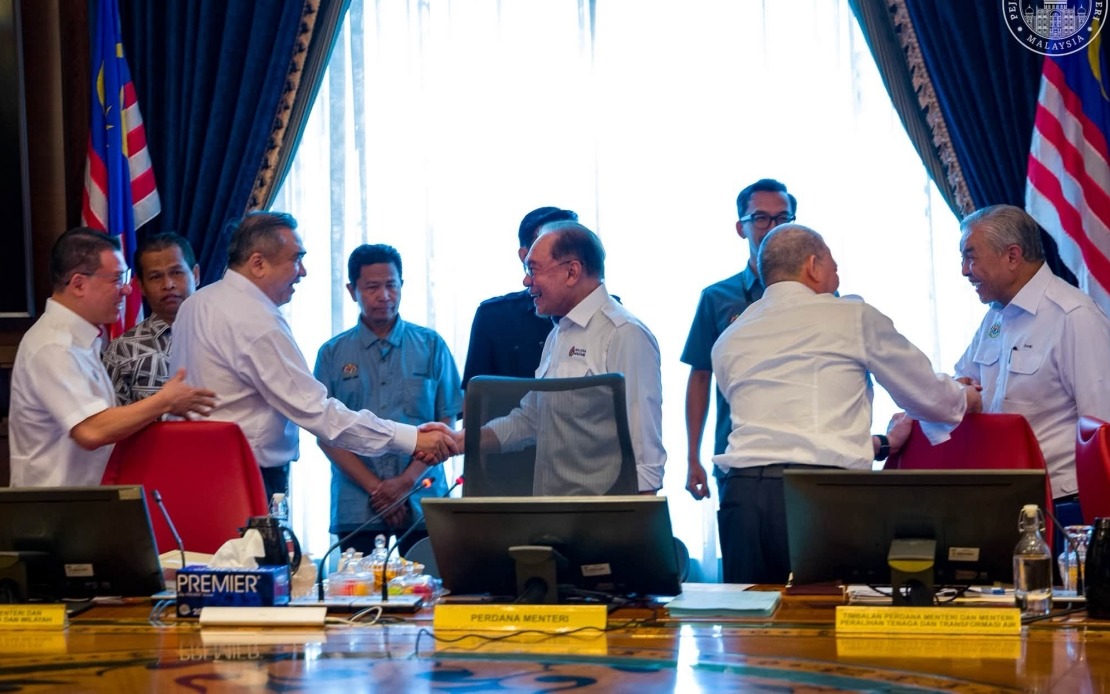
Prime Minister Datuk Seri Anwar Ibrahim has employed traditional Malay verse to convey a message about the enduring importance of national cohesion, posting a four-line pantun on his official Facebook page that emphasises values of unity, discipline and mutual accord. The carefully crafted post has resonated strongly with online audiences, accumulating over 11,500 likes within just two hours and generating more than 1,700 comments from users who engaged warmly with the Premier's lyrical approach to governance.
The Prime Minister accompanied his poetic offering with a reference to a beloved 1980s musical composition, creating a cultural touchstone that many Malaysians would recognise and appreciate. He also shared photographs from a recent Cabinet session attended by Deputy Prime Minister Datuk Seri Dr Ahmad Zahid Hamidi and Transport Minister Anthony Loke, capturing ministers in relaxed and visibly harmonious circumstances. The visual narrative reinforced the textual message about governmental unity and collegiality.
The timing and tenor of Anwar's post warrant careful consideration, coming as Malaysia navigates a complex political landscape where national stability depends heavily on the fragile alliance between Pakatan Harapan and Barisan Nasional within the Federal Unity Government. This governing arrangement, established following the 2022 general election, has proven sufficient to maintain parliamentary control but remains contingent on continued cooperation between parties that harbour fundamental policy differences and competing electoral ambitions.
The Negeri Sembilan state election, scheduled for August 1st with early voting on July 28th, presents an immediate test of that cooperation. The state assembly was dissolved on June 5th, triggering the electoral process with the Election Commission's coordination. In this contest, the two federal coalition partners are ranged directly against one another, with Pakatan Harapan, chaired by Anwar, contesting all 36 state seats whilst Barisan Nasional, led by Ahmad Zahid, is fielding candidates in 25 constituencies alongside a separate electoral pact with Perikatan Nasional.
This apparent paradox—where allies campaign vigorously as adversaries—has created considerable public focus on the relationship between PH and BN. Observers have scrutinised campaign rhetoric and strategising for signs of strain or discord that might threaten the Federal Government's stability. Anwar's pantun-based intervention can be understood as a deliberate effort to recalibrate the public narrative, signalling that electoral competition, whilst genuine, need not corrode the institutional bonds holding federal administration together.
The online reception to the Prime Minister's message provides instructive insight into Malaysian public sentiment regarding political unity. Commenters responded with enthusiasm to his conciliatory and statesmanlike tone, with several replying in pantun themselves, demonstrating how traditional forms of political communication can generate authentic engagement in the digital age. This organic response suggests that significant segments of the Malaysian electorate value messages of cohesion and find appeal in leadership that articulates such values through culturally meaningful expressions rather than through purely transactional political rhetoric.
For regional observers, the Negeri Sembilan contest and the surrounding political manoeuvrings represent a microcosm of contemporary Southeast Asian governance challenges. Coalition politics, increasingly common across the region as electoral fragmentation produces parliaments without clear majorities, requires sustained commitment to institutional mechanisms that transcend day-to-day partisan competition. Malaysia's experiment in maintaining such arrangements whilst permitting vigorous state-level electoral competition offers lessons for neighbouring democracies grappling with similar configurations.
The symbolism embedded in Anwar's use of traditional cultural forms carries particular weight in Malaysian political discourse. The pantun, rooted in Malay literary and oral traditions, carries connotations of wisdom, harmony and social cohesion that align closely with the multiethnic values Malaysia's founding principles emphasise. By channelling his message through this vehicle rather than through bureaucratic pronouncements, the Prime Minister was performing political leadership in a manner calculated to appeal to deeper cultural instincts toward unity.
Looking ahead, the outcome in Negeri Sembilan will provide significant data points regarding the health of the PH-BN relationship. Victory for either coalition could be interpreted as either a validation of their respective organisational capacity or, depending on margins and seat distributions, as evidence of strain within the federal arrangement. Conversely, results that prove competitive without producing either landslide or humiliating defeat might suggest that the alliance structure retains sufficient stability to weather genuine electoral competition at the state level.
For Malaysian corporate and international observers, the maintenance of political stability during periods of electoral contestation carries material significance. Markets and foreign investors value predictability and the absence of sudden shifts in governance arrangements. Anwar's intervention, by reinforcing public commitments to institutional continuity across electoral cycles, performs a stabilising function that extends well beyond the immediate domestic political audience to encompass international stakeholders monitoring Malaysia's political trajectory and economic governance.

