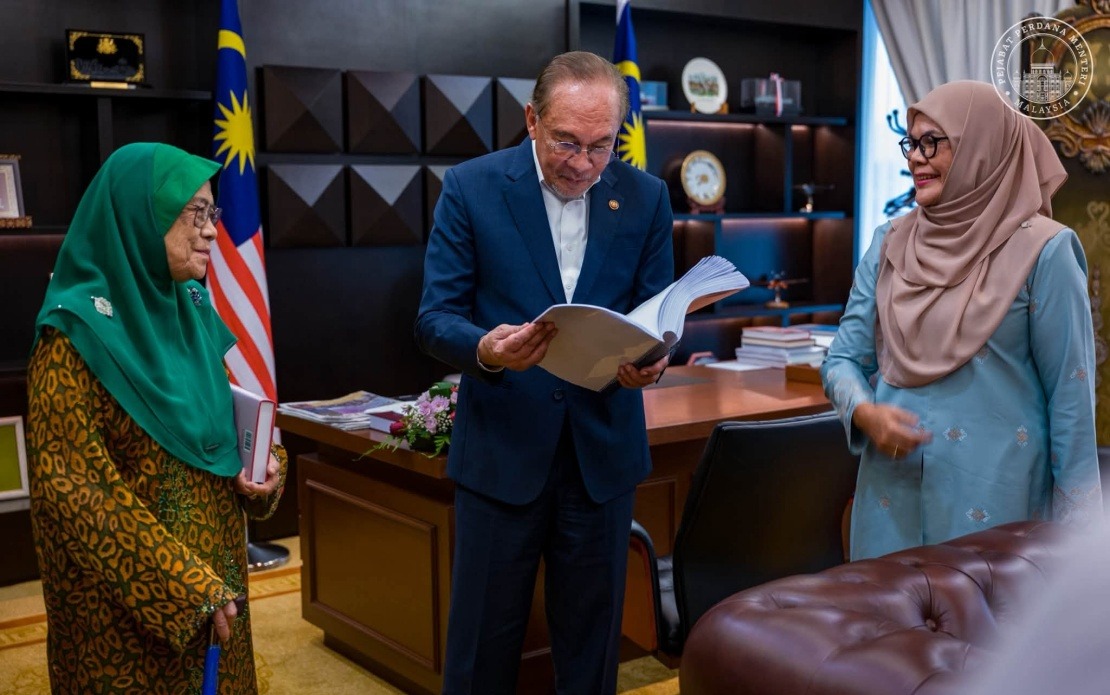
Prime Minister Datuk Seri Anwar Ibrahim has thrown his support behind a scholarly publication capturing his intellectual framework and political philosophy, expressing confidence that the work will provide valuable guidance to future generations navigating questions of governance and national development. The book, authored by Professor Dr Salinah Ja'afar, a linguist and lecturer at the Academy of Malay Studies at Universiti Malaya, represents an ambitious effort to systematically record and analyse the premier's ideas, worldview, and the lived experiences that have shaped his thinking over a long political career spanning multiple decades.
In announcing his endorsement through a Facebook statement on July 1, Anwar underscored the collaborative nature of the project, noting that he had been afforded the opportunity to review the manuscript and provide detailed feedback on its contents during the preparation phase. This hands-on involvement ensures that the published work accurately reflects his positions and maintains intellectual fidelity to his broader vision. The Prime Minister's active participation in refining the manuscript signals the significance he attaches to how his legacy is documented and interpreted by scholars and the public alike.
The project has benefited from the expertise of Professor Emeritus Datuk Dr Nik Safiah Abdul Karim, a distinguished figure in Malaysian linguistics and language scholarship, who assumed the role of academic adviser throughout the book's development and writing stages. Her involvement lends substantial credibility to the undertaking, as her scholarly reputation ensures rigorous standards and methodological soundness in how Anwar's ideas are presented and contextualised. The inclusion of such an eminent academic figure reflects a deliberate choice to position the work within serious scholarly discourse rather than treating it as a mere political tract.
The collaborative process extended beyond textual analysis, with both Salinah and Nik Safiah conducting exclusive interviews with Anwar to ensure comprehensive coverage of his intellectual and ideological positions. These in-depth conversations allowed the authors to probe the origins of his thinking, the formative experiences that influenced his worldview, and the philosophical underpinnings of his approach to leadership. By capturing his voice directly through extended interviews, the scholars could preserve the nuance and complexity often lost when political thought is reconstructed solely from published speeches or policy documents.
Anwar's public remarks emphasise his gratitude toward the author for undertaking the meticulous work of documenting, articulating, and organising his ideas into a coherent narrative framework. He acknowledges that his thinking has been moulded by accumulated life experiences—spanning activism, imprisonment, opposition politics, and now the highest executive office—alongside extensive intellectual engagement through reading and reflection. This layered formation of his worldview suggests a thinker whose positions have evolved through real-world challenges and engagement with diverse philosophical traditions.
The Prime Minister frames the book's ultimate purpose as educational and inspirational, hoping it will eventually become a reference resource for future policymakers, civic leaders, and citizens grappling with fundamental questions about nation-building architecture and the cultivation of personal integrity and values. This reflects a longer-term vision of democratic knowledge transfer, where contemporary political thought is systematised and made available for subsequent generations to study, critique, and build upon. Rather than positioning the work as definitive or closed, this framing suggests it is intended as a contribution to ongoing national conversation.
From a Malaysian political perspective, the initiative highlights a broader pattern whereby senior government figures seek to document their intellectual contributions beyond their time in office. In a regional context where political systems often struggle with institutional memory and coherent policy philosophies, efforts to systematise and publish a leader's framework can serve valuable functions in establishing continuity and preventing erosion of institutional knowledge. For Malaysian readers, the project also raises interesting questions about how political thought is documented and preserved in Southeast Asian democracies.
The emphasis on both nation-building and personal values suggests Anwar views these dimensions as inseparable—that questions of individual ethics and integrity are fundamentally connected to good governance and institutional development. This holistic approach to political philosophy contrasts with more narrowly technocratic or purely ideological framings common in contemporary politics. The book's dual focus may appeal to readers interested in understanding not just specific policies but the underlying moral and philosophical architecture supporting them.
The involvement of Universiti Malaya's Academy of Malay Studies also situates the project within Malaysian intellectual institutions, suggesting an attempt to anchor Anwar's thought within the country's scholarly traditions and academic discourse. This institutional grounding enhances the work's legitimacy and signals that the ideas being documented merit serious academic treatment rather than dismissal as mere political promotion. For universities and scholarly communities, such projects represent opportunities to engage meaningfully with contemporary political thought as it unfolds.
The timing of the book's completion and announcement also carries significance, arriving at a point when Anwar's leadership spans several years as Prime Minister. The retrospective documentation of his thinking allows for reflection on how his stated philosophies align with actual policy implementation and governance choices. Readers will inevitably measure the book's prescriptions against the real-world outcomes of his administration, creating space for legitimate scholarly debate about the relationship between political philosophy and practical governance.
For the broader Southeast Asian region, the emergence of such documented political thought from Malaysia's premier can contribute to regional intellectual exchange on governance, development, and nation-building challenges that transcend national borders. Leaders across Southeast Asia grapple with similar questions of balancing economic development, cultural preservation, institutional reform, and social cohesion. Making such frameworks explicit and available for study and debate enriches the region's pool of accessible political philosophy and practical wisdom.

