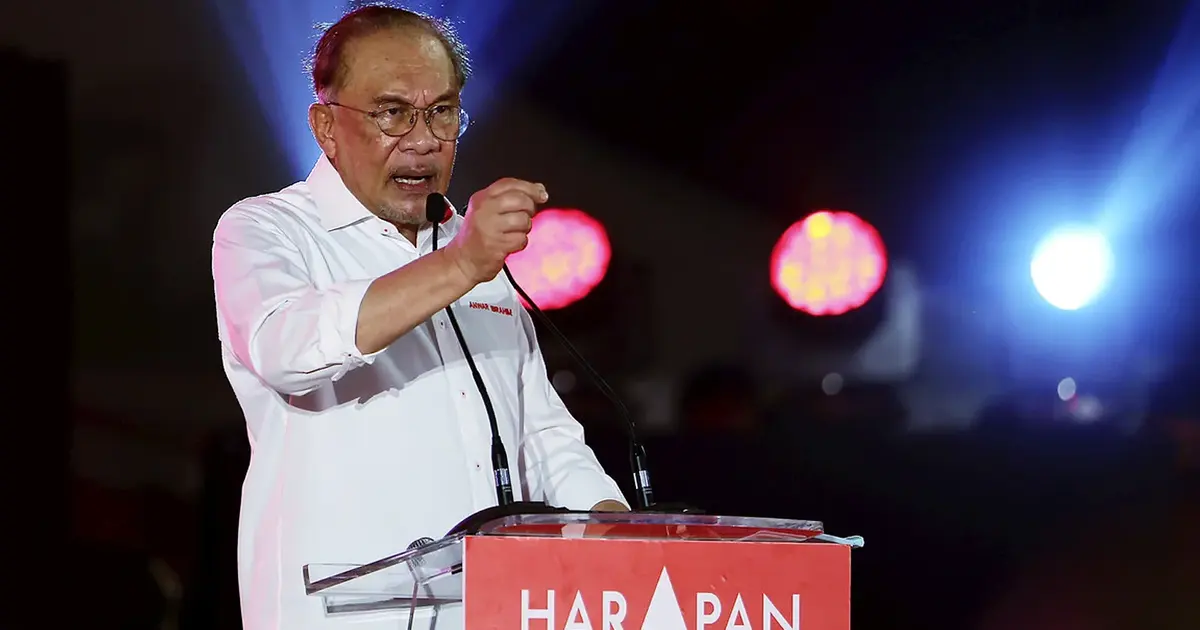
Prime Minister Anwar Ibrahim has issued a clear directive to political parties contesting the Negeri Sembilan state election to avoid entangling the state's royal institution in campaign narratives, underscoring the sensitive nature of constitutional monarchy matters during electoral contests. The Pakatan Harapan chairman's statement reflects mounting concern that divisive royal-linked issues could undermine the integrity of the democratic process in the southern Selangor state, where electoral competition has intensified among competing coalitions vying for control of the state assembly.
Anwar's intervention carries particular weight given his position as both prime minister and the head of the ruling coalition, effectively signalling to PH component parties and allied groups that royal matters must remain insulated from partisan campaign activities. The warning implicitly acknowledges that elections in Malaysian states with significant royal prerogatives create potential flashpoints where ambitious politicians might attempt to leverage institutional sensitivities for electoral advantage, a phenomenon that has occasionally surfaced in previous state campaigns across the country.
The Negeri Sembilan state polity operates within a distinctive constitutional framework where the Yang di-Pertuan Besar—the state ruler—exercises defined powers that extend beyond ceremonial functions. This institutional arrangement, rooted in the state's historical status as a federation of nine districts under traditional Minangkabau leadership structures, means that matters touching on royal authority carry heightened constitutional resonance. Any attempt to weaponise royal-related grievances or controversies during electoral campaigns risks destabilising the delicate equilibrium between elected officials and the constitutional monarchy that underpins Malaysia's political stability.
The timing of Anwar's statement reflects the high stakes surrounding Negeri Sembilan's election landscape. The state has emerged as a crucial battleground where demographic shifts, urban-rural divisions, and changing voter preferences are reshaping traditional political alignments. Control of the state assembly carries implications not merely for local governance but for the broader balance of power within Pakatan Harapan itself, as rival factions within the coalition position themselves for influence over the peninsula's remaining competitive state governments.
Historically, Malaysian electoral campaigns have occasionally tested the boundaries of acceptable political discourse when issues touching on royal institutions enter public debate. Anwar's preemptive stance suggests that coalition strategists recognised potential vulnerabilities or provocative narratives that opposition parties might exploit. By establishing clear boundaries beforehand, the PH chairman aims to deprive political opponents of platforms to amplify royal-related controversies that could fragment voter coalitions or alienate constituencies sensitive to institutional matters.
The admonition also reflects Malaysia's broader political culture, where respect for monarchical institutions remains constitutionally mandated and culturally embedded across most demographic groups. Public perception of whether a political party upholds or violates these expectations can significantly influence voting behaviour, particularly among traditional and conservative constituencies. Parties perceived as disrespectful towards royal matters risk suffering electoral punishment, as voters may interpret such conduct as breaching fundamental social contracts governing Malaysian politics.
For opposition parties, the warning effectively constrains their campaign toolkit at a moment when they might otherwise seek differentiation from the ruling coalition. By establishing that royal matters are out-of-bounds across all political competitors, Anwar forecloses an avenue through which ambitious challengers might mobilise protest votes or activate constituencies dissatisfied with current governance. This levelling of the playing field, however, benefits the ruling coalition by preventing escalation of institutional tensions that could unpredictably reshape electoral outcomes.
The statement carries implications extending beyond Negeri Sembilan to the broader Malaysian federation. With the next general election potentially only months away, establishing that royal institutions should remain apolitical during campaigns sets a precedent applicable across all forthcoming electoral contests. This norm-setting function proves particularly important given that Malaysia's constitutional monarchy system depends on maintaining widespread legitimacy and public confidence across political divides. Elections that degenerate into contests over royal prerogatives risk eroding the institutional consensus that has historically protected the monarchy from partisan polarisation.
Anwar's intervention also addresses internal coalition discipline within Pakatan Harapan. Diverse component parties spanning DAP, PKR, and Amanah maintain distinct organisational cultures and campaign styles. Explicit guidance from the coalition chairman reduces ambiguity about acceptable boundaries and helps prevent rogue actors from pursuing provocative strategies that might embarrass the broader coalition. Such internal coordination proves essential when managing coalition discipline across competing state governments and federal structures.
The Negeri Sembilan contest unfolds against broader regional trends reshaping Southeast Asian electoral politics. Across the region, tensions between democratic processes and traditional institutions increasingly surface as societies modernise and younger generations assert greater political agency. Malaysia's experience in maintaining constitutional monarchy through competitive elections therefore holds significance extending beyond national borders, potentially offering lessons or cautionary tales for other regional democracies navigating similar institutional balances.
For Malaysian voters following the Negeri Sembilan campaign, Anwar's declaration serves notice that the election should focus on conventional policy platforms, administrative competence, and development agendas rather than institutional confrontations. This framing implicitly privileges the ruling coalition's governance record over potential opposition appeals rooted in institutional grievances or constitutional debates. Whether this boundary-setting proves sufficient to prevent royal-related issues from surfacing organically remains an open question as the campaign intensifies and competing parties test acceptable limits of political discourse.

