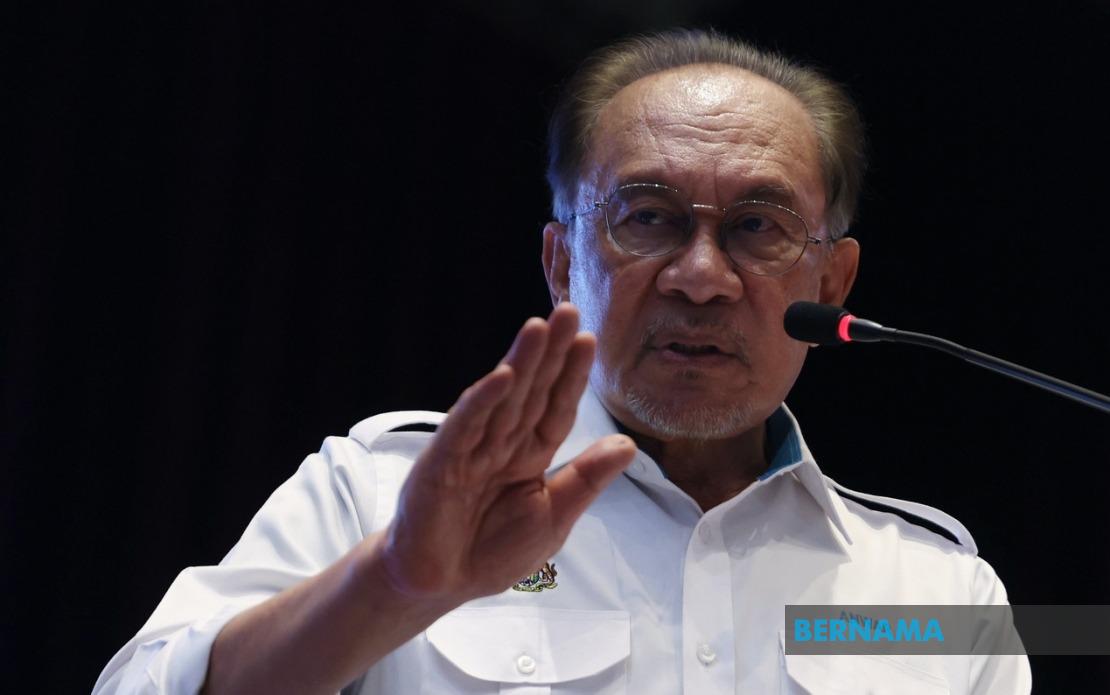
Prime Minister Datuk Seri Anwar Ibrahim issued a forceful reminder on June 24 that Malaysia's political actors must refrain from embroiling the nation's revered royal institutions in partisan contests and ideological disputes. Speaking in Alor Gajah after a civil service engagement event, Anwar articulated concern that the sanctity of the Malay Rulers risked being compromised by politicians seeking advantage in electoral campaigns. His intervention reflects mounting sensitivity within government circles regarding the boundaries between legitimate political expression and breaches of institutional respect that threaten Malaysia's constitutional framework.
The Prime Minister's statement came in response to remarks attributed to Amanah president Datuk Seri Mohamad Sabu during Pakatan Harapan's candidate announcement event in Johor on Monday. Several political observers and commentators interpreted his words as containing veiled criticism directed at the royal institution itself, rather than confining political debate to substantive policy disagreements. This incident exemplifies an emerging pattern within Malaysian politics where electoral competition occasionally spills into territory considered off-limits under the country's unwritten constitutional conventions regarding the monarchy's apolitical status.
Anwar's framing of the issue emphasised that election campaigns, by nature, involve spirited contestation of ideas and political positions. However, he drew a clear distinction between ordinary electoral competition and statements that implicate the institution of the Malay Rulers themselves. His language—describing the royal institution as "sacred"—underscores how Malaysians across the political spectrum regard the monarchy as fundamentally different from other institutional targets in political debate. The Prime Minister called for politicians to address their differences through mature discourse that respects this fundamental boundary.
The timing of Anwar's intervention carries particular weight given Malaysia's electoral calendar. The nation approaches significant contests at federal and state levels, periods when political temperatures typically rise and candidates seek visibility through increasingly provocative statements. Anwar's position as Prime Minister grants his cautionary remarks particular authority, signalling that the ruling coalition regards such boundary-crossing as contrary to national interests. The statement also implicitly distances Pakatan Harapan from any perceived encroachment on royal prerogatives, even as party figures navigate complex political landscapes.
For Southeast Asian observers, Malaysia's handling of this tension between democratic expression and institutional reverence offers instructive lessons. The region encompasses diverse constitutional frameworks and varying relationships between elected governments and traditional institutions. Malaysia's particular approach—maintaining strong constitutional protections for the monarchy while operating as an electoral democracy—requires constant vigilance from political leaders committed to upholding both democratic values and institutional integrity. Anwar's intervention demonstrates how responsible political leadership involves restraint and enforcement of unwritten norms that sustain constitutional stability.
The presence of senior government officials at the Alor Gajah event—including Melaka Chief Minister Datuk Seri Ab Rauf Yusoh and Deputy Higher Education Minister Adam Adli Abd Halim, alongside high-ranking civil servants—suggests this message carried official government endorsement rather than representing Anwar's personal opinion alone. The Civil Service represents Malaysia's institutional continuity and professional nonpartisanship, making the venue symbolically significant for reinforcing that respect for the monarchy transcends party politics. Civil servants, regardless of which government they serve, maintain loyalty to the Crown as the ultimate institutional expression of Malaysian sovereignty.
Anwar's formulation that politicians "should not drag" the royal institution into electoral disputes places responsibility squarely on political actors themselves. This framing rejects any notion that the monarchy might be fair game in political argument. It also implies that those who have ventured into such territory bear responsibility for breaching established norms. The implicit warning is that the ruling coalition will not tolerate—and will publicly rebuke—party members who cross this line, regardless of electoral calculations. Such discipline matters for maintaining institutional integrity across electoral cycles.
The distinction Anwar drew between airing political differences and involving the royal institution reflects Malaysia's constitutional design, where the Malay Rulers occupy a position above partisan competition. While the monarchy exercises constitutional powers and ceremonial functions, the principle of political neutrality remains foundational to Malaysia's stability. When politicians invoke the monarchy in partisan disputes, they risk transforming the institution from a unifying symbol into a contested political prize—a development that would fundamentally alter Malaysian constitutional practice.
For political parties across the spectrum, Anwar's statement serves as notice that the boundaries constraining electoral competition remain real and enforced. Parties seeking to build credibility as responsible governing forces must demonstrate their willingness to compete strenuously on policy and personality without venturing into institutional critique that threatens the monarchy. Such restraint becomes particularly important as Malaysia navigates demographic changes, economic pressures, and evolving political identities. Institutions that transcend partisan divides provide crucial stability during periods of political fluidity.
Looking forward, this incident and Anwar's response highlight ongoing challenges in calibrating electoral democracy with institutional reverence. As Malaysian politics becomes increasingly competitive and as social media amplifies divisive rhetoric, maintaining these boundaries requires consistent leadership messaging and party discipline. The Prime Minister's willingness to publicly correct any perceived transgression signals that his government takes this responsibility seriously. Whether other coalition partners and opposition figures internalize this message will shape whether such controversies diminish or intensify during the campaign season ahead.

