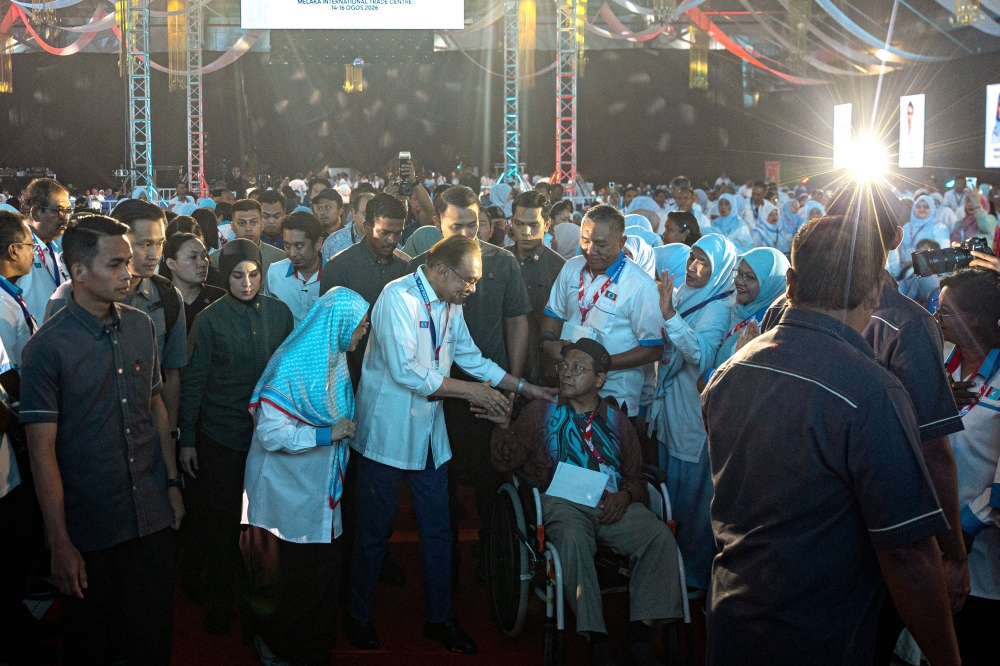
Prime Minister and PKR president Datuk Seri Anwar Ibrahim has called on his party delegates to approach the thorny question of Umno engagement with measured reasoning rather than reactive sentiment, arguing that Malaysia's broader interests must outweigh internal party frustrations.
Addressing party members in Melaka on August 16, Anwar emphasized that policymaking touching on the country's largest Malay-Muslim political organization demands a foundation rooted in pragmatism and public benefit. His remarks come amid ongoing tensions within the ruling coalition, where PKR's partnership with Umno—historically one of its fiercest rivals—continues to generate friction among grassroots supporters who harbour deep mistrust from decades of competition.
The tension reflects a fundamental challenge facing Malaysia's current political architecture. When Anwar's coalition government took office in late 2022, the inclusion of Umno alongside PKR, DAP, and other partners created an unusual governing arrangement that opponents of both sides have struggled to accept. For PKR activists and supporters, working alongside Umno feels like a betrayal of the reformist agenda that animated their movement. For Umno loyalists, similarly, the partnership represents an uncomfortable compromise with former adversaries whose leaders they once imprisoned or opposed in courts.
Anwar's intervention suggests growing concern within PKR that internal grumbling could destabilize the coalition at a moment when Malaysia faces significant economic and social pressures. By framing the Umno question as fundamentally about citizen welfare rather than party ideology, the Prime Minister is attempting to reorient his party's focus toward tangible governance outcomes—employment, inflation, public services, development—rather than historical grievances.
This rhetorical move carries particular weight given Anwar's own history. His ascent from dissident imprisoned by Mahathir to Prime Minister relies partly on the goodwill of Umno members and moderate conservatives who backed his return to politics. Yet his PKR base includes activists who view such accommodation as philosophical compromise. The Prime Minister's insistence on welfare-centred decision-making appears designed to offer both groups a shared language above their historical antagonism.
The underlying political calculus is equally significant for Malaysia's regional position. A coalition government that fragments over internal resentments risks policy paralysis precisely when Southeast Asia faces mounting geopolitical and economic volatility. Foreign investors and neighbouring governments monitor coalition stability closely; visible internal discord can undermine confidence in Malaysia's political institutions and economic management.
Anwar's emphasis on not allowing anger to dictate policy also reflects lessons from recent Malaysian political history. The government formed in 2022 succeeded previous attempts at coalition-building partly because pragmatism—accepting that former opponents would serve together—replaced the zero-sum thinking that had characterized Malaysian politics. Conversely, administrations that collapsed often did so when personal animosities and factional disputes superseded collective governance responsibilities.
Within the broader Southeast Asian context, Malaysia's coalition model offers cautious lessons for other plural democracies. Indonesia, Thailand, and the Philippines have all grappled with managing coalitions across deep ideological divides. Malaysia's current experience suggests that survival requires explicit commitment to transcending emotional reactions—what Anwar terms anger—in favour of measurable outcomes that benefit the general population.
The specific challenge Anwar faces is particularly acute because Umno remains structurally significant to the coalition's parliamentary majority. Without Umno's 27 MPs and the Malay-Muslim constituency it represents, the government would lose its commanding position in Parliament and its ability to pursue legislative initiatives. This structural reality means that managing PKR members' emotional responses to Umno partnership becomes not merely a party management issue but a question of governmental stability.
Anwar's framing also implies recognition that Malaysian voters increasingly demand competence over ideology. Successive election cycles have demonstrated that electorates reward efficient service delivery, transparent governance, and tangible improvements in living standards more readily than they reward politicians' consistency on historical principles. By anchoring coalition decisions to citizen welfare, Anwar positions his government to compete on practical grounds.
The challenge ahead involves translating this rhetorical commitment into visible results that justify the political costs of uncomfortable alliances. If ordinary Malaysians perceive that the PKR-Umno partnership enables stronger economic management, improved infrastructure, and better public services, grassroots discomfort may diminish. Conversely, if governing outcomes disappoint or stagnate, even Anwar's appeals to reason will struggle against accumulated frustration.
Moreover, Anwar's intervention suggests that maintaining coalition discipline requires not simply top-down directives but genuine party education around the logic of pragmatic governance. PKR members and supporters need persuading that accepting ideological incongruence serves their own long-term interests through stable government delivery. This represents an ongoing task rather than a problem solved through a single speech.

