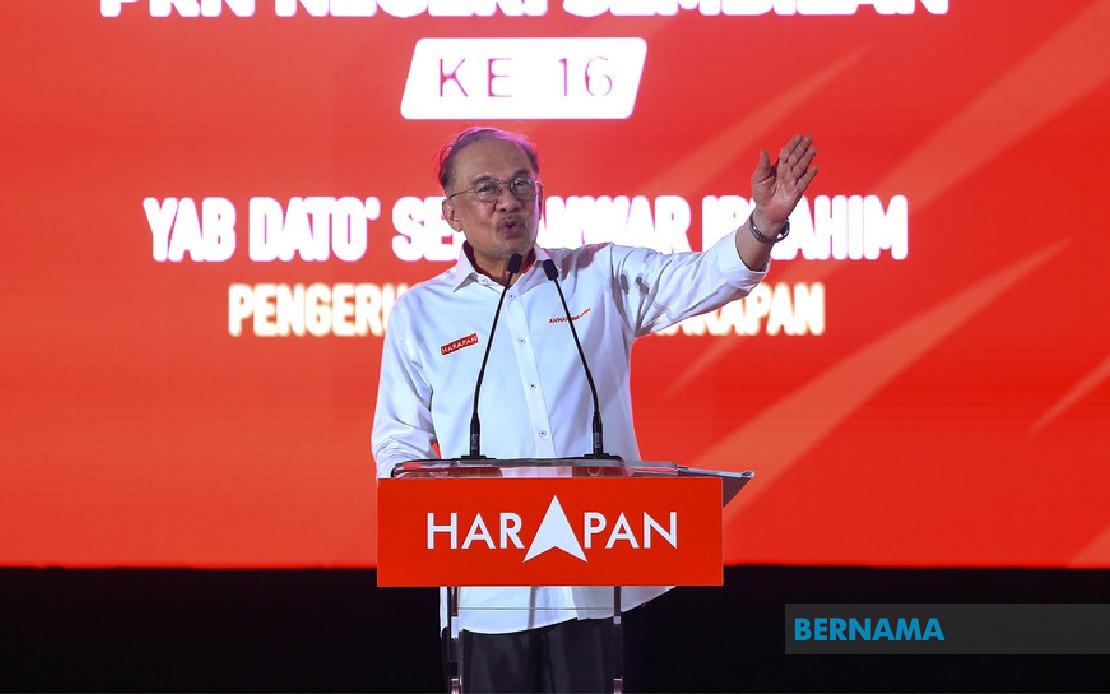
Prime Minister Datuk Seri Anwar Ibrahim has made a direct appeal to voters in Negeri Sembilan to sustain their backing for Pakatan Harapan in the forthcoming state election, framing the upcoming ballot as a critical juncture for the northern Selangor state's development trajectory. Through a Facebook statement released in Seremban, the PH chairman stressed that maintaining the coalition's hold on power is essential for preserving the gains already achieved and pushing forward with an ambitious development agenda that would benefit all residents across the state.
Anwar's intervention underscores the significance of the 16th Negeri Sembilan state election, scheduled for August 1 with nominations beginning July 16 and early voting on July 28. His public appeal reflects the coalition's strategy of consolidating support among voters who have backed PH since 2018, when Menteri Besar Datuk Seri Aminuddin Harun first assumed office. The Prime Minister's messaging emphasises that breaking this political momentum could jeopardise ongoing projects and disrupt the institutional stability that has characterised the state government's recent track record.
Central to Anwar's pitch is the argument that federal-state coordination under PH governance has unlocked resources and enabled implementation of development initiatives that might otherwise remain stalled. This coordination framework, he suggests, has proven successful in delivering tangible benefits to Negeri Sembilan residents, but requires continued political alignment to sustain momentum. The implication is that a change in state leadership could disrupt this working relationship and create friction between Kuala Lumpur and Seremban, potentially slowing project delivery and administrative efficiency.
Anwar characterised Aminuddin Harun's tenure since 2018 as marked by integrity and responsibility, presenting the Menteri Besar as a steward of clean governance during a period of broader political turbulence across Malaysia. This framing serves to anchor PH's campaign narrative around institutional reliability and ethical administration, positioning the choice before voters as one between continuity under proven leadership versus uncertainty under an alternative administration. By highlighting these qualities, Anwar aims to reassure voters that re-electing PH represents a safe, predictable path forward rather than a gamble on untested alternatives.
The Prime Minister's appeal also signals PH's wider strategic priority of maintaining control over states as a foundation for consolidating national power ahead of the next general election. Negeri Sembilan, though not among Malaysia's most populous states, carries symbolic weight as a bellwether of political sentiment and serves as part of the broader landscape of state-level contests that collectively shape the national political environment. A successful PH retention in Negeri Sembilan would reinforce the coalition's narrative of governing competence and provide momentum for future electoral campaigns.
From a development perspective, Anwar's rhetoric emphasises infrastructure, economic activity, and public services—issues that resonate with voters across income levels and demographic categories. His assertion that "more remains to be done" acknowledges that PH's record is incomplete, a calculated admission designed to set expectations for a second term while avoiding any appearance of complacency. This framing allows PH to claim credit for achievements while positioning further progress as contingent on continued electoral support.
The timing of Anwar's intervention reflects the coalition's recognition that Negeri Sembilan is not entirely secure. Despite controlling the state since 2018, PH faces competitive pressure from rival coalitions, particularly in constituencies with historically mixed voting patterns or where demographic shifts have altered the electoral calculus. By deploying the Prime Minister's voice and authority at this stage, PH aims to energise its core supporters and reach persuadable voters who might be contemplating abstention or voting against the incumbent.
Anwar's invocation of religious sentiment—using phrases such as "Alhamdulillah" and "Insya-Allah"—reflects a broader PH strategy of appealing across Malaysia's diverse religious and cultural communities while maintaining its coalition identity. This linguistic choice, common in Malaysian political discourse, helps the coalition connect with Muslim voters while remaining inclusive of non-Muslim constituents who form significant portions of the Negeri Sembilan electorate.
For Southeast Asian observers, the Negeri Sembilan contest represents a microcosm of broader democratic patterns in the region, where incumbent coalitions often seek to capitalise on administrative advantages and development records to secure re-election. The mechanisms of federal-state cooperation that Anwar highlights parallel similar governance frameworks across ASEAN, where coordination between different levels of government becomes critical for development delivery and political stability.
Looking ahead, the outcome in Negeri Sembilan could carry implications beyond the state itself. Should PH secure a decisive victory, it would strengthen Anwar's political positioning and validate the coalition's governance model as a foundation for continued national leadership. Conversely, a narrower victory or unexpected losses in certain constituencies could prompt internal reviews within PH and embolden opposition forces to intensify their campaigns in other states. The August 1 polling date therefore represents more than a routine electoral exercise—it functions as a barometer of voter confidence in PH's stewardship at both state and national levels during a period of economic adjustment and evolving political alignments across Malaysia.

