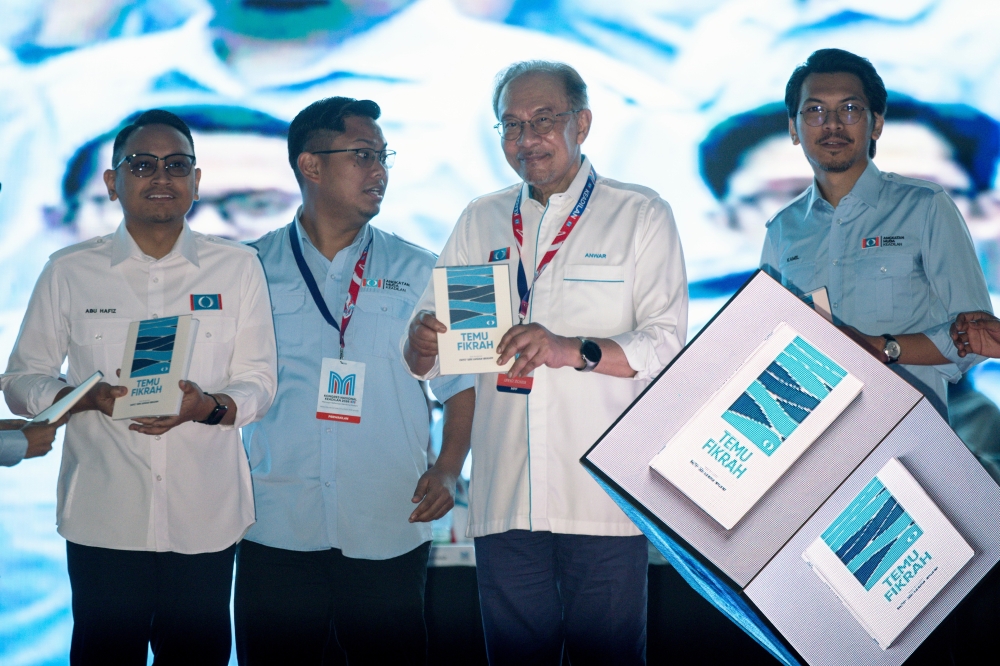
Prime Minister Datuk Seri Anwar Ibrahim has introduced Temu Fikrah, a foundational policy document developed by the youth wing of Parti Keadilan Rakyat (PKR), at an event in Melaka. The initiative represents an attempt to crystallise the party's ideological direction while simultaneously providing actionable guidance for governance implementation at the grassroots level. By merging traditional manifesto elements with pragmatic administrative frameworks, PKR Youth aims to position itself as both ideologically grounded and practically oriented within the broader coalition government.
The naming of the document—Temu Fikrah, roughly translating to "Ideas Meeting" or "Convergence of Thought"—signals an intention to create a dynamic, inclusive platform rather than a rigid blueprint. This linguistic choice carries significance in Malaysian political discourse, where the ability to appeal across communal and ideological divides remains crucial for coalition stability. The framework explicitly emphasises three pillars: courage (in policy formulation and implementation), creativity (in problem-solving and institutional innovation), and alignment with Madani governance principles—the overarching development framework that has defined the government's strategic direction since the unity administration took office.
Courage as a governing principle addresses a persistent challenge within coalition governments: the tendency toward consensus-building that can dilute bold policy initiatives. By explicitly elevating courage as a defining characteristic, PKR Youth signals that the party intends to champion progressive positions, whether on economic restructuring, social policy, or institutional reform. This is particularly relevant for Malaysia, where competing interests within the broad unity coalition often necessitate careful navigation of contentious issues. The emphasis suggests PKR Youth views its role as a catalyst for advancing reform agendas that might otherwise face resistance from more conservative coalition partners.
The creativity pillar reflects broader global trends in governance innovation, particularly relevant in Southeast Asia where many nations grapple with balancing traditional institutions against modern demands. For Malaysia specifically, this focus on creative problem-solving acknowledges that conventional bureaucratic approaches may prove insufficient for addressing contemporary challenges—whether in digital transformation, economic diversification beyond palm oil and petrochemicals, or youth employment in an evolving labour market. By embedding creativity into its governance philosophy, PKR Youth positions innovation as a core value rather than a peripheral consideration.
Alignment with Madani governance warrants closer examination within the Malaysian context. The Madani framework encompasses principles of solidarity, fairness, transparency, and sustainability. For PKR, a party historically associated with reform movements and social justice advocacy, this alignment represents both continuity and strategic positioning. The youth wing's explicit commitment to Madani principles effectively anchors itself within the government's broader legitimacy narrative while claiming ownership of progressive implementation. This move consolidates PKR's identity within the ruling coalition and differentiates it from other member parties.
The launch in Melaka carries its own symbolic weight. The state occupies a unique position in Malaysian history and contemporary politics—historically significant as a sultanate and colonial foothold, yet representing important political competition and coalition dynamics in recent years. Selecting Melaka for this announcement suggests PKR is signalling commitment to rebuilding or consolidating support in states where the party faces electoral challenges or where youth engagement needs strengthening. The geographic choice underscores that this is not merely a document for the federal capital or party headquarters, but one intended for deployment and implementation across the federation.
For PKR Youth specifically, Temu Fikrah addresses an institutional need within the party structure. Youth wings across Malaysian political parties frequently struggle with coherent identity and strategic purpose—positioned between aspirational ideology and practical constraint, between member energisation and party discipline. By publishing a comprehensive policy document that bridges manifesto ideals with governance mechanics, PKR Youth establishes itself as a serious policy actor rather than merely a mobilisation apparatus for party elections or campaigns. This development carries implications for how the party approaches talent development and succession planning.
The document's dual function as both manifesto and practical manual reflects evolving approaches to political communication in Southeast Asia. Rather than treating ideological positioning and administrative implementation as separate exercises, PKR Youth's approach integrates them. This integration acknowledges that contemporary voters—particularly younger constituencies—expect coherence between stated principles and actual delivery. The document thus serves both internal party purposes (establishing shared frameworks for decision-making) and external communication objectives (demonstrating to voters that PKR Youth has thought through implementation details).
Context within the broader Malaysian political landscape reveals additional significance. The unity coalition government that brought Anwar to the premiership represents a delicate balance among parties with divergent interests and ideological commitments. Within this environment, sub-party entities like PKR Youth claiming policy autonomy and initiative could either strengthen the coalition by demonstrating internal diversity and intellectual vitality, or create complications if positions articulated by the youth wing contradict official coalition policy. The launch's emphasis on alignment with Madani governance appears designed to forestall such complications by establishing clear parameters for youth wing activism.
The introduction of Temu Fikrah also reflects broader regional patterns in political party modernisation. Across Southeast Asia, established political parties increasingly publish strategic documents and policy frameworks to compete for credibility against newer movements and independent candidates. By professionalising its policy output and investing in document-based communication, PKR Youth positions itself within this modernised political space. The effort signals that the party takes intellectual engagement seriously and expects voters to engage with substantive policy rather than personality-based politics alone.
Implementation will prove critical to determining whether Temu Fikrah becomes a meaningful governance tool or remains largely ceremonial. The document's relevance will depend on whether PKR Youth actually references it in policy debates, whether party leadership incorporates its frameworks into decision-making, and whether the youth wing successfully uses it to mobilise members around concrete initiatives. The measure of success extends beyond the launch event itself to observable changes in how PKR approaches governance at various administrative levels and how the party engages younger constituencies on substantive policy grounds.
Looking forward, Temu Fikrah may influence how Malaysian political parties develop institutional capacity for policy work. If other parties respond by publishing comparable frameworks, Malaysian politics could gradually shift toward more policy-centred competition. Conversely, if Temu Fikrah becomes relegated to symbolism without practical implementation, it may reinforce skepticism about party documents as genuine governance tools. For PKR Youth, the document represents an opportunity to establish the party within Malaysian political discourse as a source of innovation and practical progressivism—but only if the party demonstrates sustained commitment to the principles and mechanisms it has articulated.

