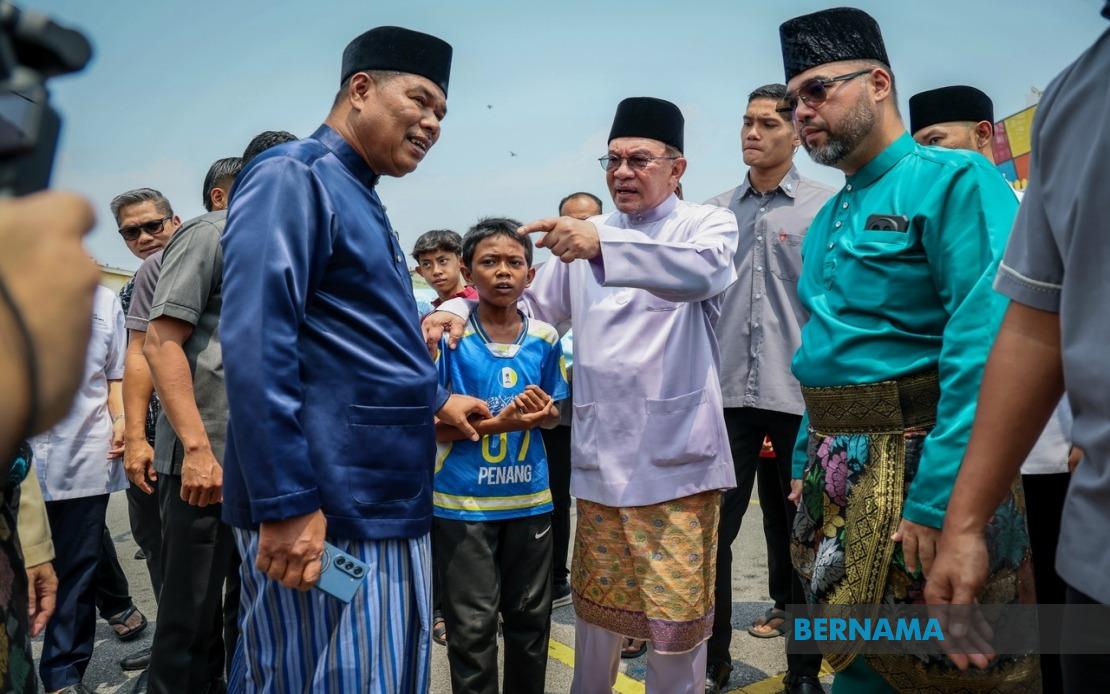
Prime Minister Datuk Seri Anwar Ibrahim has firmly signalled that he will not involve himself in the corruption investigation targeting former Human Resources Minister Datuk Seri M. Saravanan, declaring that such matters fall squarely within the purview of Malaysia's independent anti-corruption and prosecutorial agencies. Speaking to reporters after Friday prayers at Masjid Sembilang in Butterworth on August 28, Anwar made clear his view that once cases reach the stage of formal investigation and legal proceedings, they cease to be matters for political intervention or prime ministerial concern.
The statement came in response to questions about a letter Saravanan had sent to the Prime Minister. According to Saravanan's clarification, the correspondence was not designed as a plea for executive clemency or case dismissal, but rather as an explanation of his personal position regarding the allegations. This distinction proved significant, as it allowed both men to maintain that no inappropriate attempt at political pressure had occurred. Nevertheless, Anwar's immediate and unequivocal response underscored his administration's determination to signal respect for institutional boundaries between the executive and law enforcement agencies, a sensitive issue in Malaysian politics where perceptions of political interference in prosecutions have historically damaged public trust.
The Tapah Member of Parliament earlier appeared before the Kuala Lumpur Sessions Court, where he pleaded not guilty to three separate corruption charges totalling RM1.097 million. The charges relate to approvals granted for foreign worker quotas, an area that fell under his ministerial jurisdiction before he left office. The specificity of the financial quantum and the detailed nature of the allegations suggest a substantial investigative file, likely accumulated over an extended period of scrutiny by the Malaysian Anti-Corruption Commission prior to prosecution.
Anwar's deliberate distancing from the case reflects broader efforts by his administration to project an image of institutional integrity and respect for the rule of law. Since coming to power, the Prime Minister has repeatedly emphasised that his government, while committed to combating corruption, operates distinct from the enforcement agencies tasked with investigation and prosecution. This rhetorical positioning serves multiple audiences: international investors and rating agencies who view judicial independence as foundational to economic confidence, domestic observers sceptical of whether political leaders genuinely permit unfettered prosecutions, and members of his own coalition who may face scrutiny themselves.
The involvement of both the MACC and the Attorney-General's Chambers in the Saravanan case represents the standard prosecutorial pathway for high-level corruption allegations in Malaysia. The MACC conducts investigations, while the AGC's office decides whether sufficient evidence exists to prosecute and handles courtroom proceedings. By explicitly deferring to both agencies, Anwar reinforced their institutional autonomy and sent a signal to the judiciary that the executive entertains no position on the merits of the case. Such deference carries particular weight in Malaysia, where memories of political manipulation of corruption cases remain vivid and where public scepticism about whether the law truly applies equally to elites persists.
The case carries implications beyond the individual defendant. Saravanan's portfolio as Human Resources Minister placed him at the intersection of labour policy, foreign worker management, and business interests. Foreign worker quota systems are known globally as areas susceptible to corrupt arrangements, where employers, agents, and officials may conspire to allocate scarce permits in exchange for improper benefits. The RM1.097 million figure suggests either substantial bribes or a pattern of smaller arrangements over time. The court proceedings will likely expose the mechanics of how such arrangements allegedly operated, providing the public and policymakers with insights into vulnerabilities within the quota approval system.
For the Malaysian business community, particularly firms reliant on migrant labour, the prosecution sends a cautionary message about the risks of informal arrangements with officials. It also underscores that even holders of high ministerial office face prosecution if evidence of wrongdoing exists. This can be viewed positively as demonstrating the reach of anti-corruption efforts, or negatively as creating uncertainty about the stability of regulatory relationships. Either way, the case injects volatility into a sector already managing complex regulatory and labour supply challenges.
The timing of Anwar's statement, delivered immediately after court proceedings and without apparent hesitation, suggests the Prime Minister had pre-planned his response and consulted with advisers on the appropriate boundaries of executive commentary. Such careful choreography reflects the delicacy of the issue. Failure to comment might have suggested executive indifference to corruption allegations; excessive sympathy toward the defendant would have invited accusations of political interference. Anwar's measured approach—acknowledging the letter while firmly refusing to engage with its substance—represents an effort to navigate these competing pressures.
Looking forward, the Saravanan case will proceed through the court system on its merits, with the outcome determined by evidence and legal argumentation rather than political considerations. Whether the judicial process itself will restore public confidence in Malaysia's capacity to hold elites accountable remains an open question, dependent not merely on the formal verdict but on the transparency and coherence of the proceedings and the integrity of the evidence presented. Anwar's withdrawal from the political arena surrounding the case represents an acknowledgment that such confidence cannot be manufactured through executive pronouncements, but only earned through consistent institutional conduct.

