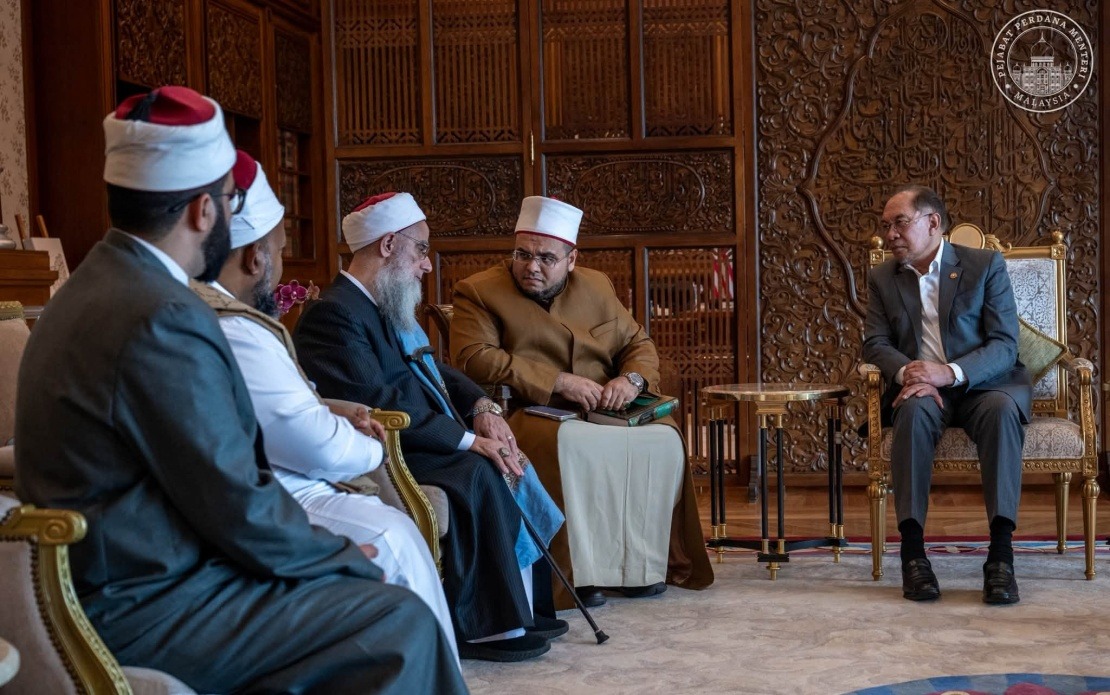
Prime Minister Datuk Seri Anwar Ibrahim received a courtesy visit from renowned Egyptian Islamic scholar Sheikh Dr Mustafa An-Nadwi Al-Hasani Mansurah at his official residence in Putrajaya on July 20, marking another significant engagement in Malaysia's ongoing diplomatic and intellectual exchanges with prominent figures in the Islamic world.
The Prime Minister used the occasion to highlight Sheikh Dr Mustafa's reputation as a leading authority in Islamic scholarship, particularly his extensive knowledge of hadith studies and his commitment to promoting moral and ethical values. Anwar's emphasis on the scholar's academic credentials and theological contributions reflects Malaysia's continued interest in engaging with respected voices within the global Islamic intellectual community, particularly those who advocate for measured and thoughtful approaches to contemporary religious discourse.
In articulating his appreciation for the visit, Anwar drew attention to Sheikh Dr Mustafa's lineage within Islamic scholarship circles. The Egyptian scholar represents the intellectual tradition established by Sheikh Abul Hasan Ali al-Nadwi, a globally recognized Islamic scholar and preacher whose influence extends across multiple generations of students and followers. This connection underscores the continuity of scholarly excellence within Muslim academic institutions and the transmission of knowledge through established pedagogical networks that have shaped Islamic thought for decades.
The Prime Minister's reflections on the nature of knowledge and wisdom carry particular resonance in contemporary Malaysia, where debates about the balance between substantive learning and sensationalism frequently occupy public discourse. Anwar's characterization of knowledge as arriving "like the morning dew, quiet, gentle, yet capable of bringing life" suggests a philosophical stance that values depth over superficial engagement and substantive understanding over reactive commentary. This perspective aligns with Malaysia's aspirations to position itself as a center for thoughtful Islamic scholarship and intellectual discourse rather than merely a venue for controversial pronouncements.
During their meeting, the two figures engaged in substantive discussions concerning current regional and international affairs, indicating that the visit extended beyond ceremonial pleasantries to encompass substantive policy conversations. Such exchanges between Malaysian leadership and international Islamic scholars have become increasingly important as Malaysia navigates complex geopolitical challenges while maintaining its identity as a majority-Muslim nation with significant non-Muslim communities and diverse religious perspectives.
Sheikh Dr Mustafa's presence in Malaysia during this particular week involved broader knowledge-sharing initiatives, suggesting that his visit formed part of a larger educational or cultural program. The scheduling of such visits often reflects deliberate planning by relevant Malaysian institutions and organizations to facilitate intellectual exchange and expose local audiences to recognized voices within international Islamic academia. For Malaysia's diverse population, exposure to balanced and erudite perspectives on Islamic teaching can contribute meaningfully to religious literacy and counter polarizing narratives.
Anwar's expression of gratitude for the scholar's prayers and well-wishes for Malaysian unity and prosperity carries symbolic weight. In a nation where religious harmony and social cohesion remain persistent policy priorities, such mutual expressions between national leaders and international religious figures publicly reinforce the commitment to these principles. The Prime Minister's reciprocal prayers for Sheikh Dr Mustafa's continued health, academic productivity, and ability to guide communities with wisdom and moderation further emphasize the alignment between Malaysia's stated values and the scholarly approach represented by the visiting Egyptian academic.
The emphasis placed on moderation and compassion in Anwar's commentary reflects enduring themes within Malaysian Islamic discourse and governance. These principles have historically distinguished Malaysia's approach to religious affairs from more rigid or absolutist interpretations found elsewhere in the Muslim world. The meeting thus serves as a quiet reaffirmation of Malaysia's institutional commitment to this moderate positioning, particularly in international forums and through engagements with recognized scholars.
From a diplomatic standpoint, such visits illustrate Malaysia's active role in cultivating relationships with intellectual and spiritual leaders across the Muslim world. These connections extend Malaysia's soft power and enhance its credibility as a country where serious Islamic scholarship flourishes alongside religious pluralism and democratic governance. For Malaysia's international standing, hosting and engaging respectfully with recognized Islamic scholars demonstrates the country's mature approach to religious affairs and its ability to welcome diverse perspectives while maintaining social stability.
The timing and nature of this engagement also merit consideration within the context of Malaysia's broader regional positioning. As Southeast Asia's largest Muslim-majority nation, Malaysia continues to play a bridging role between different Islamic intellectual traditions and approaches to contemporary challenges. Visits from established Egyptian scholars strengthen these connections and reinforce Malaysia's identity as an intellectual crossroads within the Islamic world, complementing its roles as a hub for Islamic finance, Islamic law, and interfaith dialogue.
For Malaysian audiences, particularly those engaged with Islamic education and scholarship, such visits provide opportunities to access teachings and insights from globally recognized figures without requiring international travel. The facilitation of these knowledge-sharing sessions reflects Malaysia's commitment to ensuring that serious Islamic learning remains accessible within the country, thereby supporting the development of local scholarly capacity and preventing a potential intellectual brain drain.
As Malaysia continues to navigate complex religious and social challenges, the symbolic and substantive dimensions of such high-level meetings with international Islamic figures become increasingly significant. They serve as public signals that Malaysia remains committed to grounding its religious discourse in serious scholarship, ethical principles, and intellectual traditions that extend beyond national boundaries, while simultaneously reinforcing the country's distinctive approach to balancing religious commitment with pluralistic governance.

