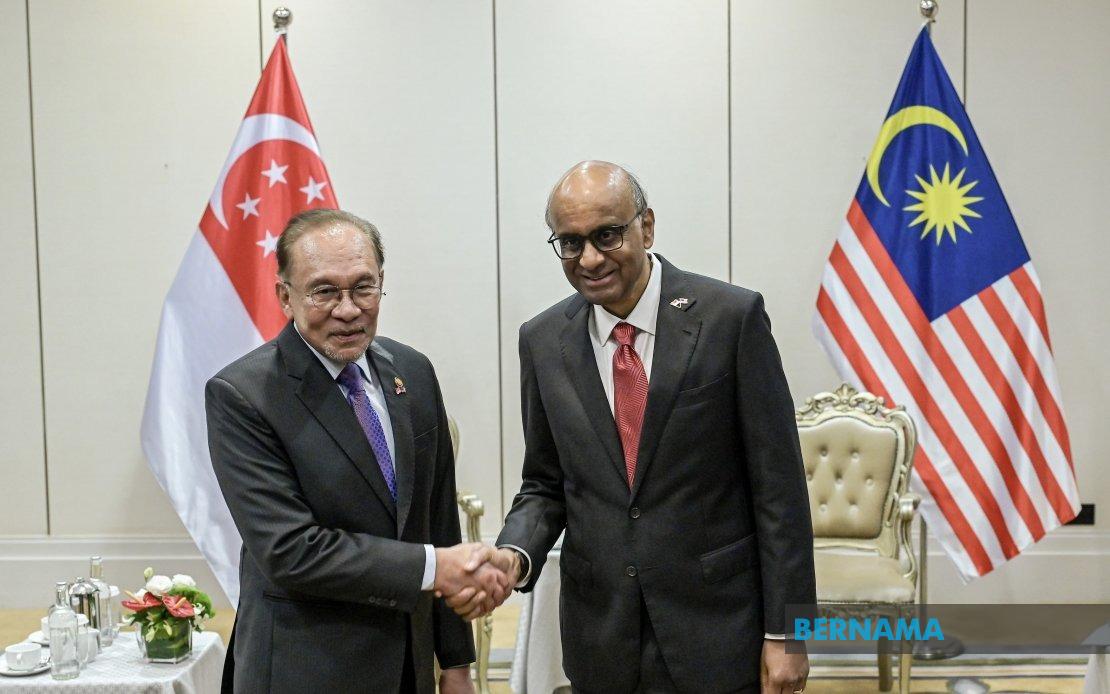
Prime Minister Datuk Seri Anwar Ibrahim welcomed Singapore President Tharman Shanmugaratnam on Monday during an official state visit that underscores the two neighbouring nations' commitment to strengthening bilateral relations. The meeting, which lasted 40 minutes, brought together senior Malaysian government officials including Foreign Minister Datuk Seri Mohamad Hasan and Investment, Trade and Industry Minister Datuk Seri Johari Abdul Ghani, signalling the importance placed on the engagement by both sides.
The state visit, which runs from July 13 to 15, comes at the formal invitation of the Yang di-Pertuan Agong Sultan Ibrahim. Earlier in the day, President Tharman received a ceremonial welcome at Istana Negara, where he was received by the King himself—a customary honour extended to visiting heads of state that reflects the diplomatic significance of the occasion. The presence of high-ranking officials from both countries, including Entrepreneur and Cooperatives Development Minister Steven Sim Chee Keong and senior government representatives, demonstrated the multifaceted nature of contemporary Malaysia-Singapore cooperation beyond traditional diplomatic channels.
This visit represents a reciprocal gesture following the Yang di-Pertuan Agong's state visit to Singapore in May 2024. Such back-and-forth exchanges are integral to regional diplomacy, particularly between two neighbouring countries whose people, economy, and geography are deeply interconnected. The deliberate timing and protocol surrounding these visits reinforce the principle of balanced engagement and mutual respect that characterises the relationship between Kuala Lumpur and Singapore.
From an economic perspective, the two countries maintain one of Southeast Asia's most robust commercial relationships. Singapore holds the position of Malaysia's second-largest global trading partner and, more significantly, represents Malaysia's largest trading partner within ASEAN. This distinction is crucial for understanding Malaysia's regional standing and the central role Singapore plays in the country's broader economic strategy.
The trade figures illustrate the vigour of the bilateral commercial relationship. In 2025, total bilateral trade between Malaysia and Singapore reached RM402.35 billion, equivalent to approximately US$93.97 billion. Although this represented a modest increase of just 1.5 per cent compared with 2024, the absolute magnitude of trade flows demonstrates the depth of economic integration between the two economies. For Malaysian businesses and policymakers, these numbers reflect substantial opportunities in goods, services, and investment flows.
More encouraging are the early-year figures, which suggest strengthening momentum. During the January to May period of 2025, bilateral trade climbed 14.5 per cent to reach RM189.90 billion, compared with RM165.93 billion during the same five-month window in the previous year. This acceleration signals renewed dynamism in the trading relationship and suggests that the modest annual growth rate masks stronger underlying trends. The jump from the first half of 2024 to the corresponding period in 2025 is particularly significant, indicating that the relationship has recovered and moved beyond any earlier stagnation.
These trade metrics carry implications for Malaysian exporters, particularly those in manufacturing, petrochemicals, and electrical and electronics sectors, which form the backbone of the bilateral commercial relationship. Singapore's role as a regional financial and logistics hub means that many Malaysian companies leverage the city-state as a gateway to broader Asian and international markets. Similarly, Singaporean investors and traders maintain substantial operations across Malaysia, spanning retail, finance, infrastructure, and real estate.
The official engagement between President Tharman and Prime Minister Anwar also underscores the importance of maintaining high-level political dialogue in an era when economic ties alone may not be sufficient to navigate regional complexities. Regional security, maritime cooperation, and transnational issues such as environmental protection and people-to-people exchanges require sustained diplomatic attention. By investing in these face-to-face meetings, both governments signal their commitment to addressing shared challenges collaboratively.
For Malaysia and the wider Southeast Asian region, the maintenance of strong Malaysia-Singapore relations carries broader significance. The two countries' ability to cooperate effectively sets a positive tone for ASEAN cohesion and contributes to regional stability. Their coordinated approach to trade, security, and development issues influences the direction of regional policy and shapes the environment in which other ASEAN members operate. A fruitful bilateral relationship between Kuala Lumpur and Singapore supports collective regional resilience and strengthens ASEAN's voice in global affairs.
Looking forward, the state visit provides an opportunity for both countries to discuss emerging priorities such as digital economy integration, green energy transition, and supply chain resilience in the post-pandemic era. With global economic uncertainties and shifting geopolitical dynamics affecting Southeast Asia, the depth and quality of Malaysia-Singapore cooperation will remain critical to both nations' prosperity and security.

