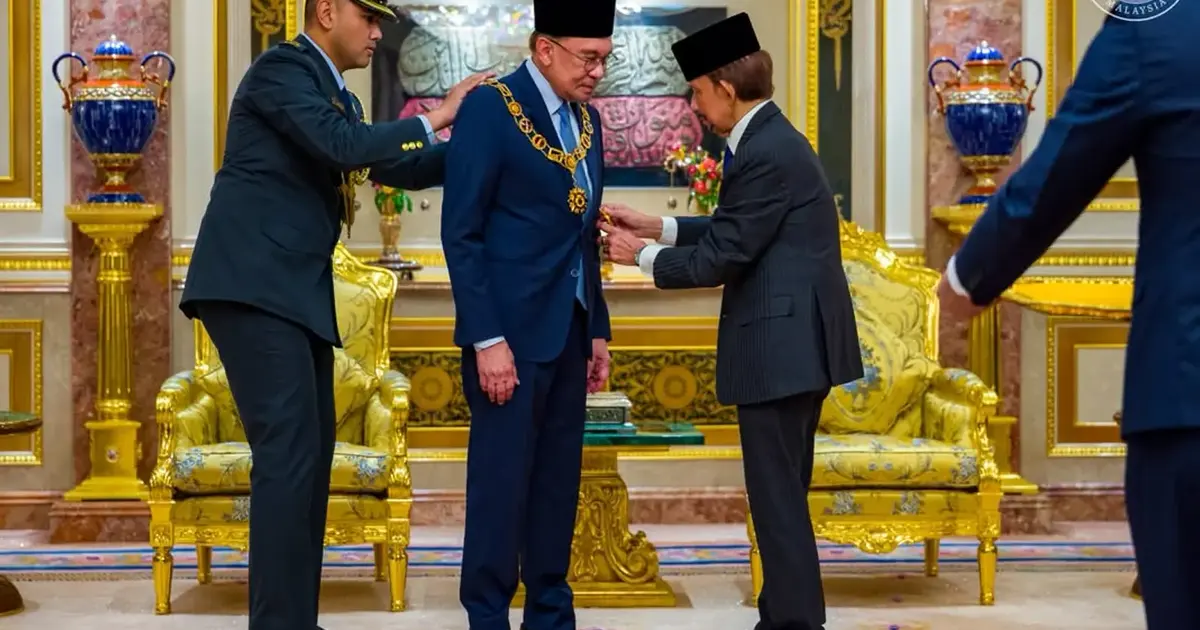
Prime Minister Anwar Ibrahim has received one of Brunei Darussalam's highest honours, recognising his contributions to bilateral relations between Malaysia and the sultanate. Sultan Hassanal Bolkiah conferred upon him the Darjah Kerabat Laila Utama Yang Amat Dihormati (D.K.), an accolade that reflects the strength of ties between the two neighbouring Southeast Asian nations.
The conferment of this honour underscores the importance both governments place on maintaining robust diplomatic and economic partnerships within the region. The D.K. honour represents Brunei's recognition of Anwar's leadership and efforts to strengthen multilateral cooperation across ASEAN. Such decorations typically acknowledge outstanding service to the Crown and meaningful contributions to bilateral relations.
Malaysia and Brunei share deep historical ties rooted in geography, culture, and shared Islamic heritage. The two nations cooperate closely through ASEAN frameworks and bilateral channels on matters ranging from security to trade. Anwar's receipt of this honour signals continued political goodwill at the highest levels between Kuala Lumpur and Bandar Seri Begawan.
The timing of this recognition comes amid Malaysia's active engagement in regional diplomacy. As ASEAN navigates complex geopolitical challenges and economic transitions, bilateral relationships between member states remain pivotal. Brunei, despite its small population, wields considerable influence within ASEAN as a founding member and has consistently championed dialogue and consensus-building.
Sultan Hassanal Bolkiah, who has ruled Brunei since 1967, maintains particular importance in Southeast Asian affairs. The sultan's authority to confer state honours reflects his position as both the head of state and head of government. Royal honours serve as diplomatic tools that acknowledge achievements while strengthening personal relationships between national leaders.
For Anwar, who has served as Prime Minister since November 2022, such international recognition validates his efforts to elevate Malaysia's standing in regional affairs. His administration has prioritised ASEAN engagement and intra-regional cooperation as cornerstone policies. The honour demonstrates that Malaysia's immediate neighbours value his leadership approach.
Brunei's honour system carries significant weight in Southeast Asian diplomatic circles. The D.K. honour places Anwar among a select group of regional and international figures recognised by the sultanate. Acceptance of such honours typically involves reciprocal diplomatic gestures that further cement relationships between nations.
The recognition also reflects broader efforts by both governments to maintain stability in Brunei's neighbourhood. Malaysia and Brunei have worked collaboratively on maritime boundary matters, security cooperation, and economic initiatives. Such formal acknowledgements help sustain momentum on these practical partnerships that benefit both populations.
This honour arrives as Malaysia continues calibrating its foreign policy position amid evolving regional dynamics. ASEAN's collective influence depends partly on strong bilateral relationships among members. When countries formally recognise their leaders' contributions, it signals commitment to ongoing cooperation and mutual respect.
For Malaysian observers, the distinction reflects positively on the country's diplomatic standing. Regional recognition of national leaders carries domestic significance, enhancing their credibility both at home and abroad. The honour contributes to Malaysia's image as an engaged, respected member of the ASEAN community.
Brunei's gesture also acknowledges Malaysia's role in supporting the sultanate's initiatives within ASEAN. Malaysia, as the larger economy and more populous neighbour, maintains particular responsibility for maintaining harmonious regional relations. Formal honours like the D.K. serve as tangible expressions of appreciation for such statesmanship.
Looking forward, this honour reinforces the foundation for continued cooperation between the two nations. Regional challenges—from climate change to technological transformation—require sustained partnership among ASEAN members. When leaders receive international recognition, it typically energises collaborative efforts on shared priorities.
The conferment illustrates how Southeast Asian nations employ traditional diplomatic protocols to strengthen contemporary relationships. Royal honours carry cultural resonance in monarchical systems while serving practical purposes in international relations. This recognition positions Anwar and, by extension, Malaysia favourably within regional power dynamics as ASEAN navigates its next chapter of development and integration.

