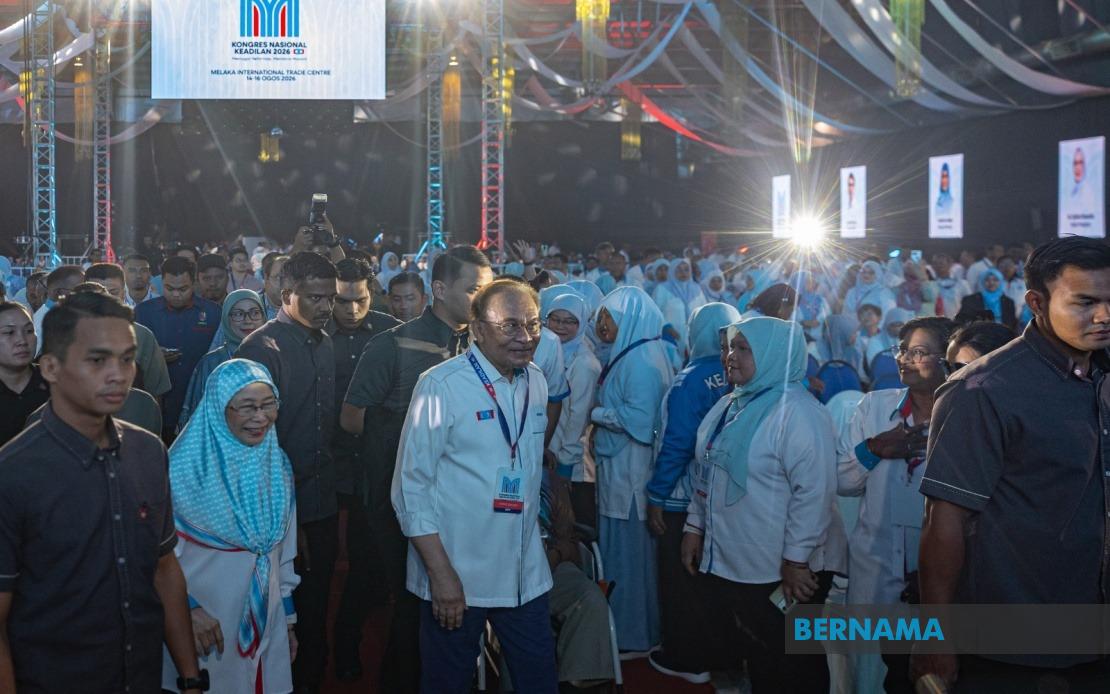
Prime Minister Datuk Seri Anwar Ibrahim has moved to reassert the durability of Malaysia's Unity Government coalition, declaring that sustained partnership with UMNO-Barisan Nasional (BN) remains a strategic imperative for the country's political stability and economic trajectory. Speaking at the PKR National Congress 2026 at the Melaka International Trade Centre on August 16, Anwar stressed that recent developments would not deter the federal administration from pursuing collaborative governance with its coalition partners, signalling an intent to navigate Malaysia's fractious political landscape through institutionalised cooperation rather than confrontation.
The Prime Minister's remarks came at a juncture when Malaysian political observers have closely monitored the relationship between Pakatan Harapan-led components and their UMNO-BN counterparts within the broader Unity Government architecture. Anwar's explicit endorsement of continued collaboration suggests a calculated pragmatism aimed at preserving the coalitional equilibrium that has underpinned governance since the administration's formation. By framing the decision as one rooted in rational decision-making rather than temporary political expediency, Anwar sought to position the Unity Government as a mature institutional arrangement rather than an unstable marriage of convenience.
Central to Anwar's messaging was a philosophical departure from what he characterised as personalised or emotion-driven political calculations. The Prime Minister articulated a framework in which policy decisions and strategic partnerships must be evaluated through the lens of collective national interest rather than individual ambition, factional advantage, or grievance management. This rhetorical positioning carries significance for the broader Malaysian political ecosystem, where accusations of self-interested manoeuvring and revenge politics have historically destabilised coalitions and fragmented voter confidence in institutional governance.
The emphasis on economic growth and people's prosperity as the twin pillars guiding continued UMNO-BN cooperation reflects a pragmatic acknowledgement that Malaysia's electorate increasingly demands tangible returns on political stability. The country has experienced volatility in investor confidence and growth trajectory amid political uncertainty over the past decade, and Anwar's framing positions the Unity Government as a stabilising mechanism that can deliver macroeconomic benefits. By linking coalition durability to household prosperity and business confidence, the Prime Minister attempted to move the political narrative beyond zero-sum factional competition towards shared developmental objectives.
Anwar's dual role as Prime Minister and Parti Keadilan Rakyat president adds layers of complexity to his statement, as it suggests he is not only representing federal executive interests but also attempting to secure internal party endorsement for the UMNO-BN partnership. PKR, as the anchoring component of Pakatan Harapan, harbours diverse factional interests and has historically maintained ideological distance from UMNO on governance principles and anti-corruption commitments. By articulating his position at a party congress, Anwar signalled that he is actively building intra-party consensus around the coalition strategy, a crucial prerequisite for sustaining government stability.
The timing of these remarks deserves analytical attention. References to "what has happened recently" indicate that specific triggers or incidents had prompted renewed questioning of Unity Government coherence. Malaysian politics frequently experiences tremors—disagreements over policy priorities, resentment over resource allocation, or personalised disputes among senior figures—that threaten coalition sustainability. Anwar's preemptive reassurance suggests that party cadres and coalition partners had begun signalling anxiety about the administration's durability, necessitating high-level reaffirmation from the Prime Minister himself.
From a Southeast Asian governance perspective, Malaysia's Unity Government represents a notable experiment in post-election coalition-building among ideologically diverse partners. Unlike competitive two-party systems that emerge from electoral mandates, the Unity Government was constructed through negotiated compromise across the Pakatan Harapan-UMNO-BN divide following the 2022 general election. This arrangement has provided Malaysia with consistent government formation and avoided the prolonged post-election negotiations that characterised previous transitions, yet it remains susceptible to defection and internal friction given the absence of a clear electoral mandate for the specific coalition composition.
Anwar's commitment to continued UMNO-BN partnership carries implications for Malaysian federalism and state-level governance as well. Several Malaysian states operate under different political dispensations, with some governed by opposition coalitions or UMNO-BN controlled administrations independent of federal coordination. The sustainability of federal-level Unity Government arrangements can influence the calculus facing state-level political actors and potentially shape electoral behaviour in forthcoming state elections scheduled across various states in the coming years.
The articulation of this position also reflects broader regional trends in Asian democracy, where grand coalitions and consensus-based governance models have gained prominence as alternatives to winner-take-all electoral outcomes. Thailand, Indonesia, and other regional democracies have grappled with similar coalition management challenges, making Malaysia's experience instructive for understanding how diverse political forces can be integrated into workable governing arrangements without sacrificing institutional effectiveness or democratic accountability.
For Malaysian business and investor communities, Anwar's reassurance about continued political cooperation directly addresses concerns about policy predictability and governance continuity. Foreign and domestic investors monitoring Malaysia's political stability interpret coalition durability as a proxy for the likelihood of sustained macroeconomic policymaking and infrastructure investment. By embedding economic growth rhetoric within his coalition partnership statement, Anwar effectively communicated that political pragmatism translates into commercial confidence.
Moving forward, the sustainability of this reaffirmed UMNO-BN partnership will depend on managing competing factional interests, distributing ministerial and resource allocations satisfactorily across coalition members, and demonstrating tangible delivery on the prosperity agenda that Anwar articulated. Historical precedent suggests that coalitions constructed on pragmatic rather than ideological foundations require consistent leadership attention and occasional recalibration to maintain member satisfaction and prevent defection.

