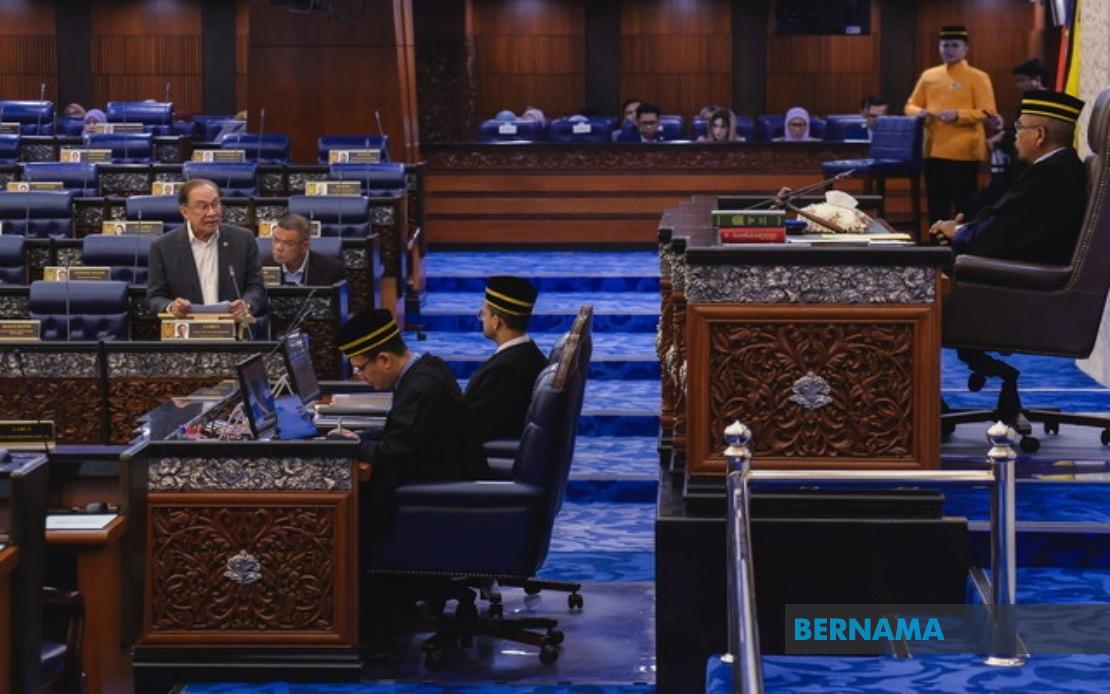
Prime Minister Datuk Seri Anwar Ibrahim has made clear that Malaysia's election laws continue to prohibit the announcement of fresh projects or policies during campaign periods, reinforcing a position his administration intends to uphold rigorously. Speaking during Minister's Question Time in Parliament today, Anwar addressed concerns raised by Datuk Seri Dr Shahidan Kassim from PN-Arau regarding the enforcement of these restrictions ahead of the forthcoming state elections in Johor, Melaka and Negeri Sembilan.
The restriction finds its legal foundation in Section 24B of the Election Offences Act 1954, a statute designed to prevent the manipulation of public resources for electoral advantage. Anwar emphasised that once nomination day is declared, all political activities must adhere strictly to these parameters. The government's position is categorical: from the moment nomination is announced until polling concludes, no government body—whether at federal, state or local level—may use its machinery to unveil new projects or pledge new policy initiatives.
This prohibition extends across all tiers of administration. City councils, state governments and federal agencies alike are bound by the same constraints. The Prime Minister's comments suggest the government views this as a fundamental safeguard for electoral integrity, preventing those in power from leveraging their administrative control to secure electoral advantage through targeted spending announcements. Such measures, authorities argue, are essential to ensure that voters base their choices on party platforms and track records rather than last-minute project pledges.
However, Anwar's statement included an important clarification that provides governmental flexibility within the legal framework. Projects that have already received formal approval or secured funding allocations under previous federal budgets do not violate election regulations when announced. This distinction is significant because it allows governments to proceed with commitments made prior to the election period without artificially constraining the flow of information about existing initiatives. The mechanism essentially separates advance planning from election-period opportunism.
The timing of this clarification is particularly relevant for Malaysian voters and observers. With state elections looming in three major states, questions naturally arise about how authorities will distinguish between genuinely pre-approved projects and those hastily assembled to influence voters. The onus falls on government agencies to maintain clear documentation of budget allocations and approval dates, creating an auditable trail that election authorities can reference if disputes arise.
For Malaysian practitioners of electoral politics, the rules create a delicate balancing act. Opposition parties will undoubtedly scrutinise any project announcements made during the campaign period, challenging their legitimacy by questioning whether they truly benefited from prior budget approvals. This adversarial process effectively acts as a compliance mechanism, as opposition scrutiny provides immediate consequences for violations. The transparency required to defend announcements becomes itself a deterrent against circumventing the rules.
The broader context matters considerably. Malaysia has experienced past election cycles where large-scale development announcements during campaign periods drew criticism from observers concerned about fair competition. By reaffirming these restrictions, Anwar signals that his administration intends to operate within prescribed legal boundaries, a positioning that carries weight given his own history of electoral contestation. His government faces electoral pressure in these state races, making his emphasis on rule-adherence noteworthy.
Enforcement mechanisms remain an area of potential concern. While Anwar's statement confirms the restrictions remain in place, the question of how violations will be detected and prosecuted remains less clearly delineated. Election authorities possess limited visibility into administrative decision-making processes unless complaints are filed and investigated. This asymmetry between rule clarity and enforcement robustness suggests that voluntary compliance by government officials remains crucial to the system's effectiveness.
For Southeast Asia more broadly, Malaysia's approach reflects a common challenge across the region: balancing government legitimacy and operational continuity against electoral fairness. Elected governments naturally wish to continue delivering services and announcing achievements, while election commissions seek to prevent the systematic abuse of state resources. Malaysia's framework attempts this balance through temporal restrictions rather than absolute prohibitions, permitting governmental business-as-usual outside campaign periods while protecting the campaign itself from administrative interference.
The practical implications ripple through state administrations currently preparing for elections. Officials must audit their project pipelines, determine which initiatives received prior approval, and prepare comprehensive documentation. This administrative burden, while modest in absolute terms, creates friction that itself discourages hasty project invention designed purely for electoral effect. The procedural requirements thus reinforce substantive compliance.
Looking ahead, the Johor, Melaka and Negeri Sembilan elections will serve as tests of whether this framework operates as intended. These are meaningful contests where all major coalitions are competitive, ensuring that violations would face scrutiny from motivated opponents. The resulting electoral competition thus creates enforcement pressure beyond formal institutional mechanisms, generating what amounts to distributed monitoring across political actors themselves.
Anwar's reiteration also carries messaging significance for the bureaucracy. Government officials at all levels now receive explicit confirmation that the Prime Minister expects adherence to these restrictions. Such public statements, particularly from the head of government, carry weight in establishing expectations throughout the civil service. Officials cognisant of the PM's position will naturally err toward caution, reporting proposed announcements up the chain of command for compliance verification rather than proceeding independently.

