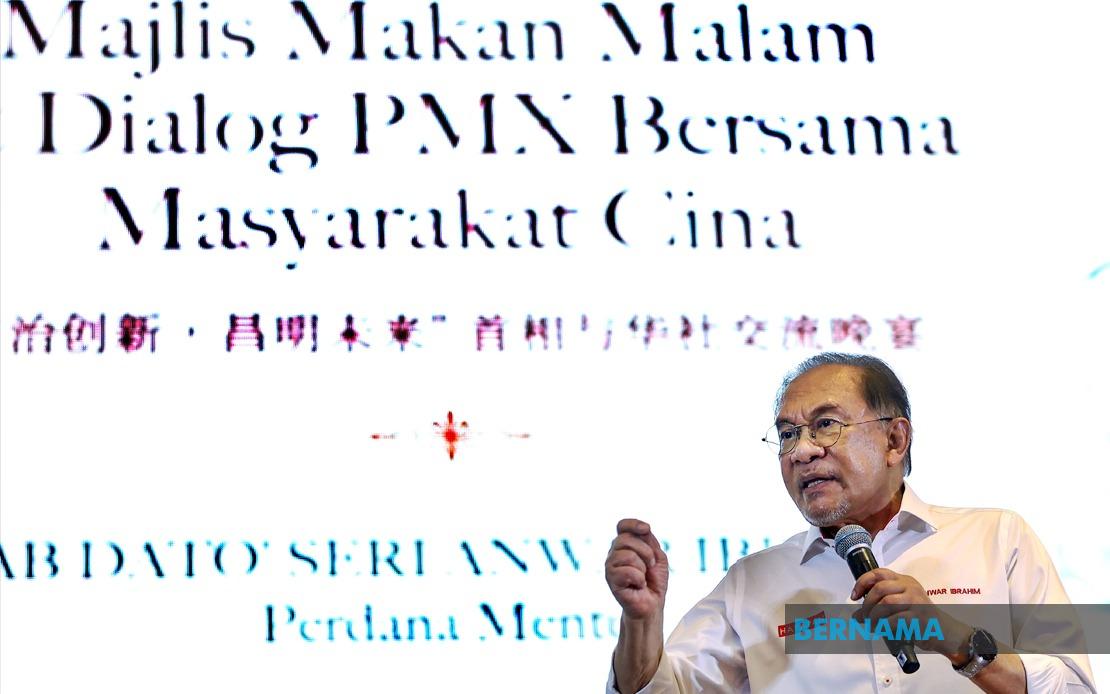
Prime Minister Datuk Seri Anwar Ibrahim has renewed his dedication to transforming Malaysia into a thriving nation, emphasising that his vision centres on inclusive governance that transcends communal boundaries. Speaking at a community gathering in Johor Bahru on July 4, the Prime Minister articulated a leadership philosophy grounded in accessibility and representation, signalling his intent to engage meaningfully with every demographic segment within the country.
At this juncture in his political career, Anwar has prioritised the construction of a durable institutional legacy rooted in principles of equity and transparency. His stated ambition is to be recalled by future generations as a leader whose tenure was characterised by impartial stewardship and unwavering dedication to the welfare of all Malaysians. This framing reflects a deliberate effort to position his administration beyond partisan concerns, instead anchoring it to broader national interests and cross-community solidarity.
During remarks made to members of the Chinese community, Anwar underscored that no citizen should be marginalised within Malaysia's political and social architecture. His assertion that serving all segments of society represents a fundamental responsibility of the Prime Minister's office carries particular weight given Malaysia's historical experience with communal tensions and the importance placed on inclusive governance models. By explicitly referencing his commitment to serve every community irrespective of ethnic background, Anwar appears to be signalling continuity with the constitutional bargain that has underpinned Malaysian nationhood since independence.
The Prime Minister's candid reflection on his advancing years introduces a temporal dimension to his leadership narrative. By acknowledging his age and mortality, Anwar frames his remaining years in office as an opportunity to cement principles that will outlast his tenure. This philosophical positioning suggests a shift from short-term political calculations toward long-term institutional reform and values consolidation. For Malaysian observers accustomed to leaders focused on immediate electoral cycles, such rhetoric represents a meaningful departure.
Anwar's emphasis on personal connection with the Malaysian populace—expressed through assertions that he must demonstrate genuine affection for his people—reflects an attempt to humanise high office and rebuild public trust in political leadership. This approach carries significance within the Malaysian context, where successive administrations have confronted questions regarding authenticity, corruption, and whether leaders genuinely prioritise national welfare over factional advancement. The Prime Minister's declaration that love between leader and citizenry must flow bidirectionally positions governance as fundamentally relational rather than transactional.
The gathering in Johor Bahru, attended by PKR vice president and Selangor Menteri Besar Datuk Seri Amirudin Shari, underscores the party's ongoing engagement with key constituencies during a period when the coalition government has sought to consolidate support across diverse communities. Johor, a state with significant demographic diversity and considerable economic importance, has historically functioned as a bellwether for broader national sentiment. The Prime Minister's choice to address Chinese community leaders in this location carries symbolic weight regarding efforts to maintain multiracial coalition cohesion.
Anwar's commitment to fair and clean governance intersects with broader international and domestic expectations regarding accountability standards. Malaysia's recent history of high-profile corruption cases and institutional reform efforts means that pledges regarding ethical leadership operate within a context where citizens and international observers have heightened scrutiny of governmental conduct. The reiteration of such commitments, while rhetorically valuable, ultimately requires demonstrable implementation through institutional mechanisms and policy outcomes that resonate beyond formal pronouncements.
The philosophical framework articulated by the Prime Minister—that national success depends on collective stewardship and shared responsibility—positions Malaysia's development trajectory as contingent upon overcoming historical divisions and consolidating national identity around inclusive principles. This narrative has resonance for Southeast Asian readers confronting similar challenges regarding nation-building, intercommunal relations, and the relationship between political leadership and social cohesion. Malaysia's experience with managing diversity offers lessons for neighbouring states navigating comparable transitions.
For Malaysian stakeholders across business, civil society, and political circles, Anwar's emphasis on serving all communities carries implications for resource allocation, policy prioritisation, and the distribution of opportunities within the state apparatus. Whether such commitments translate into substantive policy mechanisms—such as reformed procurement processes, inclusive economic programmes, or equitable access to developmental initiatives—will determine the practical significance of the stated legacy ambitions. The credibility of governance pledges ultimately depends upon alignment between rhetorical commitment and institutional reality.
The timing of these remarks, delivered during a period when the government navigates complex economic challenges and addresses expectations regarding democratic deepening, reflects the administration's effort to maintain legitimacy through appeals to shared national purpose. By grounding his leadership identity in service to all communities rather than factional interest, Anwar attempts to position his government as custodian of broader Malaysian aspirations. Whether such positioning endures depends substantially on sustained policy implementation and institutional performance across the remainder of his tenure.

