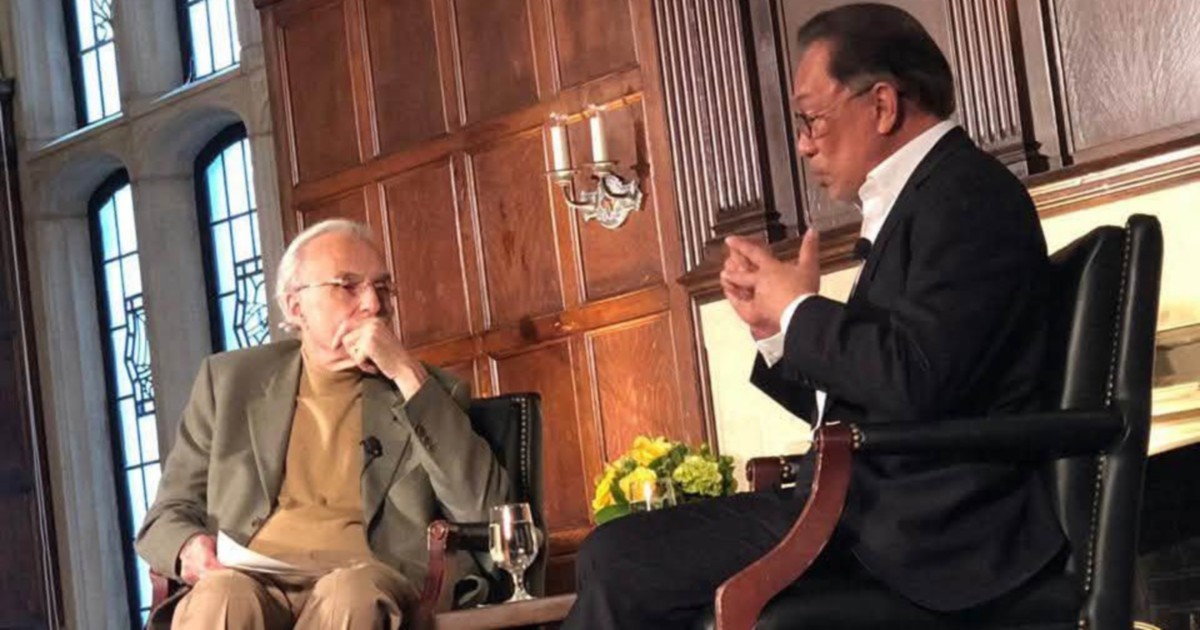
Prime Minister Datuk Seri Anwar Ibrahim has offered his deepest condolences following the death of Professor John L. Esposito, one of the world's most distinguished and authoritative voices in Islamic scholarship. The Malaysian leader's remarks underscored the significant intellectual contribution that Esposito made to global understanding of Islam and Muslim societies, a field of study that has become increasingly vital in an era of cross-cultural dialogue and heightened interest in interfaith understanding.
Esposito's passing represents a substantial loss to the academic community and to those working in the space between Islamic scholarship and Western intellectual discourse. Throughout his career spanning several decades, the American scholar became synonymous with rigorous, nuanced analysis of Islam's history, theology, politics, and contemporary relevance. His prolific body of work sought to present Islamic civilization and thought in a manner that moved beyond reductive stereotypes and ideological prejudgment, a mission that resonated with Muslim-majority nations and intellectuals worldwide.
The timing of Anwar's tribute reflects the enduring relevance of Esposito's scholarly legacy in Southeast Asia, a region where Malaysia itself plays a significant role in contemporary Islamic discourse. As a leader who has positioned himself at the intersection of Islamic governance and modern statecraft, Anwar's acknowledgement speaks to the universal appreciation for Esposito's efforts to foster informed dialogue between Muslim and non-Muslim worlds. The scholar's death comes as Malaysia and other regional nations continue to grapple with how to articulate Islamic values within pluralistic, globalized societies.
Throughout his tenure at Georgetown University's Prince Alwaleed Bin Talal Center for Muslim-Christian Understanding, Esposito established himself as an architect of interfaith dialogue and a champion of scholarly rigor in Islamic studies. His numerous publications, including foundational works on Islamic fundamentalism, the Islamic world in the 21st century, and the relationship between Islam and democracy, shaped academic curricula and policy discussions across the Western academy. Malaysian students and scholars have benefited from his frameworks and insights, contributing to the broader intellectual ecosystem that informs regional discussions on Islam's role in modern governance and social development.
Anwar's condolences highlight a broader recognition among Muslim leaders and intellectuals of the value that Western academic engagement with Islamic thought can bring to global understanding. Esposito's approach, grounded in historical scholarship rather than polemics, offered a corrective to sensationalized portrayals of Islam that have proliferated in media and political discourse since the early 2000s. For Malaysia, a country that has sought to position itself as a center of Islamic learning while maintaining its multicultural character, Esposito's intellectual output provided valuable legitimacy and sophisticated frameworks for navigating the complex terrain of religious identity and national development.
The scholar's commitment to examining Islam in its political, social, and cultural dimensions proved particularly consequential for understanding movements, governance structures, and the diversity of Muslim opinion across the Middle East, Asia, and Africa. His refusal to present Islam as a monolithic force or an inherently backward impediment to modernity resonated with Muslim thinkers and leaders who sought intellectual ammunition against both Islamophobic narratives and rigid fundamentalist interpretations. This balanced approach was instrumental in elevating the quality of discourse about Islam in academic and policy circles.
In the Malaysian context, Esposito's scholarly contributions provided an important counterweight to Western media narratives and contributed to more sophisticated conversations about Islam's compatibility with democracy, pluralism, and economic modernity. As Malaysia has navigated complex questions about the role of Islamic law in a multicultural nation and the integration of Islamic finance into global markets, frameworks developed by scholars like Esposito have informed policy discussions and academic research. His work demonstrated that rigorous intellectual engagement with Islamic thought could occur without either whitewashing religious extremism or capitulating to Orientalist caricatures.
The Prime Minister's tribute also acknowledges the essential role that academic bridge-builders play in an increasingly fractured world. In an era when political movements and media outlets have often sought to sharpen civilizational divides and promote simplistic narratives about incompatibility between Islamic and Western values, Esposito's steady, evidence-based scholarship provided an alternative model. His passing removes from the world a scholar who dedicated his career to demonstrating that serious, respectful intellectual engagement across religious and cultural boundaries was not merely possible but essential for global stability and mutual understanding.
Esposito's influence extended beyond academia into policy realms, with his analyses informing government officials, international organizations, and civil society groups seeking to understand Islamic movements and their implications. For Malaysia, which has invested considerable effort in positioning itself as a beacon of moderate Islam and interfaith harmony, the scholar's work provided external validation and sophisticated analytical tools for pursuing these objectives. His death represents not only a loss of a prolific mind but also a closing of a chapter in which Western academia engaged seriously with Islamic civilization as a complex, dynamic force worthy of intellectual respect.
Moving forward, Anwar's acknowledgement of Esposito's contributions serves as a reminder of the ongoing need for scholarship that treats Islamic thought and history with the gravity and nuance they deserve. In a region where Islam remains central to identity and governance, yet where Muslim nations must navigate globalization, secularization pressures, and the influence of Western intellectual traditions, the kind of rigorous, sympathetic scholarship that Esposito embodied remains invaluable. His legacy will likely endure through the countless students, scholars, and policymakers across Muslim-majority nations and the West who drew upon his frameworks to advance their own understanding and work.

