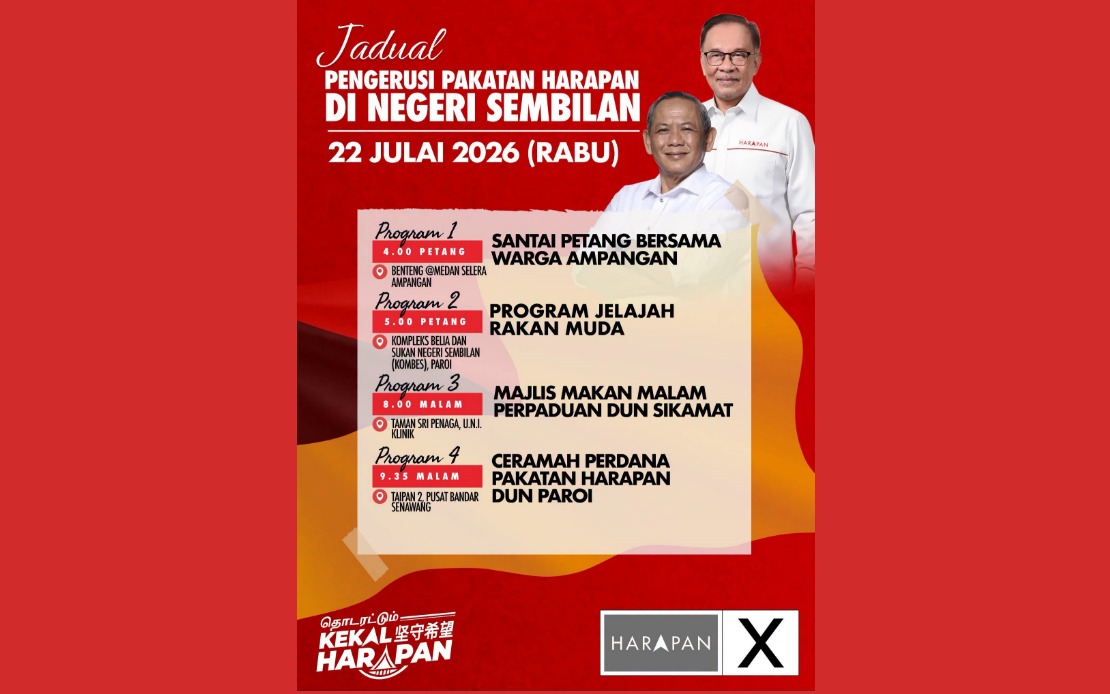
Prime Minister Datuk Seri Anwar Ibrahim has stepped up Pakatan Harapan's campaign operations in Negeri Sembilan, with an ambitious schedule of four public engagements across strategic constituencies as the coalition seeks to consolidate its hold on the state government. The PH chairman's intervention on the fifth day of campaigning underscores the national leadership's commitment to maintaining political control in what has emerged as a critical battleground in Malaysia's electoral calendar.
Anwar's presence in Negeri Sembilan carries particular significance for the coalition's broader electoral strategy. As PKR president and sitting prime minister, his star power is intended to energize grassroots supporters and neutralize opposition momentum in a state where Datuk Seri Aminuddin Harun has led the PH government. The timing of the prime minister's visit reflects careful campaign choreography, designed to maintain media attention and signal confidence in the coalition's competitive position with less than two weeks until polling day on August 1.
The four-stop itinerary reveals the campaign's geographic targeting. Starting at 4 pm with an informal community gathering called "Santai Petang Bersama Warga Ampangan" at Benteng @ Medan Selera Ampangan, Anwar will then move to the Negeri Sembilan Youth and Sports Complex in Paroi at 5 pm for the "Jelajah Rakan Muda" programme. This emphasis on youth engagement reflects PH's strategic focus on mobilizing younger voters, a demographic that has proven unpredictable in recent Malaysian elections and remains a contested battleground between competing coalitions.
The evening agenda includes a unity dinner in the Sikamat constituency, emphasizing the coalition-building elements essential to PH's multiethnic political project. Such gatherings serve multiple purposes: they allow Anwar to address concerns of different community leaders, demonstrate the internal cohesion of the coalition, and project an image of unified political governance. The final major event is a mega "ceramah" in Paroi at the Pusat Bandar Senawang, a traditional format that remains central to Malaysian political communication despite modern digital alternatives.
PH's campaign messaging has centered on a 10-point manifesto launched earlier in the week, which frames the coalition's vision for a more developed and inclusive Negeri Sembilan. This programmatic approach attempts to elevate campaign discourse beyond personality-driven politics, though Anwar's personal involvement inevitably personalizes the message regardless of manifest content. The manifesto commitments appear designed to address both urban modernization concerns and rural development aspirations, reflecting the state's mixed economic base.
The composition of PH's candidate slate reveals the internal balance within the coalition. Of the 36 state seats contested, PKR fields 16 candidates, DAP contributes 11, and Amanah provides nine. This distribution reflects both the electoral strength of individual parties and negotiated power-sharing arrangements that can prove contentious in post-election coalition governance. For Malaysian observers, the candidate allocation signals where each partner perceives its strongest competitive positions and where compromise has been necessary to maintain coalition unity.
Negeri Sembilan presents particular strategic value within Malaysia's federal political framework. As a smaller state sandwiched between Selangor and Pahah, it lacks the population density of major urban centers but maintains significant symbolic importance. Control of the state government allows PH to demonstrate sustained governance capacity beyond Kuala Lumpur and selected other strongholds, countering any opposition narrative of electoral decay or declining support. Conversely, loss of the state would represent a symbolic reversal and provide momentum to Barisan Nasional or Perikatan Nasional alternatives.
The Election Commission's schedule establishes early voting on July 28, followed by the main polling date on August 1. This calendar compresses the effective campaigning period, making intensive efforts like Anwar's visit strategically important for last-minute persuasion and volunteer mobilization. Early voting mechanics, which typically favor organized parties with strong institutional capacity, potentially advantage the established PH coalition over newer or less-structured political formations.
For regional observers, the Negeri Sembilan election serves as a barometer of broader Malaysian political sentiment at mid-term of Anwar's federal government. Economic conditions, including inflation impacts on ordinary Malaysian households, education policy developments, and perceptions of government performance in areas like healthcare and infrastructure, all filter into state-level voting decisions despite nominal state-level campaign messaging. The result will provide early indication of whether PH retains sufficient popular support to contemplate additional electoral contests or faces an erosion that demands policy recalibration.
Anwar's campaigning in Negeri Sembilan also reflects the current political reality where prime ministerial authority and executive resources can be deployed to assist allied state governments facing competitive elections. This interplay between federal and state politics remains a persistent feature of Malaysian governance, with implications for autonomy and democratic federalism. The visibility of federal leaders in state campaigns, while politically normalized, raises ongoing questions about the distinction between national and sub-national political competition in Malaysia's constitutional framework.

