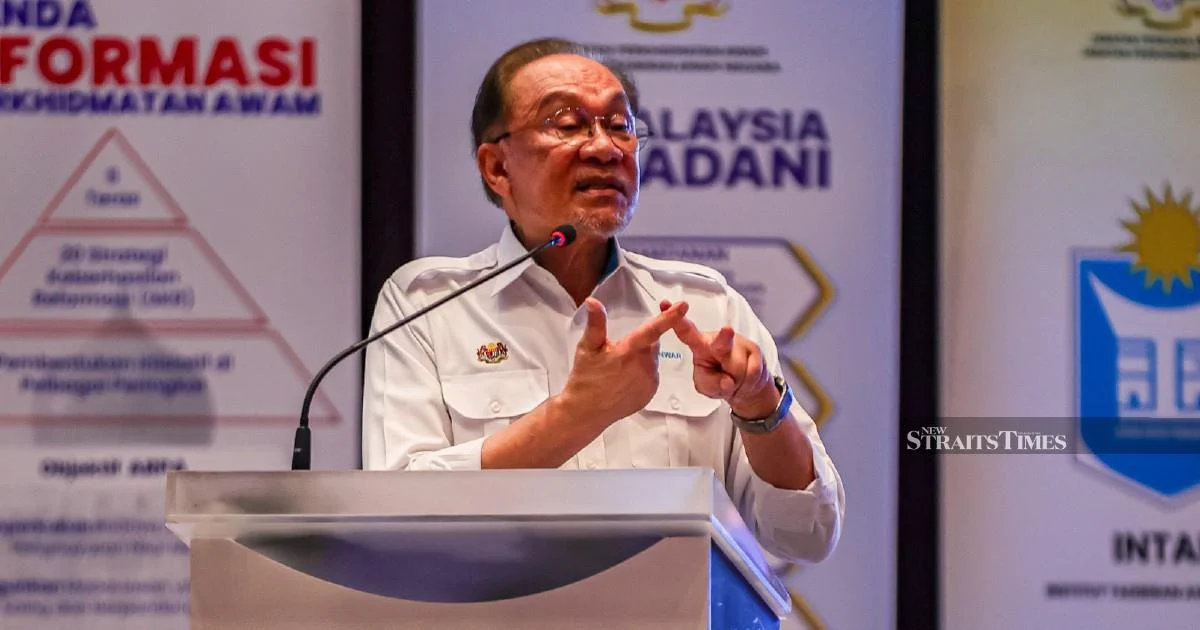
Prime Minister Datuk Seri Anwar Ibrahim moved swiftly to quell brewing tensions within Malaysia's political establishment on Friday, asserting that Parti Amanah Negara (Amanah) president Datuk Seri Mohamad Sabu had not intended to disparage rival political parties during remarks made at a Pakatan Harapan (PH) candidate announcement event held in Tangkak.
Anwar's intervention represents an attempt to prevent escalating rhetorical tensions that frequently erupt during Malaysia's competitive electoral campaigns. The incident underscores the delicate coalition dynamics within PH, where member parties must balance assertive campaigning with maintaining the broader alliance's cohesion. Such flash points are not uncommon in Malaysian politics, where coalition partners often face pressure from their respective grassroots supporters to demonstrate independence and vigour on the campaign trail whilst simultaneously honouring coalition commitments.
The timing of Anwar's remarks is particularly significant given the intensifying political competition across the country. Campaign events frequently become focal points for rhetorical flourishes and pointed commentary about rival political formations. Amanah, as a coalition partner within PH, occupies a unique position—it must simultaneously advance its own electoral prospects whilst avoiding statements that could fracture the broader opposition alliance or provoke unnecessary conflict with other political actors.
MatSabu's role as Amanah president carries considerable weight within PH discussions. As a senior coalition figure, his public comments carry implications beyond his immediate party boundaries, affecting coalition messaging and inter-party relations. This reality likely motivated Anwar's prompt clarification, which served to reframe Sabu's remarks and reset the narrative before media amplification could deepen any perceived rift or controversy.
The Prime Minister's call for calm reflects a broader management approach within the coalition. PH comprises multiple distinct political entities with different ideological orientations, membership bases, and strategic preferences. Managing such a diverse coalition requires constant calibration, where leaders must address tensions before they metastasize into more serious conflicts that could undermine electoral coordination or legislative cooperation.
For Malaysian voters and political observers, Anwar's response demonstrates the ongoing challenge of maintaining coalition unity whilst allowing member parties sufficient autonomy to appeal to their distinct constituencies. This balancing act has been central to PH's political existence since its formation, and remains relevant across successive electoral cycles as the coalition adapts to changing political circumstances and competitor strategies.
The incident also illuminates the role of careful messaging in contemporary Malaysian politics. In an environment where social media amplification can rapidly transform isolated comments into full-blown controversies, senior political leaders increasingly find themselves engaged in real-time narrative management. Anwar's intervention represented precisely this kind of preventive communication strategy—addressing concerns before they crystallize into lasting damage to coalition credibility or unity.
Amanah's position within PH carries particular significance for Malaysia's broader political equilibrium. As a predominantly Malay-Muslim party positioned within a coalition that spans diverse ethnic and religious communities, Amanah serves as an important bridge between different electoral constituencies. Any perception of internal discord or mockery among coalition partners could potentially undermine confidence among communities that the coalition can effectively govern with cohesion and mutual respect.
Anwar's defence of Sabu also signals to coalition members that the Prime Minister intends to enforce standards around public discourse and inter-party respect. By firmly stating that no mockery had occurred, Anwar established clear parameters for acceptable coalition communication, effectively warning against future statements that could be construed as divisive or dismissive of coalition partners' legitimacy or values.
Looking forward, this episode represents the kind of routine friction that coalition politics inevitably generates. The key question for PH remains whether such tensions remain containable through senior leadership intervention, or whether underlying structural pressures within the coalition eventually create more substantial rifts. Anwar's swift and decisive response suggests confidence in the coalition's durability, at least in the short term.
Malaysian political analysts frequently observe that opposition coalitions face particular challenges maintaining unity, given the absence of government resources to distribute as incentives for cooperation. The voluntary nature of coalition participation means that member parties must regularly recommit to shared objectives whilst managing their distinct identities and supporter expectations. Anwar's intervention in the Sabu matter exemplifies this ongoing negotiation between collective action and individual party interests.