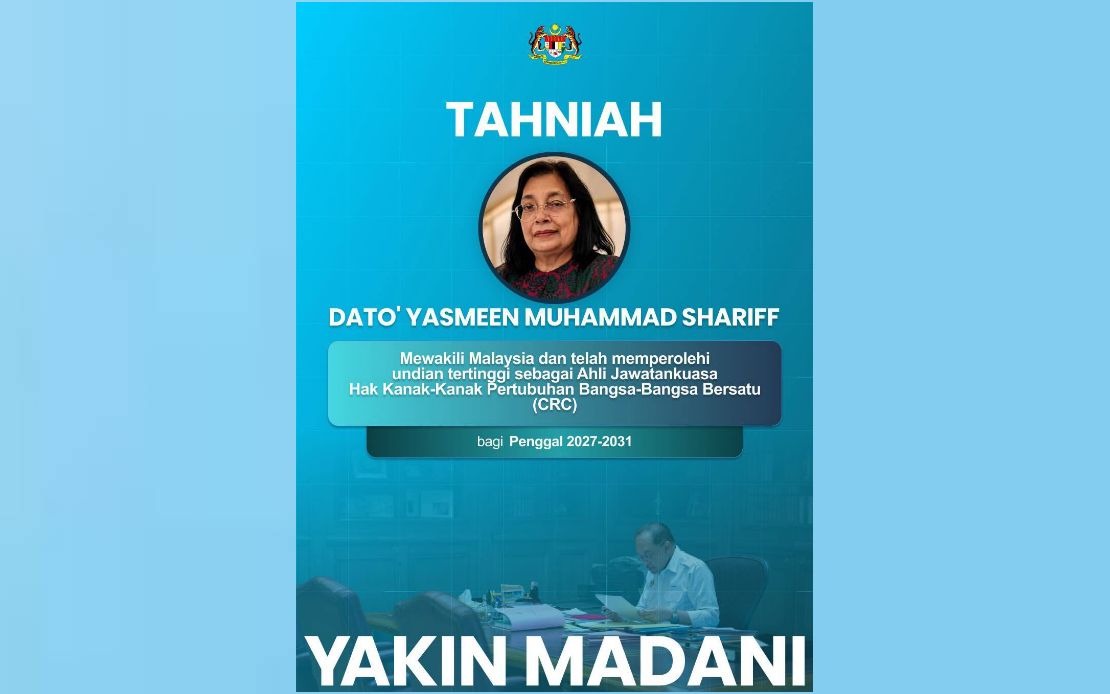
Prime Minister Datuk Seri Anwar Ibrahim has publicly commended Datuk Yasmeen Muhamad Shariff following her successful election to the United Nations Committee on the Rights of the Child, cementing what he characterised as international recognition of Malaysia's diplomatic credentials and commitment to advancing children's welfare on the world stage.
Yasmeen's appointment, effective for the 2027-2031 term, emerged after she garnered 136 votes from 189 States Parties during voting at the 21st Meeting of States Parties to the Convention on the Rights of the Child held at UN headquarters in New York on Tuesday. The strong electoral mandate underscores the backing she received from fellow member nations, a sentiment Anwar sought to amplify through his public message of support.
In a statement posted on Facebook, the Prime Minister emphasised that Yasmeen's victory transcends personal achievement, instead representing a broader validation of Malaysia's role within international governance structures. He framed the election outcome as evidence that the global community places considerable trust in Malaysia's capacity to contribute meaningfully to multilateral forums addressing pressing human rights concerns, particularly those affecting vulnerable populations such as children.
The Ministry of Women, Family and Community Development formally announced the election results, contextualising Yasmeen's selection within her established track record in international children's rights advocacy. This represents her second appointment to the committee, marking a return engagement after she previously served as a member during the 2013-2017 term. Her reselection suggests sustained confidence in her expertise and commitment, even after an interim period outside the body.
Anwar directed his congratulations not only to Yasmeen personally but extended recognition to the entire Ministry of Women, Family and Community Development for facilitating what he termed a highly commendable accomplishment. This inclusive acknowledgment reflects the institutional nature of UN committee representation, where civil servants and nominated experts function as part of coordinated national delegations advancing their country's values and priorities within multilateral structures.
Serving as a committee member carries specific technical responsibilities aligned with the UN mandate on children's rights. Yasmeen will discharge her duties in a personal capacity as an independent expert, meaning she operates without formal instruction from Malaysian government officials, though her selection still carries implicit national endorsement and benefits Malaysia's soft power positioning. This dual nature—personal expertise combined with national representation—characterises how UN expert committees balance independence with member-state interests.
The Prime Minister's statement positioned this development as a foundation for broader Malaysian ambitions in the international arena. He expressed conviction that the success would motivate Malaysia to intensify efforts directed at strengthening its global standing, suggesting he views this victory as both recognition of past contributions and catalyst for enhanced future engagement across multiple domains of multilateral diplomacy and cooperation.
For Malaysia specifically, securing representation on UN rights monitoring bodies carries strategic significance beyond ceremonial value. Committee members influence the interpretation and implementation of international norms governing children's welfare, education, protection from exploitation, and access to justice. Malaysian membership thus provides formal channels to advocate for approaches reflecting Southeast Asian contexts and concerns, potentially shaping global policy conversations that eventually feed back into regional and domestic governance frameworks.
The Committee on the Rights of the Child itself functions as a treaty monitoring body responsible for reviewing compliance among signatory nations, including Malaysia, with obligations under the Convention on the Rights of the Child and its protocols. Having a Malaysian expert within this scrutiny mechanism creates structural opportunities for informed advocacy regarding regional nuances in child protection and family policy, while simultaneously positioning Malaysia as a contributor to international standard-setting in this critical domain.
Yasmeen's reappointment also reflects continuity in Malaysia's approach to children's rights advocacy over the past decade. Her previous service during 2013-2017 established a foundation of knowledge and relationships, advantages that her renewed tenure can build upon. This consistency suggests the ministry and government maintain a coherent long-term strategy in this portfolio rather than treating UN committee participation as episodic engagement.
The broader significance for Malaysian policymaking lies in ensuring that international expertise and experience gained through such appointments translates into strengthened domestic frameworks. UN committee service exposes Malaysian experts to comparative practices, emerging challenges, and global best practices in child protection and family welfare, knowledge that should inform legislative and administrative improvements domestically.
Anwar's public endorsement also signalised the government's prioritisation of children's rights within its broader agenda, particularly under the remit of the Ministry of Women, Family and Community Development. Elevating this achievement through prime ministerial communication amplifies its visibility and reinforces commitment to this policy area among domestic and international audiences, potentially facilitating greater resource allocation and institutional backing for related initiatives.

