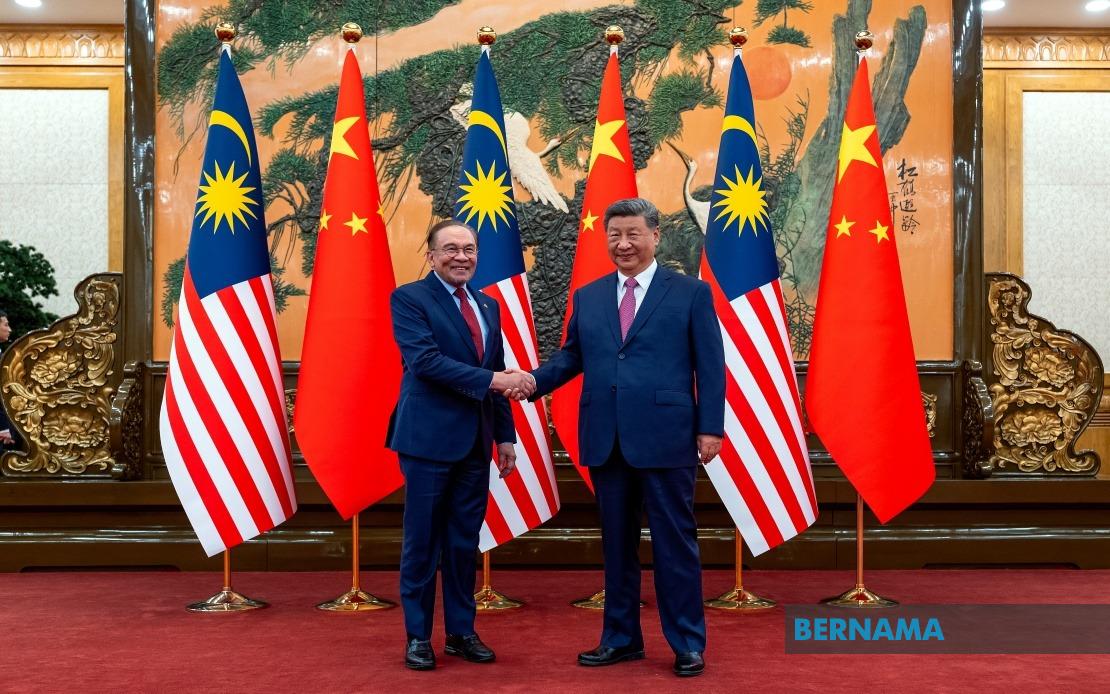
Prime Minister Datuk Seri Anwar Ibrahim has extended official felicitations to the Chinese government marking the 105th anniversary of the Communist Party of China, underscoring the enduring diplomatic relationship between Kuala Lumpur and Beijing. Through a formal letter transmitted to Chinese President Xi Jinping, Anwar conveyed warm wishes from both the Malaysian government and its citizens, signalling the continued importance placed on bilateral engagement at the highest levels.
In announcing the diplomatic gesture via social media, the Prime Minister took the opportunity to recognise the ruling party's historical trajectory and its influence in shaping contemporary China. Anwar acknowledged the profound role that the party's long institutional history and deeply rooted civilisational values have played in driving national development and modernisation across the Chinese state. This recognition reflects Malaysia's understanding of China's internal political significance and the centrality of the party to Beijing's governance structure and strategic direction.
A central pillar of Anwar's message focused on Malaysia's landmark diplomatic recognition of the People's Republic of China on May 31, 1974, a watershed moment that positioned Malaysia as Southeast Asia's first non-socialist nation to formally establish relations with Beijing. The historical significance of this decision cannot be overstated in the regional context. During the Cold War era, such recognition represented a bold geopolitical calculation, demonstrating Malaysian pragmatism and strategic independence at a time when much of the region remained divided along ideological lines.
According to the Prime Minister, the 1974 decision was made with considerable foresight and wisdom, reflecting careful consideration of Malaysia's regional interests and long-term economic opportunities. This founding diplomatic act has indeed proven foundational, establishing a framework upon which subsequent Malaysian governments have constructed increasingly sophisticated bilateral arrangements spanning trade, investment, defence cooperation, and people-to-people exchanges. The relationship's fifty-year trajectory demonstrates the durability of that initial commitment.
Over the subsequent five decades, Malaysia-China relations have evolved considerably in depth and complexity. The foundation laid in 1974 has enabled both nations to weather periodic regional tensions and navigate the broader geopolitical shifts that have characterised the Asia-Pacific landscape. Malaysia has benefited substantially from Chinese investment and market access, whilst Beijing has valued Malaysia's strategic location along critical sea lanes and its role as a bridge between China and the broader ASEAN community.
Anwar's reaffirmation of Malaysia's commitment to deepening strategic cooperation with China emphasises the continuity of this bilateral engagement despite domestic political transitions in Kuala Lumpur. The Prime Minister explicitly grounded this commitment in three foundational principles: mutual respect, established trust, and reciprocal benefits—language that reflects both the aspiration to maintain equilibrium in the relationship and recognition of the need for balanced engagement.
The broader regional implications of sustained Malaysia-China cooperation merit consideration. As ASEAN navigates increasingly complex great-power competition in Southeast Asia, Malaysia's maintenance of strong Beijing ties whilst simultaneously managing relationships with other major powers—including the United States and India—positions the country as a key node in regional stability architecture. This balancing act remains delicate but strategically significant for ASEAN cohesion and the maintenance of the regional order.
For Malaysian businesses and investors, the continued emphasis on deepening bilateral cooperation signals government commitment to facilitating Chinese involvement in Malaysian development projects and maintaining preferential market access for Malaysian exports to China. This has tangible implications for sectors ranging from palm oil and electronics to manufacturing and infrastructure development, which collectively constitute a substantial portion of Malaysia's outbound trade.
Anwar's diplomatic communication also reflects Malaysia's conscious positioning within China's broader diplomatic calendar and symbolic acknowledgments of significant dates. Such formal gestures, whilst often ceremonial in nature, carry weight in diplomatic practice and serve to reinforce public messaging about the character and health of bilateral ties. They also demonstrate Malaysia's responsiveness to Beijing's diplomatic initiatives and calendar, an important consideration in maintaining functional relations.
Looking forward, the maintenance and deepening of Malaysia-China cooperation under Anwar's leadership will likely continue along established trajectories focused on economic integration and regional security cooperation. The Prime Minister's explicit invocation of the 1974 recognition decision frames contemporary engagement as a natural continuation of decades-old strategic commitment rather than a departure from established policy. This rhetorical approach helps ensure continuity and predictability in the bilateral relationship, qualities valued highly in both Kuala Lumpur and Beijing as both nations navigate complex regional and global circumstances affecting their mutual interests and broader development objectives.

