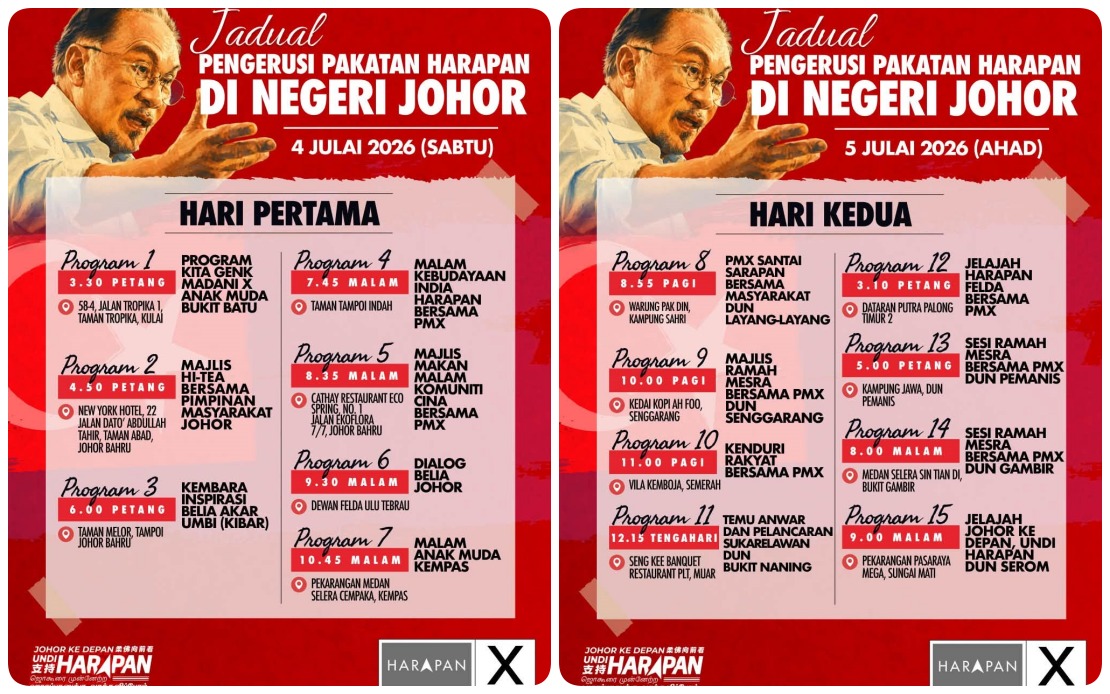
Prime Minister Anwar Ibrahim is throwing Pakatan Harapan's full weight behind its Johor campaign, with a punishing schedule of seven separate events scheduled for July 4 designed to energise the coalition's ground machinery and reach voters across the state ahead of polling day on July 11. The intensive day of campaigning underscores the political significance of Johor, Malaysia's southern powerhouse, where PH's performance will carry broader implications for the coalition's standing nationally. Anwar's hands-on involvement reflects the stakes involved as the coalition seeks to consolidate support and fend off rival campaigns in a state that remains politically contested.
The Prime Minister's itinerary, as announced via his official Facebook page, begins with direct voter engagement early in the day before transitioning to a more formal high tea reception with Johor community leaders at a hotel in Johor Bahru scheduled for 4.50 pm. This segment of his schedule is calculated to bring Anwar into contact with influential figures spanning business, civil society, and grassroots networks, allowing him to both convey the coalition's message and gauge public sentiment on key policy concerns affecting the state. The reception format, less formal than a political rally yet more structured than street campaigning, permits extended conversation and relationship-building that can prove decisive in consolidating elite and middle-class support.
Youth engagement forms a critical pillar of this campaign phase, with Anwar scheduled to participate in a Johor Youth Dialogue session at Felda Ulu Tebrau Hall at 9.30 pm. The emphasis on young voters reflects broader PH strategy to rebuild trust among the demographic that has shown volatility in recent electoral cycles, particularly following internal coalition tensions and governance challenges. Young voters represent a substantial portion of Johor's electorate and remain persuadable through direct engagement with senior leadership, making this evening session a strategic investment in consolidating youth support.
The schedule announced for July 4 constitutes merely the opening phase of Anwar's Johor blitz. The Prime Minister plans to sustain this momentum on July 5 with eight additional campaign programmes, doubling down on the coalition's commitment to saturate the state with high-profile political activity. This two-day intensive push reflects confidence in PH's organisational capacity while simultaneously signalling to grassroots volunteers and candidates that headquarters is fully invested in the campaign. The cumulative effect of such sustained engagement, particularly from the party chairman and sitting Prime Minister, can materially boost volunteer morale and encourage fence-sitters to commit to supporting the coalition.
Pakatan Harapan is contesting all 56 state assembly seats in the Johor election, fielding a coalition slate comprising 20 candidates from PKR, 19 from Amanah, and 17 from DAP. This full-slate approach demonstrates confidence in the coalition's reach and the viability of its candidates across diverse constituencies. The seat distribution reflects negotiated agreements between the three coalition parties, balancing internal interests while maintaining a unified front against opposition parties. Each party's representation carries symbolic and practical importance for maintaining coalition cohesion and preventing post-election disputes over resource allocation and ministerial portfolios.
The broader election context encompasses 172 candidates competing for the 56 state assembly seats, indicating a competitive field in which multiple opposition parties are mounting serious challenges. This crowded field suggests no single party can assume automatic victory in any given seat, necessitating the kind of intensive campaigning Anwar and other senior leaders are conducting. The presence of numerous candidates from multiple parties means that victory margins in individual contests may prove thin, making ground-level organisation and voter turnout critical differentiators between success and failure.
Election day is set for July 11, with early voting scheduled for July 7, compressing the campaign window and placing emphasis on maximising voter contact in the remaining days before ballots are cast. This accelerated timeline means that every campaign event carries elevated importance, as opportunities for reaching undecided voters diminish. The early voting provision allows some voters to cast ballots earlier, potentially allowing PH to lock in committed supporters and then concentrate later campaigning efforts on persuading swing voters and boosting overall turnout among supporters.
From a broader Malaysian political perspective, the Johor election represents an important test of PH's resilience and electoral appeal. The state has historically served as a political bellwether, and strong PH performance would bolster the coalition's narrative heading into eventual federal elections. Conversely, a disappointing result would hand opposition parties a significant morale boost and potentially embolden voices questioning PH's viability as a governing coalition. Anwar's personal involvement in the campaign signals recognition of these stakes and his determination to secure a mandate that strengthens his political position and validates the coalition's record in office.
For Malaysian voters and observers, the Johor campaign demonstrates how senior political leadership allocates time and resources during electoral contests. The decision by a sitting Prime Minister to spend days conducting intensive state-level campaigning reflects the practical and symbolic importance of state elections within Malaysia's federal system, where state governments control substantial resources and policy domains. While federal politics often dominates national media attention, state-level contests remain crucial laboratories for testing policies, rewarding grassroots organisers, and building political depth at the subnational level.

