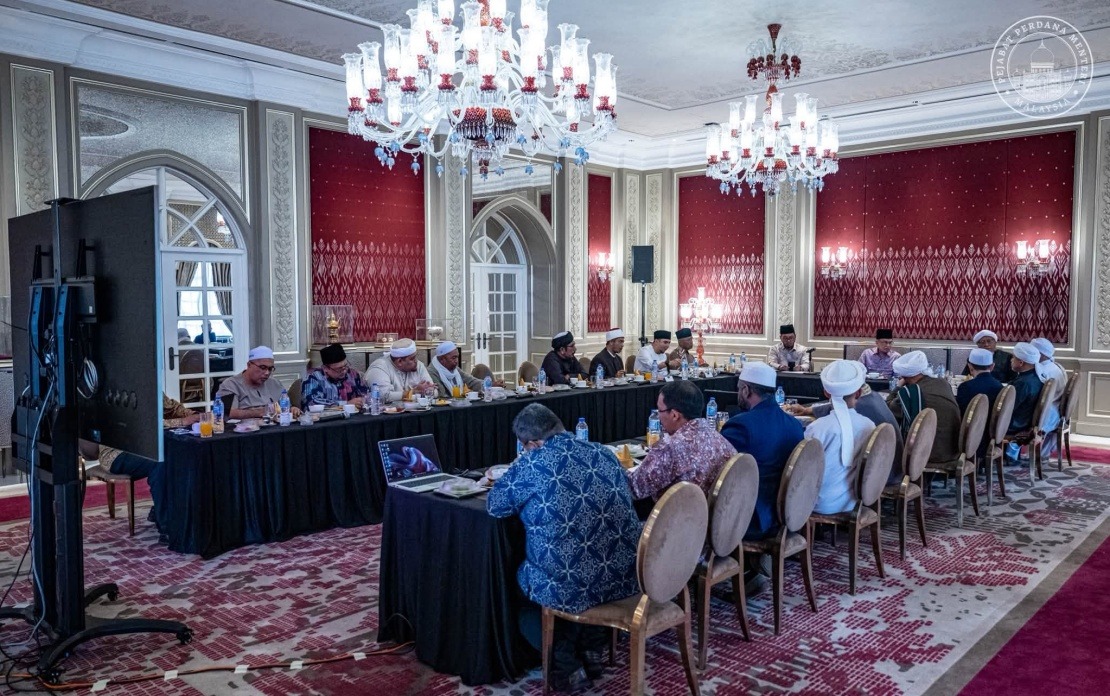
Prime Minister Datuk Seri Anwar Ibrahim has underscored the critical role that ongoing consultation with Islamic scholars plays in shaping the government's approach to religious and social matters. Speaking during a series of discussions held in conjunction with Maulidur Rasul celebrations, Anwar framed these engagements not as routine administrative meetings but as substantive occasions for institutional reflection and refinement of policy direction. His comments reflect a deliberate strategy to position scholarly expertise as a cornerstone of governance, particularly in areas touching on Islam and community welfare.
Anwar's emphasis on these dialogues comes amid broader discussions about how Malaysia's multicultural government balances religious considerations with policy implementation. The Prime Minister met Sheikh Dr Muhyiddin Awwamah of Darul Hadis al-Awwamiyyah during the afternoon sessions, part of a structured programme bringing together officials and respected Islamic thinkers. This approach demonstrates an institutional commitment to seeking guidance before finalising decisions affecting Malaysia's Muslim population, which comprises roughly 70 per cent of the country's 34 million inhabitants.
The intellectual credibility lent by these consultations is particularly significant given that Sheikh Dr Muhyiddin represents a scholarly lineage of considerable standing. His father, Al-'Allamah Sheikh Muhammad bin Awwamah, is recognised throughout the Islamic world as a preeminent hadith expert and Islamic scholar whose contributions have shaped contemporary Islamic jurisprudence. By explicitly acknowledging the senior scholar's literary legacy, Anwar signals respect for institutional knowledge and the accumulated wisdom embedded in Islamic scholarly tradition. This generational framing—connecting contemporary policy discussions to decades of scholarly work—suggests the government views religious guidance as something continuous rather than episodic.
Anwar's characterisation of these meetings as opportunities for collective refinement reveals a nuanced understanding of governance in a Muslim-majority democracy. Rather than presenting policies as government directives handed down to religious constituencies, this framework positions consultation as mutual enrichment. The Prime Minister emphasises that advice from scholars helps ensure government initiatives are "refined according to the needs of the Muslim community and the demands of the times," suggesting an acknowledgement that static policies fail to address evolving social realities. This is particularly relevant in Malaysia, where urbanisation, digital transformation, and changing family structures continuously reshape the practical context in which Islamic principles are applied.
The timing of these discussions during Maulidur Rasul, the Prophet Muhammad's birthday, carries symbolic weight beyond the immediate policy agenda. Observing these consultations during a significant Islamic calendar event anchors government-scholar dialogue within the religious calendar itself, suggesting that policymaking in Malaysia is inherently tied to Islamic spiritual and intellectual traditions. This public association with religious observance reinforces the government's positioning within Malaysia's Islamic framework while simultaneously demonstrating institutional respect for theological expertise.
For Malaysian readers, this approach reflects a particular model of religious governance distinct from secular Western democracies. Unlike jurisdictions where religious and state functions remain formally separate, Malaysia's constitutional framework recognises Islam's special position and grants state governments jurisdiction over Islamic affairs. Within this context, consultation with leading scholars becomes a mechanism for ensuring policies remain coherent with Malaysia's constitutional identity while remaining responsive to contemporary challenges. The government's openness to scholarly input potentially strengthens policy legitimacy among religiously observant constituencies who might otherwise question the religious credentials of state decisions.
The explicit mention of Anwar's appreciation for the senior scholar's published works introduces another dimension to these consultations. Intellectual products—books, treatises, scholarly papers—serve as repositories of refined thinking on religious matters. By acknowledging these contributions as "an intellectual legacy connecting generations and continuing the chain of Islamic scholarly tradition," Anwar frames government policy-making as part of an intellectual continuum stretching backward through Islamic history and forward toward future generations. This perspective potentially elevates contemporary policy discussions beyond immediate political considerations and grounds them in longer-term intellectual development.
Regionally, Malaysia's approach to religious scholarship has implications for Southeast Asian Islamic governance more broadly. As the region's most developed Muslim-majority democracy with a substantial non-Muslim population, Malaysia's model of integrating scholarly advice into policy formation could influence how other Southeast Asian governments approach similar questions. Indonesia, Brunei, and the southern Philippines all grapple with balancing religious governance with plural societies, and Malaysia's institutional mechanisms for scholarly consultation may offer applicable insights. The country's relative success in maintaining social stability while respecting Islamic principles has made its governance models worthy of regional study.
Anwar's framing also addresses potential tensions between technical expertise and religious wisdom. Modern governments increasingly rely on data analysts, economists, and technical specialists to inform decisions. By explicitly valuing scholarly knowledge alongside administrative capacity, the Prime Minister suggests that religious and intellectual expertise need not compete but can instead complement each other. This synthesis becomes particularly important when policies touch on sensitive issues where technical solutions must harmonise with religious principles—areas spanning education, family law, financial regulation, and healthcare ethics.
The Prime Minister's declaration that "religion continues to flourish when those in power are willing to listen to the voice of knowledge" contains an implicit philosophy of governance worth unpacking. Rather than portraying religious flourishing as something achieved through state enforcement or top-down mandates, this formulation suggests that religious vitality emerges when leaders remain intellectually humble and open to external counsel. For Malaysian governance, this represents a model emphasising collaborative rather than authoritarian approaches to religious matters, with potential implications for how the government engages diverse Islamic schools of thought and interpretations.
Moving forward, these structured consultations may establish precedent for how Malaysia's government approaches emerging challenges at the intersection of religion and public policy. Issues including artificial intelligence ethics, climate change responses, digital economy regulation, and biomedical advances will increasingly require frameworks that integrate both technical understanding and theological reflection. By institutionalising these dialogues with recognised scholars, the government creates mechanisms for developing such integrated approaches before crises force reactive decision-making. The consistency of these meetings—held regularly rather than only during controversies—suggests a commitment to proactive rather than defensive religious governance.
The broader significance of Anwar's emphasis on scholarly consultation extends to questions of institutional legitimacy and public trust. Governments that visibly incorporate diverse expertise and perspectives, particularly in sensitive domains like religion, typically enjoy greater public confidence than those perceived as making isolated decisions. By publicly highlighting these consultations and explicitly valuing scholarly input, the administration demonstrates accountability to constituencies who care deeply about religious matters. This transparency potentially buffers the government against criticism that policy decisions lack adequate religious consideration, while simultaneously creating space for constructive dialogue when disagreements inevitably arise.
Ultimately, Anwar's framing of government-scholar dialogue as essential governance infrastructure reflects recognition that Malaysia's development as a nation depends on successfully integrating its Islamic identity with the practical demands of modern administration. As the country navigates rapid social change, demographic shifts, and evolving global contexts, continued engagement with recognised Islamic intellectuals provides mechanisms for ensuring policies remain simultaneously rooted in religious principles and responsive to contemporary realities. Whether these consultations translate into substantive policy shifts or function primarily as legitimacy-building exercises remains an open question, but their formalisation at the prime ministerial level signals serious institutional commitment to treating religious scholarship as valuable governance input rather than mere ceremonial decoration.

