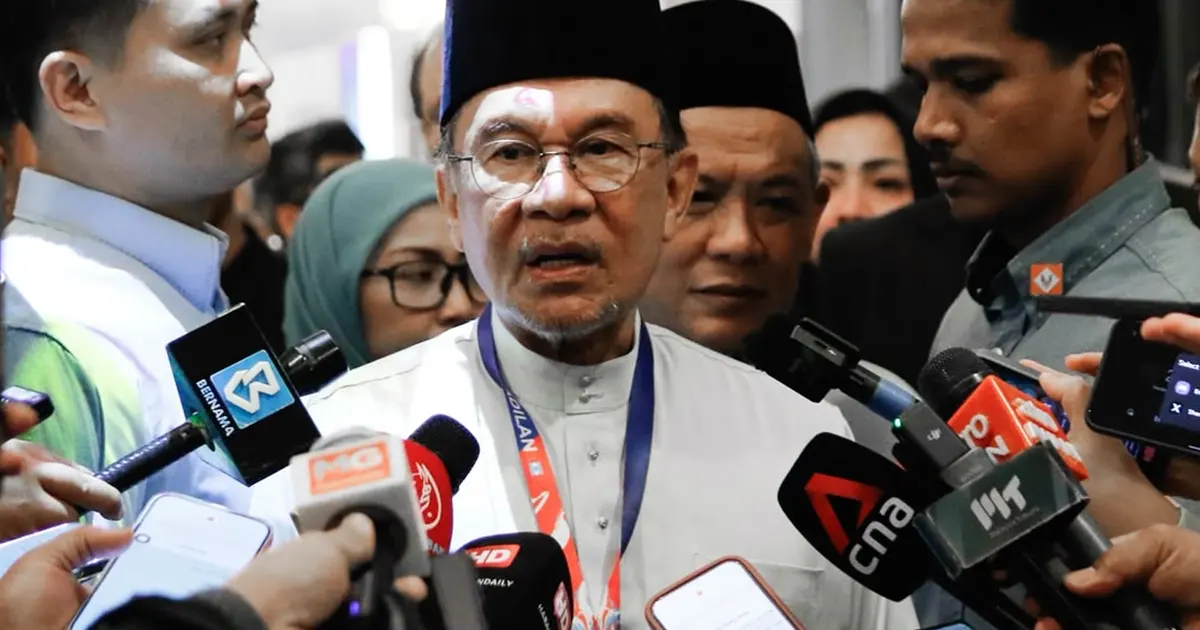
Prime Minister Anwar Ibrahim has moved swiftly to distance himself from criticism levelled by Khairy Jamaluddin regarding his working relationship with Deputy Prime Minister Ahmad Zahid Hamidi. In remarks made during a recent podcast appearance, the former Umno Youth chief had raised questions about the dynamics between the two senior leaders, but Anwar has now clarified that such concerns do not represent his own assessment of the partnership.
The prime minister's response underscores the delicate balance required in Malaysia's current political landscape, where the stability of the government depends on maintaining cohesion across multiple coalition parties. Khairy's comments, made in a media forum accessible to a broad audience, had touched on a sensitive aspect of cabinet politics at a time when the government faces mounting pressures on multiple fronts. By characterising these observations as stemming from a divergent viewpoint rather than from shared cabinet concerns, Anwar has attempted to contain any potential fallout while signalling that such public commentary may not align with his private assessment.
The distinction Anwar has drawn—that he and Khairy simply perceive the matter differently—carries significant weight in Malaysian political discourse. This phrasing allows the prime minister to acknowledge Khairy's statements without validating them or suggesting internal fractures within his administration. It is a carefully calibrated response that preserves the authority of his leadership while avoiding direct confrontation with a respected party figure who commands considerable influence within Umno circles.
Khairy Jamaluddin's visibility and political credibility remain substantial despite his stepping back from formal youth leadership roles. His views carry weight among Malaysia's educated, urban constituency and within intellectual circles that follow political development closely. The podcast platform he chose for these remarks expanded their reach beyond traditional parliamentary discourse, making Anwar's need to respond more pressing. By framing the issue as a matter of perspective rather than substantive concern, the prime minister has attempted to prevent the narrative from crystallizing into a broader story about cabinet dysfunction.
The relationship between Anwar and Zahid has long been a point of interest for political observers seeking to understand the inner workings of the current administration. The two men come from different political traditions and generational cohorts, yet they have managed to work together within the framework of the unity government that took shape following Malaysia's 2022 elections. The partnership has been tested by various challenges, and perceptions of strain between them—whether real or imagined—can have ripple effects throughout the coalition.
Anwar's clarification also reflects the broader challenge of maintaining message discipline in an era of podcasts, social media commentary, and distributed media platforms. Unlike previous generations of Malaysian politicians who could more easily control their public statements through traditional channels, today's political figures find their words circulating rapidly across digital spaces, often accompanied by interpretation and commentary from various quarters. Anwar's intervention suggests awareness that allowing such commentary to go unanswered could feed narratives that undermine confidence in his administration.
The prime minister's assertion that different perspectives on a matter need not imply systemic dysfunction speaks to a wider governance principle—that disagreement and varied viewpoints within a cabinet can coexist with effective administration. This framing potentially offers Anwar some insulation against future criticism, as he can continue to argue that cabinet operations remain sound even when individual members voice differing opinions on specific issues or relationships. However, this approach requires that such disagreements remain matters of emphasis rather than becoming public battles.
For observers monitoring Malaysian politics, the exchange illustrates the ongoing complexity of coalition management in the post-2022 environment. The unity government comprises parties that did not traditionally work together, making the management of internal relations and public perception especially critical. Any suggestion that senior members lack confidence in one another could amplify concerns about the government's stability, particularly given Malaysia's economic vulnerabilities and the various social pressures the administration confronts.
Khairy's decision to air his views through a podcast rather than through formal parliamentary channels or private communications suggests that he felt the observations warranted public airing, possibly to shape broader discussion about governance quality or coalition dynamics. The platform choice—less formal than traditional media yet more structured than social media—indicates a calculated effort to reach a thoughtful audience while maintaining some distance from direct political confrontation. Anwar's response in turn signals that such commentary, while noted, should not be interpreted as reflecting genuine cracks in the administrative apparatus.
Moving forward, the episode underscores the importance of managing perceptions of leadership relationships in Malaysia's current political context. Zahid, as deputy prime minister, carries substantial responsibility for government operations and represents an important power centre within Umno. Any persistent narrative about fractured trust between him and Anwar could complicate policy implementation and coalitional stability. By firmly rejecting the premise that he harbours trust concerns regarding his deputy, Anwar has sought to foreclose this particular line of critical inquiry.
The prime minister's response also carries implications for how other coalition members gauge the temperature of internal relationships. By treating Khairy's comments as a personal rather than collective assessment, Anwar signals that he remains confident in his administration's functioning despite occasional critical commentary from within allied circles. This sends a message to both supporters and detractors that day-to-day governance challenges and occasional public disagreement need not be interpreted as harbingers of governmental collapse. Whether this framing ultimately proves sufficient to contain broader questions about cabinet cohesion will depend on how subsequent events unfold and whether further public commentary emerges on similar themes.

