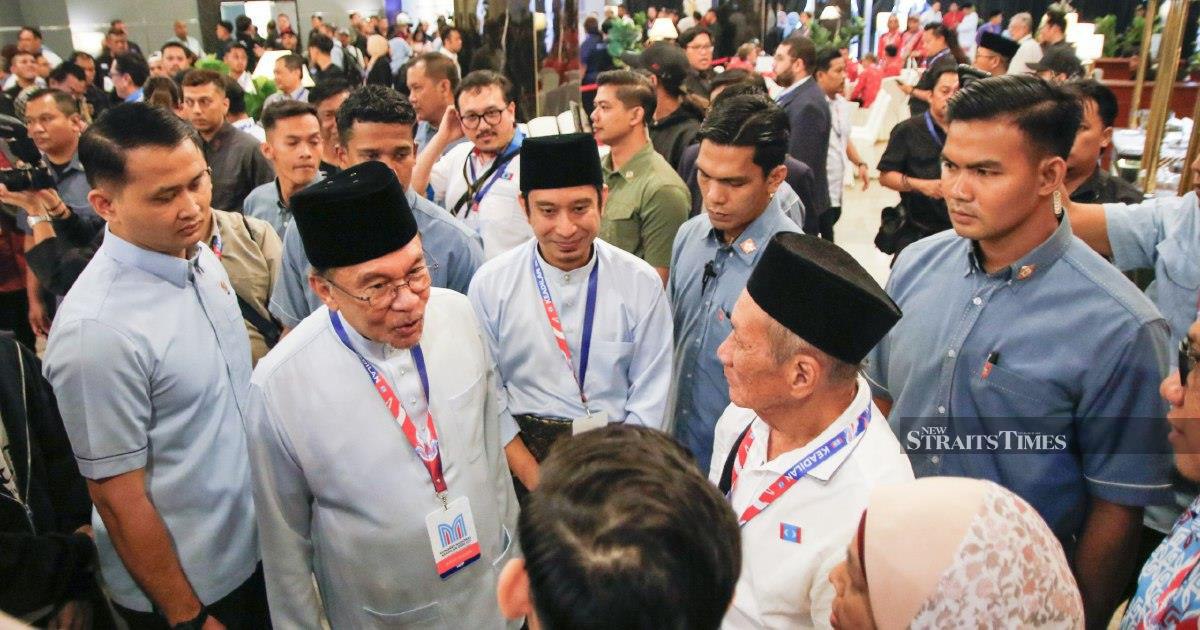
Prime Minister Datuk Seri Anwar Ibrahim has moved to quash persistent speculation about friction with Deputy Prime Minister Datuk Seri Dr Ahmad Zahid Hamidi, publicly reaffirming that their partnership remains intact and functional at the national level. The clarification, made in Ayer Keroh, comes amid recurring media reports suggesting tension between the two senior leaders who represent different political constituencies within Malaysia's coalition government.
The emergence of such rumours reflects the delicate political balance that has characterised Malaysian governance since the 2023 general election. The partnership between Datuk Seri Anwar's People's Justice Party (PKR) and Datuk Seri Dr Ahmad Zahid's United Malays National Organisation (UMNO) forms the backbone of the current ruling coalition, which also includes other parties. Any fracture in this relationship would have significant implications for the government's stability, legislative agenda, and the broader political equilibrium in Parliament.
Datuk Seri Anwar's public statement serves as a reassurance to both coalition partners and the Malaysian electorate that despite differences that naturally arise within any multi-party government, the core relationship remains professional and functional. Such pronouncements are routine in coalition politics, where leaders must constantly manage perceptions and maintain confidence among their political allies. The Prime Minister's emphasis on national-level ties suggests that while there may be differences of opinion or approach on specific issues, these do not translate into a fundamental breakdown of the working relationship.
The context of such denials is important for Malaysian readers to understand. Coalition governments inherently contain multiple power centres, competing priorities, and occasional policy disagreements. UMNO, as the senior Malay-majority party, brings significant representation and organisational strength to the coalition, while PKR leads the governing bloc with its multiethnic base. These different voter profiles and party ideologies occasionally create friction on policy matters, from economic approaches to religious and social questions.
Datuk Seri Dr Ahmad Zahid's position as Deputy Prime Minister gives him substantial portfolio responsibilities and influence over key government decisions. The deputy role has historically been a focal point for political manoeuvring, as ambitious figures use the position to build support and demonstrate leadership capability. This structural reality means that speculation about the PM-DPM relationship is a perennial feature of Malaysian political commentary, not necessarily indicative of genuine crisis.
For Southeast Asian observers, Malaysia's coalition dynamics carry regional significance. The stability of the Malaysian government affects regional economic cooperation, security arrangements, and the broader political stability of the region. Any indication of serious governmental instability could influence investor confidence and regional partnerships. Datuk Seri Anwar's proactive clarification thus addresses not just domestic political concerns but also the confidence of international stakeholders who monitor Malaysian governance structures closely.
The timing and venue of such statements often matter in Malaysian politics. By making this clarification at a public event rather than in response to specific provocation, Datuk Seri Anwar attempted to frame the narrative on his own terms. This approach prevents rumour-driven news cycles from dominating the political discourse and allows the government to focus on its policy agenda rather than internal management narratives.
Historically, UMNO and PKR have had a complicated relationship shaped by their different political origins and rivalry in previous electoral cycles. Their current coalition partnership represents a significant shift from previous political configurations and requires continuous management and reaffirmation. The fact that such reassurances are necessary reflects the relative newness of this particular power-sharing arrangement and the underlying tensions that remain from historical political competition.
For Malaysian businesses and citizens concerned about policy consistency, statements confirming strong ties between the PM and DPM are reassuring indicators of governmental continuity. Coalition stability directly affects the government's ability to implement medium-term economic and social policies without disruption. Markets and investors take comfort in clear signals that the leadership structure remains cohesive and functional.
The broader political context also includes consideration of other coalition partners and their own relationships with both the Prime Minister and Deputy Prime Minister. Maintaining good relations across multiple parties requires careful attention to inclusion, representation in cabinet positions, and respect for established power-sharing agreements. Public statements affirming key relationships thus serve as subtle signals to all coalition members about the government's commitment to the existing arrangement.
Moving forward, the Malaysian political landscape will likely continue to generate periodic speculation about internal coalition tensions, as this is natural in any multi-party government arrangement. The key indicator of genuine crisis would be concrete political actions—parliamentary defections, resignations, or significant policy divergences—rather than rumours or media speculation. Until such actions materialise, statements like Datuk Seri Anwar's reaffirmation should be taken at face value as maintenance of essential coalition discipline.
Ultimately, Datuk Seri Anwar's comments reflect the ongoing requirement in Malaysian coalition politics to project unity while managing inevitable differences. His explicit denial of a rift, coupled with emphasis on national-level functioning, attempts to recalibrate public perception while acknowledging the reality of multi-party governance. For observers seeking genuine indicators of governmental stability, such statements form one data point among many that must be evaluated alongside concrete policy outcomes and parliamentary behaviour.

